
Benefits of Automated Commercial Kitchen Equipment

Labor shortages, inconsistent output, and rising food costs are squeezing restaurant margins from every angle. The benefits of automated commercial kitchen equipment, known in the industry as kitchen automation technology, go well beyond saving time. Properly deployed, these systems address throughput bottlenecks, reduce ingredient waste, improve food safety, and deliver measurable financial returns. This article breaks down exactly what you get from automation, what it costs to implement, and which equipment types deliver the most value for your specific operation.
Table of Contents
- Key takeaways
- 1. Benefits of automated commercial kitchen equipment: operational efficiency
- 2. Consistency and food quality benefits from automation
- 3. Energy management and waste reduction advantages
- 4. Cost savings and return on investment
- 5. Food safety and hygiene improvements
- 6. Comparison of popular automated kitchen equipment types
- My take on automation in commercial kitchens
- Upgrade your kitchen with Culinaryprofis
- FAQ
Key takeaways
| Point | Details |
|---|---|
| Automation improves throughput | Automated systems speed up repetitive prep tasks and reduce rush-hour bottlenecks across high-volume kitchens. |
| Consistency protects quality | Precise portioning and programmed recipes reduce variation in serving sizes and food safety outcomes. |
| Energy savings are measurable | Scheduled operation and real-time monitoring tools can cut overnight energy consumption by up to 66%. |
| ROI is faster than expected | Many catering automation systems pay back within 8 to 24 months through labor, energy, and waste reductions. |
| Hybrid models outperform full automation | Combining automated equipment with skilled staff oversight delivers better results than replacing workers entirely. |
1. Benefits of automated commercial kitchen equipment: operational efficiency
The clearest win from kitchen automation is speed. Automated equipment handles repetitive, time-sensitive tasks, such as portioning dough, frying at precise temperatures, or managing multi-rack baking cycles, without slowing down during peak hours.
Here is what that translates to in practice:
- Faster throughput: A digital twin scheduling system in a commercial bakery produced 24.4% faster production with zero quality violations, by running energy-intensive operations during off-peak windows.
- Labor reallocation: When machines handle repetitive prep, your skilled staff can focus on plate presentation, guest interaction, and quality checks.
- Bottleneck reduction: Florida International University’s automated kitchen pilot eased rush-hour bottlenecks during student meal service while keeping human oversight for food safety.
- Consistent cycle times: Unlike manual workflows that vary by shift or staffing level, automated cooking machines run to programmed parameters every time.
Pro Tip: Before purchasing any automation equipment, track your current prep times, waste percentages, and labor hours per service. These baseline metrics let you calculate actual ROI rather than relying on vendor projections.
For large-scale operations, the compounding effect of these efficiency gains matters more than any single metric. A kitchen that processes 50 more covers per service, with 15% less waste, adds up quickly over a full year.
2. Consistency and food quality benefits from automation
Human error is not a character flaw. It is an operational reality in any busy kitchen. Temperature miscalibration, inconsistent portioning, and recipe drift across shifts all erode customer satisfaction over time.
Automated kitchen equipment directly addresses each of these:
- Portion control: Consistent serving sizes reduce ingredient waste and keep food costs predictable across every service.
- Recipe precision: Programmed cooking parameters eliminate guesswork. Every cook cycle runs at the same temperature, duration, and sequence regardless of who is operating the machine.
- Hygiene and food safety: Automated systems minimize human touchpoints, lowering contamination risk and making it easier to meet sanitation standards consistently.
- Freshness management: Platforms like Kitchen Brains use predictive analytics to optimize cooking quantities, telling staff exactly when to cook and when to discard product to maintain freshness.
These advantages matter most in multi-location operations where brand consistency across sites is non-negotiable. A catering company serving 500 guests cannot afford for one station to produce different portion sizes than another. Automated prep equipment removes that variable entirely.
3. Energy management and waste reduction advantages
Energy is one of the largest controllable costs in a commercial kitchen. Most operators do not realize how much they are spending overnight on equipment left running at full capacity.
Here is a clear picture of what automation contributes to energy and waste performance:
| Benefit area | Result observed | Source context |
|---|---|---|
| Overnight energy reduction | Up to 66% reduction | Digital energy tools targeting ovens, fridges, extraction |
| Annual energy bill savings | ~£2,500 per business | Hospitality trial across UK pubs, restaurants, hotels |
| Production speed improvement | 24.4% faster output | Bakery digital twin scheduling study |
| Energy savings via scheduling | 23% energy reduction | Off-peak scheduling in food manufacturing |
A GOV.UK hospitality trial found that digital energy-saving tools helped restaurants and hotels reduce energy bills by nearly £2,500 annually on average. The key was continuous monitoring and scheduled operation, not just swapping out old equipment.
On the waste side, automation contributes through better inventory management and quality monitoring. A systematic review of 73 food industry studies confirmed that automation can reduce food waste through dynamic inventory management and process optimization. The caveat is that results depend on integrating waste tracking with inventory and quality monitoring. Isolated automation rarely delivers the expected reductions on its own.
Pro Tip: Do not rely solely on equipment upgrades for energy savings. Pair your automated kitchen tools with a real-time monitoring program that schedules off-peak operation and flags energy hotspots. Continuous adjustment yields more savings than any single installation.
For beverage production operations, the same principles apply. Automating production schedules reduces idle energy consumption and aligns output with actual demand.
4. Cost savings and return on investment
The financial case for automation is real, but it requires honest accounting. Here is what the numbers actually look like across different categories:
- Labor cost reduction: Automation systems can reduce personnel requirements for repetitive tasks. BRIMATO’s catering automation technology eliminates manual handling of trays, plates, and cutlery while improving employee satisfaction and reducing turnover.
- Payback periods: Most catering and kitchen automation systems deliver ROI within 8 to 24 months, depending on the equipment type and volume of operation.
- Ingredient waste savings: Precise portioning and programmed cooking cycles reduce overproduction and ingredient waste consistently across shifts.
- Indirect savings: Lower staff turnover means reduced hiring and training costs. Improved working conditions reduce sick days and safety incidents.
The 2.4-month payback achieved in the bakery digital twin scheduling study is on the short end, but it illustrates what is possible when automation is deployed with clear performance targets. Shifting your KPIs from labor hours to process quality windows is what makes that level of return achievable.
Realistic ROI assessment requires measuring pre-automation baselines, tracking actual performance post-installation, and accounting for both direct and indirect savings. Read up on setting up institutional kitchen operations to understand how large-scale operators structure these calculations.
5. Food safety and hygiene improvements
This benefit is underrated in most automation discussions. The impact of automation on food prep goes beyond speed and portion control. It directly affects your food safety record.
Every manual touchpoint in a kitchen is a potential contamination event. Automated portioners, robotic fryers, and conveyor systems reduce the number of times human hands contact food during preparation. That reduction in contact lowers the risk of cross-contamination and makes HACCP compliance more straightforward to document.
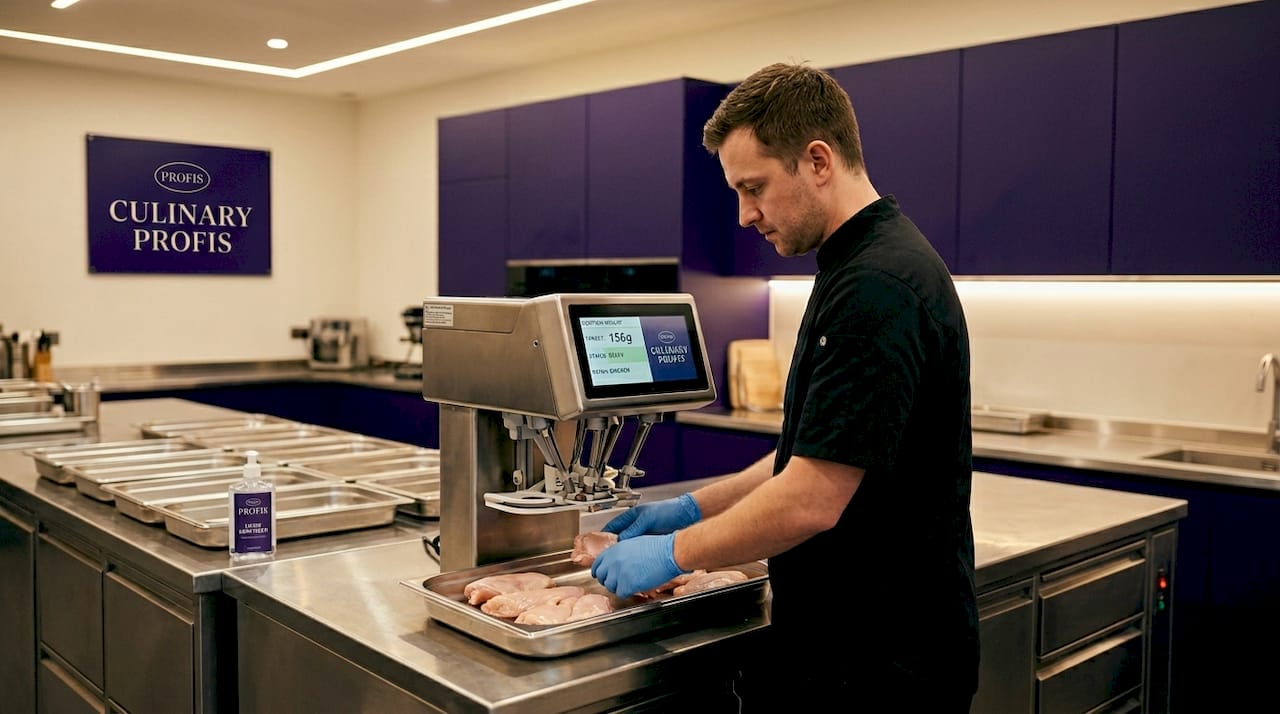
Programmed cooking cycles also eliminate the undercooking risk that comes from rushed or fatigued staff during a dinner rush. The equipment runs to its set parameters. There is no cutting corners on hold times or core temperatures.
For catering operations handling large event volumes, this consistency in food safety protocol is not just good practice. It is risk management.
6. Comparison of popular automated kitchen equipment types
Choosing the right equipment type depends on your kitchen’s volume, menu structure, and workflow. Here is a comparison of the most common options:
| Equipment type | Key benefit | Best use case |
|---|---|---|
| Automated combi oven | Consistent multi-mode cooking, reduced labor per rack | High-volume baking, roasting, steaming |
| Dough divider and rounder | Uniform portioning, high throughput | Commercial bakeries, pizza operations |
| Robotic fryer | Precise temperature control, hands-free frying | Fast casual restaurants, high-volume fry stations |
| Prep station refrigerators | Organized cold storage, reduced spoilage | Catering prep lines, sandwich and salad stations |
| Conveyor-based cooking systems | Continuous throughput, consistent cook times | High-volume grilling, toasting, pizza production |
Combi ovens, such as those with rotary rack designs, handle baking, roasting, and steaming in one unit. That flexibility reduces the number of specialized appliances you need on the floor. The duty cycle of commercial ovens directly affects how well these units perform under sustained high-volume use, so matching the equipment spec to your service volume matters.
For bakery operations, automated dough dividers and rounders handle a task that is both labor-intensive and precision-dependent. A machine processing 1,500 dough portions per hour maintains the same weight tolerance across every piece, something that is physically impossible to replicate manually at that volume.
Pro Tip: Map your kitchen’s actual workflow before selecting equipment. Identify the three tasks that create the most bottlenecks or inconsistency in your current operation. Buy automation for those tasks first, not the most technically impressive option available.
For IoT-integrated beverage and food production lines, AI-driven production optimization adds another layer of scheduling and quality control that pairs well with physical automation equipment.
My take on automation in commercial kitchens
I’ve worked with enough food service operators to know that automation anxiety is real. The fear is that machines will replace the craft and creativity that define a good kitchen. In my experience, that concern is misplaced, but only if you approach automation with the right framework.
What I’ve found consistently is that the kitchens that get the most out of automation are the ones that treat it as a support system for skilled staff, not a replacement. The Florida International University model is a good example. They kept human oversight in place for food safety and maintenance while using automation to handle the volume problem. That hybrid approach is more sustainable than either extreme.
What most operators miss is the post-installation phase. Buying the equipment is the easy part. Continuously measuring performance against your baseline metrics, adjusting parameters, and retraining staff on new workflows is where the real returns are captured. I’ve seen kitchens invest in solid automation and then fail to capture the projected savings simply because no one was assigned to track performance after month one.
My honest advice: set measurable targets before you buy, assign ownership of the optimization process to a specific person, and expect a 60 to 90 day adjustment period before you see stable performance gains.
— John
Upgrade your kitchen with Culinaryprofis
Culinaryprofis carries professional-grade automated kitchen equipment built for the demands of restaurant, catering, and institutional food service operations. The range includes high-performance combi ovens, automated dough processing units, and commercial refrigeration designed for sustained high-volume use.
The AMPTO Rotorbake E2 combi oven delivers consistent baking and steaming performance across a 10-tray capacity, reducing labor per cooking cycle significantly. For bakery operations, the AMPTO DR15AK dough divider and rounder processes up to 1,500 portions per hour with uniform weight tolerance.
Browse the full commercial kitchen equipment catalog at Culinaryprofis. Free shipping, flexible returns, and expert support are available on all orders.
FAQ
What are the main benefits of automated commercial kitchen equipment?
The primary benefits include faster throughput, consistent food quality, reduced labor costs, improved food safety, and measurable energy savings. Most systems deliver ROI within 8 to 24 months depending on operation volume.
How does automation improve food safety?
Automated equipment reduces the number of manual touchpoints during food preparation, lowering contamination risk and making consistent temperature compliance easier to achieve and document.
What types of kitchens benefit most from automation?
High-volume operations including restaurant chains, catering companies, institutional kitchens, and commercial bakeries see the strongest returns because automation’s efficiency gains compound at scale.
How long does it take to see ROI from kitchen automation?
Payback periods typically range from 8 to 24 months. A bakery digital twin scheduling system achieved ROI in 2.4 months through energy savings and faster production output.
Does automation replace kitchen staff?
No. Hybrid models combining automated equipment with skilled staff oversight deliver the best outcomes. Automation handles repetitive, high-volume tasks while staff focus on quality control, customization, and food safety management.