
Why commercial oven duty cycle matters for kitchens

Most kitchen managers don’t think about duty cycle until an oven dies mid-service. That’s a costly mistake. Understanding why commercial oven duty cycle matters is the difference between a kitchen that runs on schedule and one that absorbs $35 per minute in unplanned downtime losses. Duty cycle, the rated percentage of time an oven can operate continuously before it needs to rest, directly shapes temperature stability, equipment lifespan, and your cost per bake. This guide breaks down what duty cycle means in practice, how it interacts with oven design and maintenance, and how to match your equipment to your actual volume demands.
Table of Contents
- Understanding commercial oven duty cycle and its impact
- How oven design and technology support high duty cycles
- Preventive maintenance’s role in sustaining oven duty cycle performance
- Matching oven duty cycle to kitchen workload and volume demands
- Deep maintenance and operational insights for reliable high-duty oven use
- Rethinking oven duty cycle: Insights no one else tells you
- Optimize your kitchen with professional commercial ovens and maintenance solutions
- Frequently asked questions
Key Takeaways
| Point | Details |
|---|---|
| Duty cycle definition | Duty cycle specifies how long a commercial oven can reliably run without rest to prevent damage and maintain quality. |
| Impact of mismatch | Using an oven beyond its rated duty cycle causes thermal stress, leading to costly equipment failures and downtime. |
| Importance of maintenance | Regular preventive maintenance can reduce oven failures by 70% and significantly improve reliability in high-demand kitchens. |
| Oven sizing strategy | Choose oven capacity based on peak volume needs rather than average demand to ensure consistent cooking performance. |
| Operator best practices | Daily monitoring, proactive gasket replacement, and tuning controls help sustain high duty cycle performance and energy efficiency. |
Understanding commercial oven duty cycle and its impact
Duty cycle is not a marketing term. It is an engineering specification that defines how long a commercial oven can run at full capacity within a given time window before thermal stress starts accumulating. A 70% duty cycle means the oven is rated to operate for 42 minutes out of every hour. Push it past that threshold consistently, and you are accelerating wear on heating elements, gaskets, control boards, and burner assemblies.
The consequences are not always immediate. Thermal stress is cumulative. You may run an oven at 90% duty cycle for weeks before a sensor fails or a gasket cracks, but when it does fail, it will almost certainly happen during peak service. Ovens matched properly to usage have 40% fewer unplanned downtime events than those running beyond their rated cycle. That gap is significant when you factor in labor idle time, food waste, and lost table turns.
The importance of oven duty cycle becomes clearer when you put a dollar figure on downtime. Unexpected breakdowns in commercial kitchens carry losses estimated at $35 per minute when you account for staff wages, wasted product, and missed covers. A single two-hour failure during a Friday dinner service can erase a week of margin. Matching your oven’s duty cycle rating to your actual kitchen volume is not optional maintenance planning. It is financial risk management.
Key factors that determine how duty cycle affects ovens in daily operation:
- Peak service hours vs. rated operating hours: Know your busiest windows and cross-reference them against the oven’s rated duty cycle before purchasing.
- Thermal mass and insulation quality: Ovens with heavier insulation retain heat longer, reducing how hard the heating system works to maintain setpoint.
- Door opening frequency: Each door opening drops internal temperature. High-traffic kitchens that open oven doors every few minutes are effectively running at a higher functional duty cycle than the thermostat suggests.
- Ambient kitchen temperature: A hot kitchen in summer forces the oven’s cooling systems to work harder, compressing its effective duty cycle.
- Product load per cycle: Dense, cold product loads require more energy to bring up to temperature, increasing burner or element on-time per cycle.
Choosing convection ovens for high duty environments starts with reading the spec sheet for duty cycle rating, not just wattage or BTU output. Many buyers skip this step entirely.
How oven design and technology support high duty cycles
Not all commercial ovens are built for the same workload. The design differences between a unit rated for 60% duty and one rated for 90% are not cosmetic. They show up in insulation thickness, fan motor quality, control system precision, and heat exchanger design.
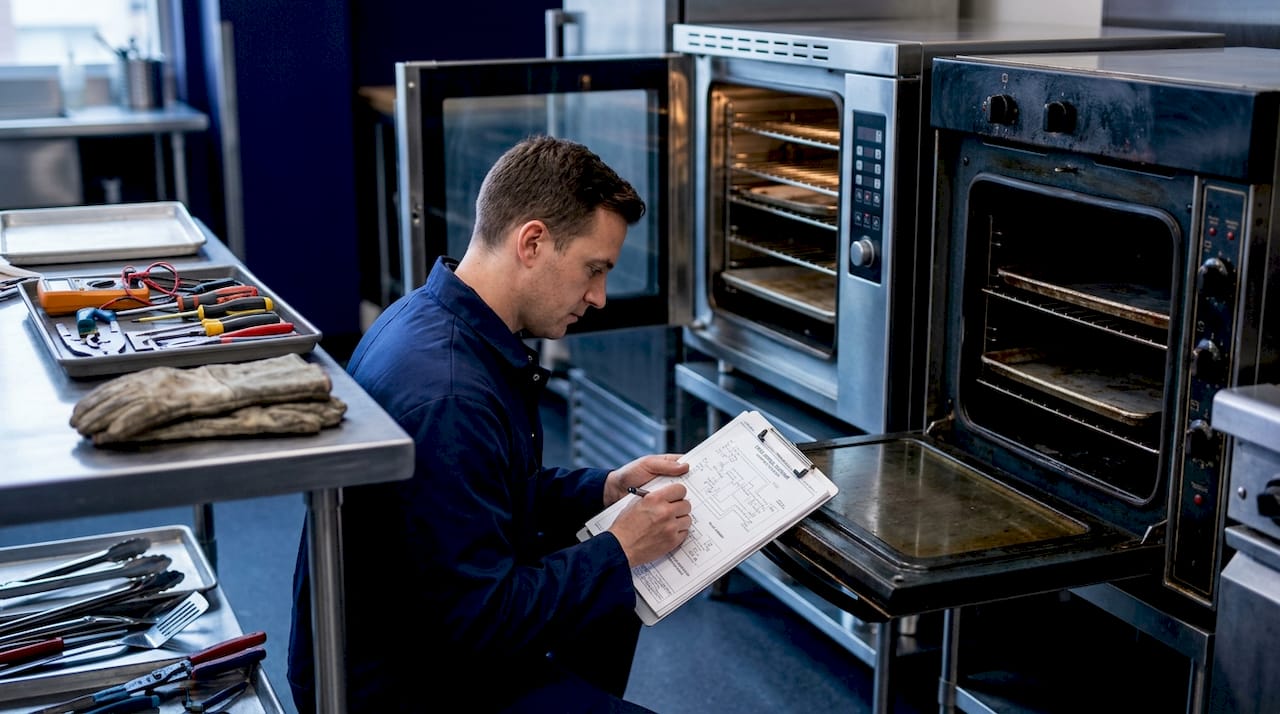
One of the most practical metrics for high-volume kitchens is heat recovery time. Commercial convection ovens recover heat in 2 to 3 minutes after door openings, compared to 10 to 15 minutes for residential-grade units. In a bakery running 40 trays per hour, that difference compounds into dozens of delayed batches per shift. True convection, meaning a dedicated heating element surrounding the fan rather than just a fan redistributing existing heat, is the standard you need for batch consistency at high duty cycles.
Commercial convection vs. conventional oven comparison
| Feature | Commercial convection | Conventional commercial |
|---|---|---|
| Heat recovery after door open | 2 to 3 minutes | 8 to 12 minutes |
| Temperature uniformity | Within 5°F across cavity | Up to 25°F variance |
| Duty cycle rating (typical) | 80 to 100% | 50 to 70% |
| Energy use per batch | 15 to 25% lower | Baseline |
| Fan-driven airflow | Yes, dedicated element | No |
| Suitable for continuous service | Yes | Limited |
Design features that directly support high duty cycle operation:
- Multi-layer insulation panels: Reduce heat loss through the oven walls, keeping the heating system from cycling on as frequently.
- Sealed door gaskets with compression ratings: Maintain a tight seal under repeated thermal expansion and contraction cycles.
- Variable-speed convection fans: Allow operators to reduce airflow for delicate products without sacrificing temperature stability.
- Stainless steel interior construction: Resists corrosion from steam and food acids, maintaining thermal reflectivity over years of heavy use.
- PID (proportional-integral-derivative) temperature controllers: These systems anticipate temperature swings and adjust heating output proactively, rather than reacting after a drop occurs.
Explore high-duty convection oven models that include these features as standard, not as upgrades.
Preventive maintenance’s role in sustaining oven duty cycle performance
An oven rated for 90% duty cycle will not stay at 90% without structured maintenance. Degraded components quietly reduce the effective duty cycle over time. A worn door gasket, for example, does not cause an immediate failure. It causes a slow energy leak that forces the heating system to run longer per cycle, functionally pushing the oven past its rated threshold without triggering any alarm.
Preventive maintenance reduces unexpected failures by 70% compared to reactive repair approaches. Structured PM programs also return 10 to 15 times their cost in avoided repairs and downtime within 18 months. Those are not projections. They are documented outcomes from food production environments running high-cycle ovens continuously.
Critical maintenance tasks for high duty cycle ovens:
- Burner tune-ups every 90 days: Dirty or misaligned burners reduce combustion efficiency and increase on-time per cycle.
- Gasket inspection and replacement: Compromised seals cause temperature drift and energy waste. Replace on a fixed schedule, not when they visibly fail.
- Sensor calibration checks: A temperature sensor reading 15°F high is causing your kitchen to overbake product and overwork the heating system simultaneously.
- Fan motor bearing inspection: Worn bearings increase friction, reduce airflow, and eventually cause motor failure mid-service.
- Control board and safety device testing: Thermal cutoffs and pressure switches need to function correctly to protect the oven from true overload conditions.
Pro Tip: Schedule gasket replacements on a fixed 90-day cycle regardless of visible condition. By the time a gasket looks deteriorated, it has already been leaking heat and compromising temperature uniformity for weeks. The cost of a replacement gasket is a fraction of one service call.
Neglecting these tasks creates a cascade effect. Increased energy use leads to higher operating temperatures in surrounding components. Temperature drift causes inconsistent product quality. Failed safety devices remove the last line of protection against thermal overload. Review oven maintenance best practices and apply the same discipline to your full equipment lineup.
Matching oven duty cycle to kitchen workload and volume demands
Buying an oven based on average throughput is one of the most common and expensive mistakes in commercial kitchen planning. Average usage figures mask your actual risk. Your oven does not run at average load during a Saturday brunch rush. It runs at peak load, and that is the number that determines whether your duty cycle rating holds or breaks.
Here is a practical framework for sizing correctly:
- Calculate your peak hourly output. Count the maximum number of trays, pans, or portions you need to produce in your single busiest hour.
- Determine cook time per batch. Include loading and unloading time, not just oven time.
- Calculate required oven cycles per hour. Divide peak output by your oven’s batch capacity.
- Apply a 20% buffer. Never size an oven to run at 100% of rated capacity. Build in headroom for door openings, product variation, and unexpected volume spikes.
- Cross-reference with duty cycle rating. Confirm the oven’s rated duty cycle exceeds your calculated peak operating percentage.
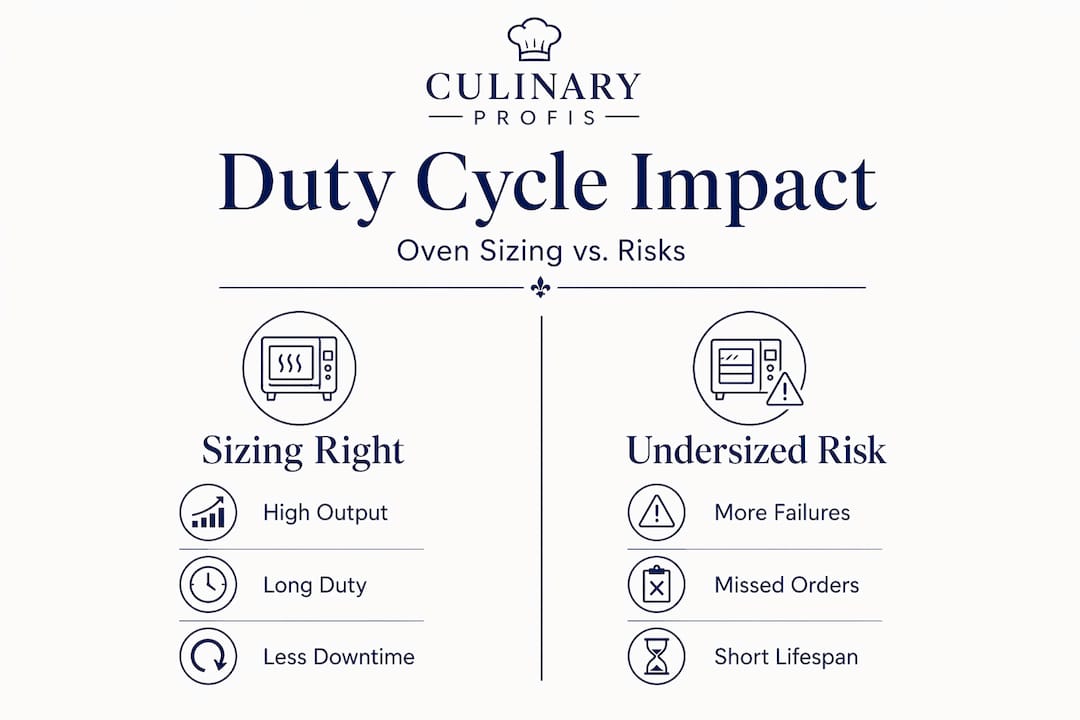
Operators often underutilize convection ovens at 30% of capacity when sized for average rather than peak volume, which sounds like a waste but is actually a sign of poor planning in the opposite direction. The real danger is undersizing, which drives the oven past its duty cycle rating daily.
Oven sizing impact on kitchen performance
| Kitchen volume | Recommended oven type | Typical duty cycle rating | Risk if undersized |
|---|---|---|---|
| Under 100 covers/day | Single-deck convection | 60 to 70% | Low, manageable |
| 100 to 300 covers/day | Double-deck or full-size convection | 75 to 85% | Moderate, monitor closely |
| 300 to 600 covers/day | High-capacity convection or conveyor | 85 to 95% | High, thermal stress risk |
| Over 600 covers/day | Conveyor or multi-deck commercial | 95 to 100% | Critical, requires proper spec |
For high-volume pizza operations, conveyor ovens offer a distinct advantage because they run at a fixed, continuous duty cycle with no door-opening losses. Deck ovens, by contrast, suit artisan bakeries with longer, less frequent batch cycles. Review oven capacity options for peak volume to find the right fit for your production rhythm.
Deep maintenance and operational insights for reliable high-duty oven use
Beyond standard PM checklists, there are operational practices that separate kitchens with consistent bake quality from those constantly chasing temperature problems. Most of these are not in the owner’s manual.
Misaligned conveyor belt tension and bearing failures cause mid-shift downtime that operators frequently misdiagnose as electrical faults. Logging actual oven temperatures daily, not just relying on the digital display, and tuning PID controls to match your product load prevents temperature swings of 40 to 50°F that destroy batch consistency.
Often-overlooked maintenance checks for high-duty ovens:
- Conveyor belt tracking alignment: A belt running even slightly off-center wears unevenly and can jam during peak service.
- Bearing lubrication on fan motors: Dry bearings increase motor load and reduce airflow before they fail completely.
- Insulation integrity checks: Damaged insulation panels create hot spots on the oven exterior and cold zones inside the cavity.
- Combustion air intake cleaning: Blocked intakes on gas ovens reduce flame quality and increase carbon monoxide output.
- Door hinge tension adjustment: Loose hinges cause doors to seal unevenly, creating localized heat loss.
Pro Tip: Replace door seals before you can see visible deterioration. A seal that looks intact but has lost its compression rating is already costing you energy and bake uniformity. Use a simple paper test: close the door on a sheet of paper and try to pull it out. If it slides freely, the seal needs replacement.
Digital temperature logging, even a basic data logger attached to your oven cavity, gives you a factual record of thermal performance over time. When you see the average temperature holding time per cycle increasing, that is an early warning that insulation or heating components are degrading. Catch it early and you schedule a repair. Miss it and you absorb an emergency breakdown. Check the latest oven maintenance insights and tips for updated guidance on monitoring tools.
Rethinking oven duty cycle: Insights no one else tells you
Here is what most equipment guides and vendor spec sheets do not tell you: duty cycle mismatch rarely announces itself with a dramatic failure. It shows up first as slightly uneven browning, a batch that takes two minutes longer than it should, or an energy bill that creeps up 8% over a quarter. By the time the oven fails outright, the financial damage has already been accumulating for months.
The conventional wisdom in commercial kitchens is to buy the biggest, most powerful oven you can afford and run it hard. That approach ignores the fact that thermal stress is not just about maximum temperature. It is about the frequency and pattern of heating cycles. Short, intense bursts of high-load operation are often harder on oven components than long, steady continuous runs at the same average temperature. An oven running 20 aggressive 15-minute cycles per shift may degrade faster than one running a steady 6-hour bake at the same total energy input.
True continuous-duty ovens save money only when they are matched thoughtfully to peak workload. An oversized continuous-duty oven running at 30% of its capacity is not a safety margin. It is a waste of capital and floor space. The goal is alignment: duty cycle rating matched to actual peak demand, with a realistic buffer built in.
Invest in digital monitoring and a basic computerized maintenance management system (CMMS) to track early signs of degrading duty performance. Waiting for a technician to tell you something is wrong is reactive and expensive. A CMMS that logs temperature trends, door-open frequency, and energy consumption per shift gives you the data to act before a failure occurs. Explore kitchen equipment maintenance perspectives for practical approaches to building this kind of visibility into your operation.
Oven maintenance is not a checkbox task you complete quarterly and forget. It is an ongoing process tied directly to product quality, energy costs, and kitchen profitability. The kitchens that treat it that way run longer, spend less on repairs, and produce more consistent food.
Optimize your kitchen with professional commercial ovens and maintenance solutions
Culinary Profis carries commercial-grade ovens built for continuous, high-duty operation in demanding foodservice environments. Whether you run a high-volume bakery, a full-service restaurant, or a catering operation with variable peak demands, the right equipment makes the difference between reliable service and costly breakdowns.

Browse commercial convection ovens rated for sustained high-duty cycles, or explore gas oven ranges designed for peak-volume kitchens. Every unit in the catalog is selected for durability, energy efficiency, and performance under real commercial workloads. Pair your oven purchase with a structured preventive maintenance schedule and the right sizing for your peak throughput, and you protect both your equipment investment and your kitchen’s bottom line. Visit Culinary Profis to browse the full lineup and get expert support on selecting the right unit for your operation.
Frequently asked questions
What does commercial oven duty cycle mean?
It refers to the percentage of time a commercial oven can operate within a given period before needing to rest to prevent overheating or damage. Ovens matched properly to usage have significantly fewer unplanned downtime events than those running beyond their rated cycle.
How does exceeding the oven’s rated duty cycle affect kitchen operations?
Exceeding the rated duty cycle causes thermal stress that accelerates component wear and leads to more frequent breakdowns, with downtime costs reaching $35 per minute in active service environments.
Why is preventive maintenance important for high duty cycle ovens?
Preventive maintenance reduces unexpected failures by 70% and returns 10 to 15 times its cost within 18 months, making it the most cost-effective way to protect oven performance and lifespan under heavy use.
How can I determine the right oven size for my kitchen’s peak workload?
Calculate your maximum trays or portions per hour during peak service, factor in actual cook and load times, then size for that peak number with a 20% buffer. Sizing for peak volume avoids the temperature drops and batch failures that come from running an undersized oven past its rated duty cycle.
What are common signs that an oven needs maintenance related to duty cycle stress?
Watch for uneven baking across a tray, longer heat recovery times after door openings, rising energy costs without increased output, and recurring sensor or safety device errors. Degraded door seals and insulation are among the earliest indicators that duty cycle performance is declining.
Recommended
- Dukers DCCOG1 Gas Convection Oven - Commercial Kitchen | CulinaryProfis
- Dukers Gas Oven Range - Commercial Restaurant Range | CulinaryProfis
- Whynter TSO-488GB Grande 40 Qt Multi-Function Convection Steam Oven Air Fryer | CulinaryProfis
- Dukers Commercial Deep Fryer - Gas LPG/NG Models | CulinaryProfis