
How to Set Up Institutional Kitchen Operations

Running a large-scale kitchen is nothing like managing a restaurant line. When you set up institutional kitchen operations, you are building a system that must perform consistently across hundreds of covers, strict health codes, multiple staff roles, and zero margin for workflow failure. Whether you are outfitting a hospital, university dining hall, correctional facility, or corporate cafeteria, the decisions you make before the first piece of equipment gets bolted to the floor will determine whether your kitchen runs smoothly or grinds to a halt under pressure. This guide covers every critical layer: layout, equipment, staffing, sanitation, and compliance.
Table of Contents
- Key takeaways
- How to set up institutional kitchen operations: start with capacity
- Designing workflow and layout for efficiency
- Selecting equipment for institutional kitchens
- Operational standards: staffing, sanitation, and maintenance
- Troubleshooting common operational challenges
- My take on what most institutional kitchen setups get wrong
- Equipment for institutional kitchens from Culinaryprofis
- FAQ
Key takeaways
| Point | Details |
|---|---|
| Workflow before equipment | Map your full operational cycle before selecting a single appliance to avoid costly layout mistakes. |
| Capacity defines everything | Your cover volume and menu complexity dictate layout type, equipment sizing, and staffing ratios. |
| Sanitation is non-negotiable | Chlorine sanitizer must hold 50 to 100 ppm, and sanitizer must never contact detergent residue. |
| Labor cost benchmarks matter | Labor exceeding 35% of revenue signals a staffing structure problem, not just a scheduling issue. |
| Compliance starts at installation | Ventilation access, utility provisions, and health code alignment must be locked in before opening day. |
How to set up institutional kitchen operations: start with capacity
Before you touch a floor plan or browse equipment catalogs, you need hard numbers. Specifically, you need to know your peak cover volume, your average daily output, and how many distinct menu categories you will run simultaneously.
High-volume kitchen management is defined for operations exceeding 300 covers per service or running continuous high-output environments. That threshold matters because it changes nearly every downstream decision, from the number of cooking stations you need to how many refrigeration units you must size.
Here is what to assess before any large-scale kitchen planning begins:
- Cover volume thresholds. Determine your worst-case service rush, not your average. Design for peak, not median.
- Service frequency. A kitchen running three meal periods daily needs fundamentally different throughput capacity than one running a single lunch service.
- Menu complexity. A menu with twelve proteins, four cooking methods, and allergen-controlled items requires more equipment variety and more prep stations than a simplified cycle menu.
- Budget alignment. Your operational scope must match your capital budget. Oversizing equipment for a 200-cover operation wastes money and floor space. Undersizing for 500 covers creates bottlenecks that no amount of staffing can fix.
Once you have these numbers documented, every subsequent decision, from institutional kitchen design to equipment procurement, has a clear reference point.
Designing workflow and layout for efficiency
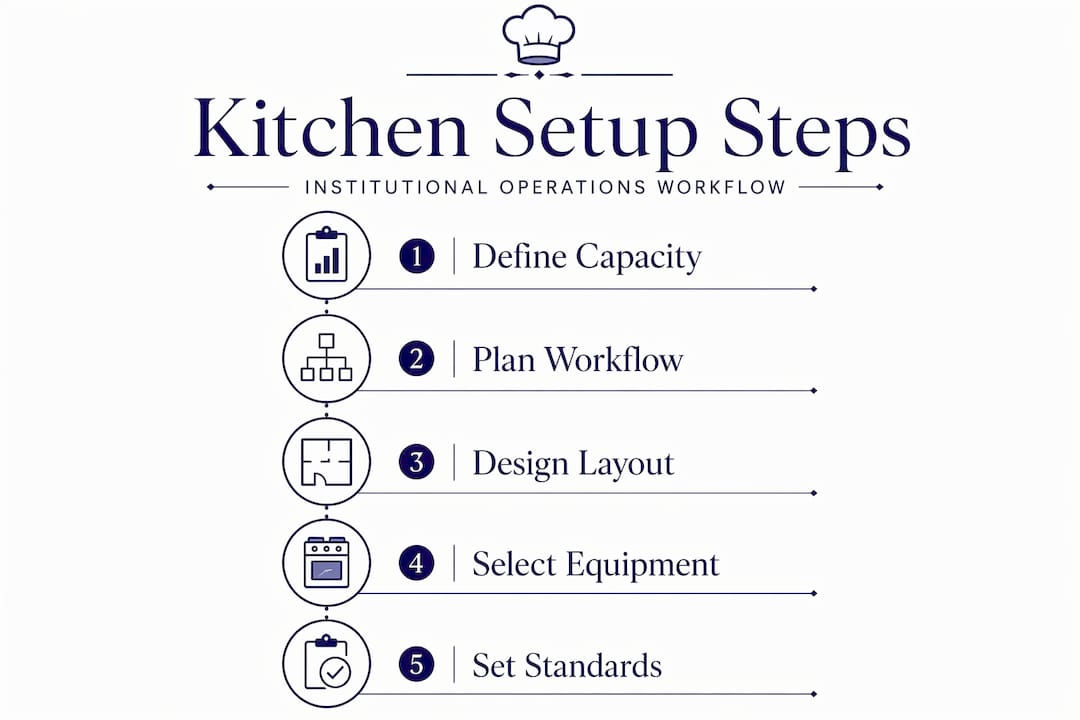
Workflow planning must precede equipment selection to reduce bottlenecks and control labor costs. This is the principle most organizations violate. They fall in love with a particular oven or a vendor’s floor plan template, then try to retrofit workflow around it. That approach consistently produces friction.
The correct sequence is:
- Map the full operational cycle. Trace every item from delivery dock to plate to dish return: receiving, dry and cold storage, prep, cooking, plating, service, and warewashing. Every step needs dedicated space and a logical path.
- Establish unidirectional flow. Clean food and dirty dishes should never cross paths. Raw product should move in one direction; soiled ware should move in the opposite direction toward the warewash area.
- Choose a layout type based on volume. Zone-style layouts work well for multi-concept operations where prep, cooking, and finishing are physically separated. Assembly-line layouts suit high-volume single-concept operations like cafeteria service. Island-style layouts support flexible cooking with central equipment surrounded by prep perimeter.
- Set aisle widths correctly. Minimum 48-inch aisles allow two staff members to pass safely without collision, which is the baseline for any commercial kitchen setup.
- Validate the design physically. Use masking tape on the floor to simulate the layout before construction begins. Tape walk-throughs reveal collisions and dead-end paths that look perfectly logical on a blueprint but fail completely in real service conditions.
- Account for multi-outlet complexity. If your institutional kitchen feeds multiple service points, satellite stations, or catering output simultaneously, your layout must include dedicated staging areas for each outlet without disrupting the main production line.
Pro Tip: Walk your tape layout during a simulated rush with your actual staff. Have someone play the expediter, someone run the line, and someone handle dish return. You will find problems in twenty minutes that a consultant would miss in a week of blueprint review.
Selecting equipment for institutional kitchens
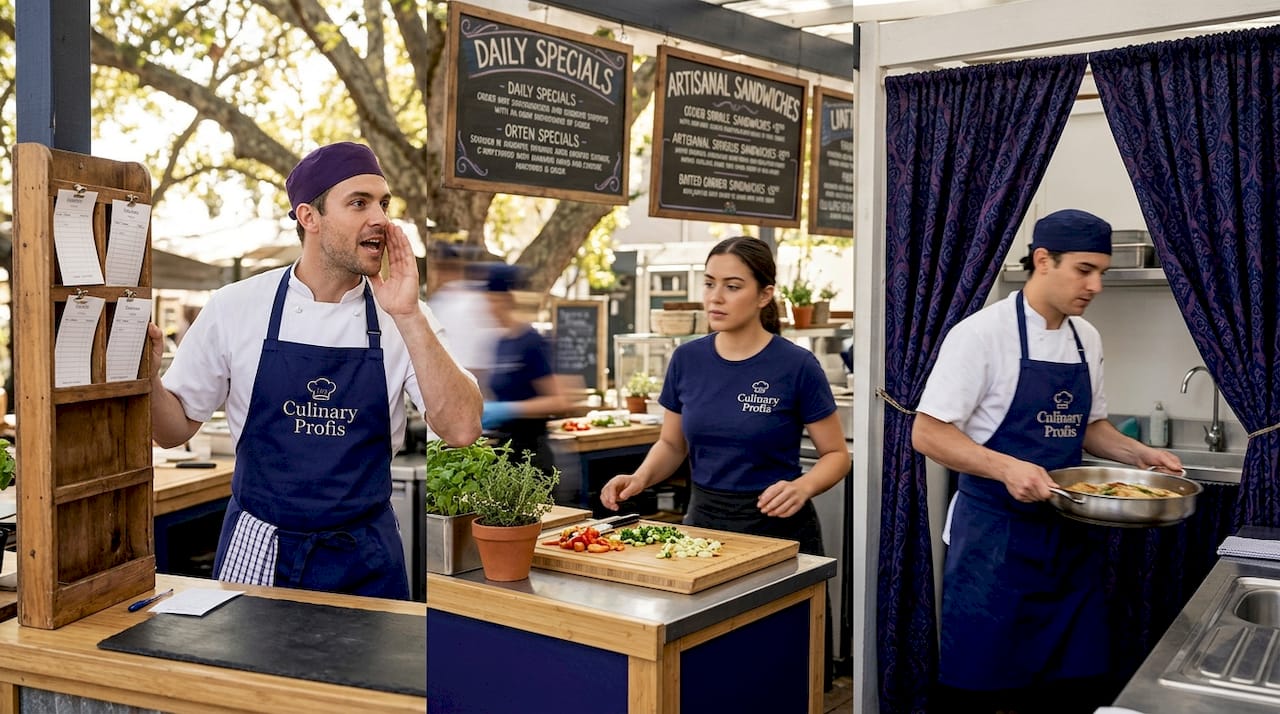
Equipment selection for institutional kitchens is a matching exercise. You are matching capacity, duty cycle, and cooking method to your volume and menu. The wrong equipment does not just underperform. It fails mid-service, creates safety hazards, and generates repair costs that erode your operating budget.
The core equipment categories for any institutional kitchen setup are:
| Category | Key Consideration | Volume Indicator |
|---|---|---|
| Cooking appliances | Duty cycle rating for continuous use | 300+ covers requires heavy-duty rated units |
| Refrigeration | Reach-in vs. walk-in based on prep proximity | Walk-in required for daily bulk receiving |
| Warewashing | Conveyor vs. door-type based on cover volume | Conveyor units suited for 500+ covers per service |
| Prep stations | Dedicated zones for raw, allergen-controlled, and ready-to-eat | Separate surfaces mandatory for HACCP compliance |
Commercial oven duty cycle is one of the most overlooked specs in institutional purchasing. A light-duty convection oven rated for intermittent use will fail within months in a kitchen running continuous batch production. You need units rated for 100% duty cycle if your cooking schedule runs without breaks.
Batch production kitchens, specifically those cooking large quantities of proteins, grains, or soups in advance, benefit significantly from large-capacity kettles and tilting skillets rather than relying on multiple smaller pots on open burners. The throughput difference is substantial, and the labor savings compound across every service.
On installation: denied ventilation access post-lease can prevent kitchen operation entirely. Before signing any lease or finalizing a build-out plan, confirm that your ventilation, grease trap, and utility access provisions are written into your agreement. This is a detail that has shut down otherwise well-planned kitchens before they served a single meal.
Operational standards: staffing, sanitation, and maintenance
Getting the physical kitchen right is half the work. The other half is the operational framework that keeps it running day after day.
Staffing and labor management
Labor costs exceeding 35% of revenue indicate a structural staffing problem. In institutional kitchens, this usually means too many generalists and not enough role specialization. Define clear station ownership, assign an expediter to manage communication flow between the line and service, and build your schedule around peak cover periods rather than flat hourly coverage.
Station redundancy for kitchens over 400 covers per service is not optional. A single-point failure at the grill station during a 600-cover lunch service is an operational crisis. Cross-train staff on adjacent stations and build backup coverage into your scheduling model.
Staff turnover above 75% annually signals a systemic compensation or culture problem, not a hiring problem. Institutional kitchens that invest in documented SOPs, structured onboarding, and clear advancement paths retain staff at significantly higher rates.
Sanitation protocols
Three-compartment sink procedure is non-negotiable. Chlorine sanitizer requires 50 to 100 ppm; iodine sanitizer requires 12.5 to 25 ppm; hot water sanitizing requires a minimum of 171°F. These are not guidelines. They are health code requirements.
One of the most common and costly sanitation errors in institutional kitchens: mixing sanitizer with detergent chemically inactivates the sanitizer, producing zero antimicrobial activity. The sanitize compartment must be completely free of detergent residue before sanitizer is added. Train every staff member on this. Then verify it daily.
The FDA Food Code 2022 requires a full-time food safety lead on every shift in high-volume operations. Food safety failures in these environments most often stem from skipped temperature logs and allergen miscommunication under pressure, not from ignorance of the rules.
Pro Tip: Build your food safety logs into your shift opening and closing checklists. When temperature logging is a checklist item rather than a separate task, compliance rates increase significantly without additional supervision.
Review your foodservice equipment sanitation standards regularly. Equipment that passes visual inspection can still harbor biofilm in gaskets, seams, and hard-to-reach surfaces if cleaning protocols are not equipment-specific.
Troubleshooting common operational challenges
Even well-planned kitchens run into problems. Knowing where to look speeds up resolution.
- Workflow bottlenecks. If service slows at a specific station consistently, the problem is usually one of three things: undersized equipment for the volume at that station, insufficient prep completed before service, or a layout path that forces staff to cross traffic to retrieve ingredients or tools. Audit each bottleneck against all three causes before assuming it is a staffing issue.
- Labor cost overruns. Track labor as a percentage of revenue weekly, not monthly. Monthly reporting hides the specific service periods where overstaffing or overtime is occurring. Weekly data lets you adjust scheduling before the problem compounds.
- Sanitizer concentration failures. Test sanitizer concentration at the start of every shift and after any solution change. A test kit costs almost nothing. A failed health inspection costs significantly more.
- Equipment failures. Schedule preventive maintenance on a fixed calendar, not on a “when it breaks” basis. Ovens, refrigeration units, and warewash machines all have manufacturer-recommended service intervals. Skipping them voids warranties and accelerates failure.
- Inspection readiness. Health inspectors look at temperature logs, sanitizer concentration records, staff food handler certifications, and equipment condition. Keep these documents organized and accessible at all times, not just when an inspection is scheduled.
My take on what most institutional kitchen setups get wrong
I have seen a lot of institutional kitchens built with impressive equipment lists and mediocre results. The pattern is almost always the same. The planning process was equipment-driven instead of workflow-driven. Someone decided on a particular range or a specific refrigeration setup first, then tried to make the layout work around those choices.
What I have found is that the kitchens that actually perform under pressure are the ones where someone spent serious time walking the tape before a single piece of equipment was ordered. Not reviewing blueprints. Actually walking the space, simulating the rush, and finding the spots where two people would collide or where a cook would have to walk fifteen feet to retrieve a pan.
The other thing I have learned: documentation is not bureaucracy. It is the only thing that makes a kitchen trainable. When your SOPs are written, tested, and updated regularly, you can onboard a new cook in days instead of weeks. When your maintenance schedule is documented, you catch problems before they become failures. The kitchens that struggle most with turnover are the ones where everything lives in the head of one experienced cook who eventually leaves.
Vendor and lease negotiations deserve more attention than most operators give them. Get your ventilation rights, utility access, and grease trap provisions in writing before you sign anything. These are not administrative details. They are operational prerequisites that can make or break your ability to run the kitchen at all.
— John
Equipment for institutional kitchens from Culinaryprofis
When you are ready to source equipment that matches the operational standards covered in this guide, Culinaryprofis carries the commercial-grade solutions institutional kitchens require.
The Culinaryprofis catalog includes heavy-duty cooking equipment for batch production, commercial reach-in refrigeration sized for high-volume receiving and storage, and a full range of professional kitchen appliances across every category this guide covers. Products are sourced from established commercial brands, rated for continuous-use duty cycles, and backed by Culinaryprofis’ expert support team. Whether you are outfitting a new facility or upgrading an existing operation, the platform provides the equipment categories and procurement support that institutional buyers need. Free shipping and a flexible return policy are standard. Contact Culinaryprofis directly for volume purchasing guidance.
FAQ
What is the first step to set up institutional kitchen operations?
Define your peak cover volume and menu complexity before selecting any equipment or finalizing a layout. All downstream decisions in institutional kitchen design depend on these numbers.
How wide should aisles be in a commercial kitchen?
Aisles should be a minimum of 48 inches wide to allow two staff members to pass safely and maintain efficient traffic flow during service.
What sanitizer concentration is required in a three-compartment sink?
Chlorine sanitizer must be maintained at 50 to 100 ppm, iodine at 12.5 to 25 ppm, and hot water sanitizing requires a minimum temperature of 171°F.
How do you prevent bottlenecks in a high-volume kitchen?
Map your full workflow cycle before installation, use unidirectional traffic paths, and validate the layout with a physical tape walk-through before construction begins.
What labor cost percentage signals a staffing problem in institutional kitchens?
Labor costs exceeding 35% of revenue indicate a structural staffing misalignment that scheduling adjustments alone will not resolve.