

Call us NOW


When you operate a food truck, catering trailer, or pop-up concession, every piece of equipment you select either works for your business or against it. The decision to choose portable commercial cooking equipment is not simply about finding a compact griddle or a lightweight fryer. It involves matching your menu output, meeting health and fire code requirements, managing electrical and fuel loads, and selecting gear that physically survives the road. This guide breaks down each of those layers so you can make purchasing decisions with full confidence and avoid the costly mistakes that trip up too many mobile operators.
| Point | Details |
|---|---|
| Match equipment to your menu | Select griddles, fryers, and ranges based on your specific menu volume before comparing brands or prices. |
| Verify mobile-rated certifications | Standard stationary equipment often lacks vibration tolerance specs required for safe road transport. |
| Plan ventilation before purchase | Type I hood requirements directly affect which cooking appliances you can legally install and operate. |
| Evaluate fuel sources carefully | LPG/propane reduces electrical load while induction improves precision; hybrid setups often work best. |
| Test before you commit | Always request spec sheets, verify recovery times, and confirm warranty coverage for mobile use. |
Before you compare models or request quotes, you need a clear picture of what your mobile kitchen actually requires. Mobile catering setups need a menu-matched cooking lineup, commercial refrigeration, a Type I hood with fire suppression, and compatible utility power. Those are the baseline requirements, not optional upgrades.
Start by listing every item on your menu and the cooking method each one requires. A breakfast-focused food truck needs a high-capacity griddle and a salamander. A fried food concept needs a commercial fryer with fast oil recovery. A full-menu catering operation needs a range with multiple burners and possibly a convection oven. Equipment that does not match your output volume creates bottlenecks that no amount of staff can fix.
Beyond cooking gear, you need mobile-specific refrigeration. Reach-in units designed for road use must handle vibration, temperature fluctuation during transit, and limited floor space. Pairing your cooking line with properly rated cold storage protects food safety compliance from day one.
Pro Tip: Before you finalize your equipment list, sketch your full service workflow from cold storage through the cooking line to the pass window. Gaps in that workflow almost always reveal equipment you forgot to budget for.
Here is a checklist of baseline requirements to verify before selecting any unit:
Sanitation standards apply equally to mobile operations. Foodservice equipment sanitation requirements cover surface materials, cleanability, and handwashing provisions, all of which health inspectors review before approving your operation.
The choice between electric, induction, and gas is one of the most consequential decisions in any mobile kitchen build. Each option has real operational trade-offs that affect your daily throughput, fuel costs, and code compliance.
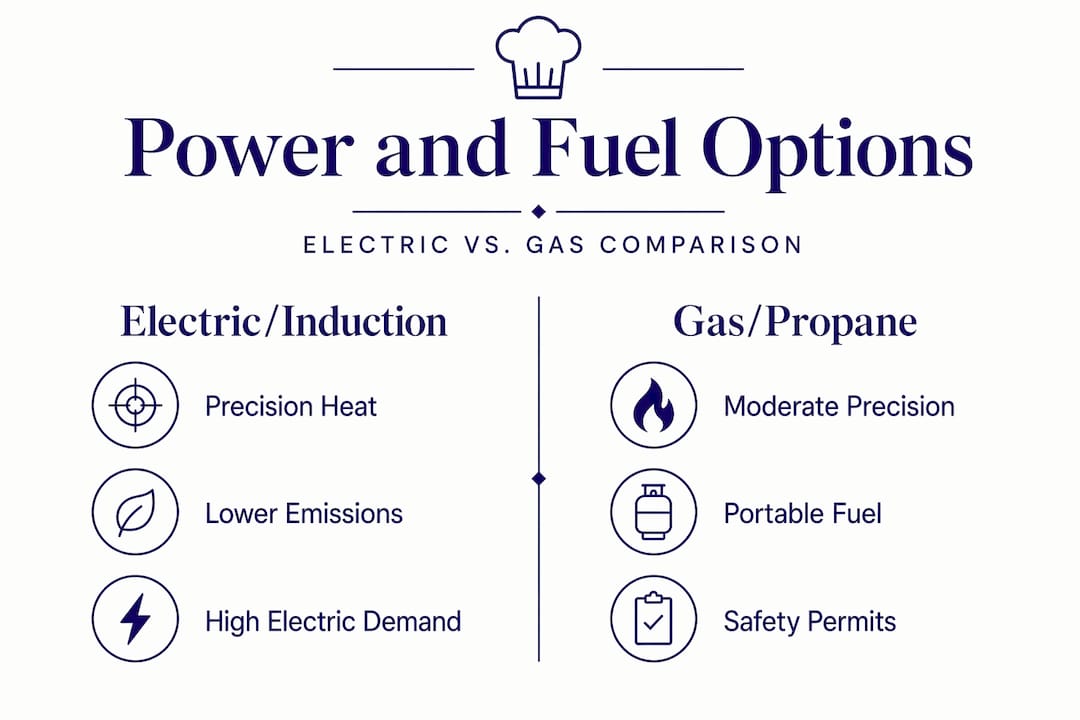
Induction cooking offers precision and cleaner operation but increases peak electrical demand on your generator or shore power connection. If your truck or trailer already runs refrigeration, lighting, and point-of-sale equipment on a single generator, adding induction burners can push you past your amperage limit. LPG and propane reduce that electrical load significantly and are preferred for high-heat applications like wok cooking, large griddles, and commercial fryers.
| Feature | Induction/Electric | LPG/Propane |
|---|---|---|
| Heat precision | High | Moderate |
| Peak electrical load | High | Low |
| Startup cost | Moderate | Low to moderate |
| Fuel availability | Grid or generator | Portable tank |
| Ideal use case | Sauces, delicate proteins | High-heat frying, griddle work |
| Code compliance complexity | Lower | Requires ANSI Z21.69 connectors |
Hybrid setups are worth serious consideration. Running an induction station for precise temperature control alongside a propane range for high-heat output gives you the benefits of both without pushing your electrical system past its limits. Many experienced mobile operators land on this configuration after their first season.
Safety compliance is non-negotiable on the gas side. Gas appliances on casters must use ANSI Z21.69-compliant connectors with restraining devices to prevent accidental disconnection during movement or cleaning. Many new operators underestimate how much stress routine repositioning puts on gas connections. Installing the correct hardware from the start prevents both safety incidents and failed inspections.
Pro Tip: Ask your local fire marshal’s office which fuel configurations require separate permits in your jurisdiction before you purchase any gas-fired appliances. Permit requirements vary significantly by county and can add weeks to your timeline.
Selecting the right cooking appliances means going beyond wattage or BTU totals. The details that actually determine performance in a mobile kitchen are plate thickness on griddles, oil recovery time on fryers, and burner configuration on ranges.
For griddles, plate thickness and BTU per square inch determine heat consistency far more reliably than total BTU output. A 36-inch griddle with a 1-inch steel plate and 75,000 BTU distributed evenly across the surface outperforms a thinner plate model with a higher total BTU rating but uneven heat zones. Uneven griddles produce inconsistent cook times and require constant repositioning of product, which kills your service speed.
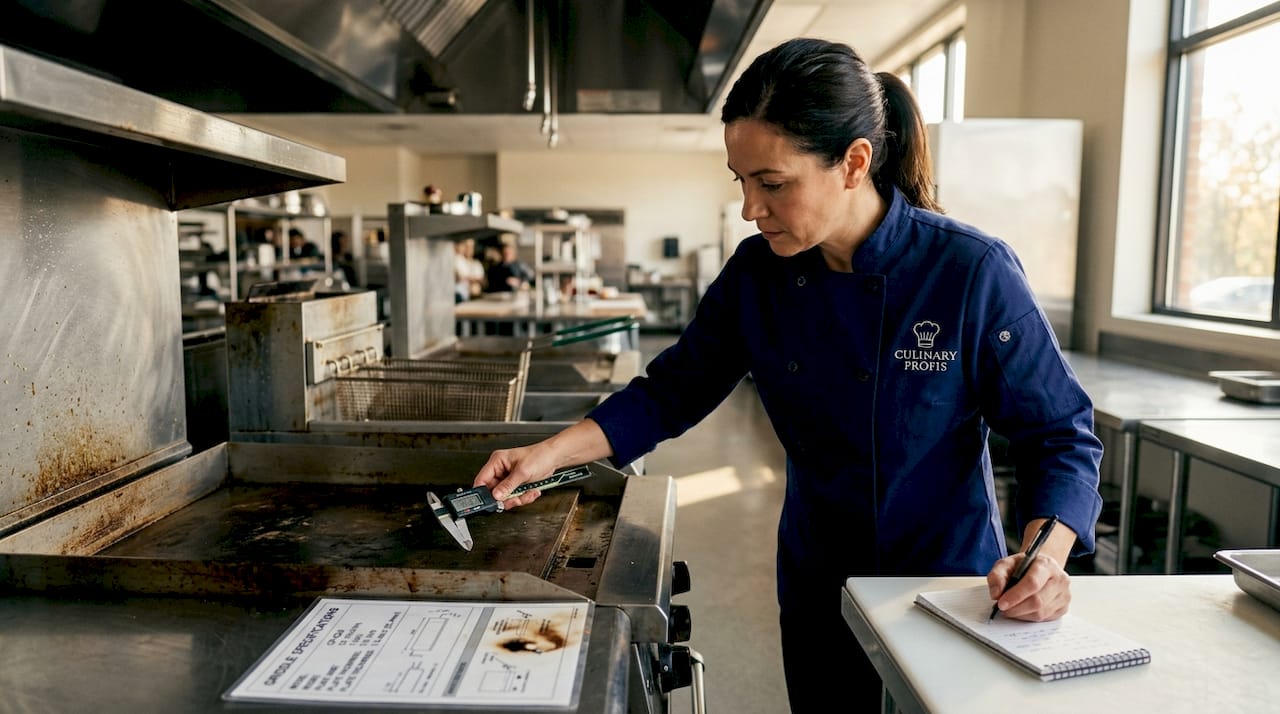
Fryer selection comes down to throughput math. Calculate how many pounds of product you need to fry per hour at peak service and match that to the fryer’s rated capacity. Recovery time is the metric that matters most. A fryer that takes three minutes to return to temperature after each batch limits your output more than a smaller tank capacity would. Throughput in mobile kitchens depends on balanced heat delivery and fast recovery times, not raw BTU output alone.
Here is what to prioritize when evaluating each equipment type:
Ranges for mobile use should also carry a mobile-rated certification or the manufacturer should explicitly confirm suitability for non-stationary installations. Warranty coverage that excludes mobile use is a common issue. Always ask in writing whether the warranty applies to food truck or trailer installations before purchasing. For a practical reference on high-output options, Culinaryprofis covers high-volume cooking appliances suited to professional environments.
Ventilation is not an afterthought in a mobile kitchen. It is a code requirement that directly controls which appliances you can legally operate. Type I hoods are required over cooking equipment producing grease vapors, with a narrow exception for electric units producing less than 5 mg/m³ of grease at 500 cfm airflow. Most commercial griddles, fryers, and ranges require a Type I hood regardless of fuel source.
The hood itself is only part of the system. Grease duct systems require tightly sealed seams and accessible clean-out panels at regular intervals to prevent grease accumulation. In a mobile kitchen, ducts that are difficult to access for cleaning become fire hazards quickly because service frequency is higher and cleaning windows are shorter.
Fire safety and ventilation requirements are the primary constraints in portable cooking equipment selection. They influence appliance choice, mounting positions, and connection standards before any other factor. Plan your hood system first, then select the appliances that fit beneath it. (Source)
Your fire suppression system must interlock with the cooking line, meaning the suppression activates automatically and shuts off gas or electrical supply to appliances during a discharge. A portable Class K fire extinguisher mounted within reach of the cooking line is also a standard requirement in most jurisdictions. Inspectors check both.
Maintenance scheduling protects your investment and keeps you passing inspections. Clean grease filters every service day. Have your suppression system inspected every six months. Document cleaning and maintenance in a log you keep on the vehicle. Early compliance planning that includes equipment placement, ventilation routing, and suppression systems prevents costly corrections after the build is complete.
Selecting portable cooking solutions for a mobile operation works best as a structured process rather than a shopping list. Follow these steps to reduce the risk of costly mistakes.
Pro Tip: When procuring multiple appliances, negotiate spec sheets, delivery timelines, and warranty documentation as a package. Suppliers who cannot provide written vibration specs or mobile warranty terms are not the right fit for a mobile operation. For guidance on purchasing multiple units, Culinaryprofis has a practical resource on procuring bulk cooking appliances.
I’ve reviewed and worked with a lot of mobile kitchen builds, and the pattern that repeats itself is this: operators prioritize cooking performance and skip the compliance work until a health or fire inspector forces their hand.
Ventilation is where this shows up most often. I’ve seen operators purchase a full cooking line, install it in a trailer, and then discover their hood does not meet the required coverage area or their duct seams fail inspection. Tearing out and rebuilding ventilation after the fact costs more than getting it right the first time. Every time.
The second mistake is ignoring vibration specs. Not all equipment labeled “portable” or “mobile” actually has tested vibration tolerance data. I’ve seen gas connection failures on trucks less than a year old because the operator used stationary restaurant equipment without ANSI Z21.69 connectors. The repair costs, downtime, and re-inspection fees are preventable.
My advice: treat compliance documentation with the same seriousness as cooking performance specs. The operator who invests in mobile-rated, certified equipment with a documented maintenance schedule will spend less money over three years than the one who cuts corners early and patches problems later.
— John
Culinaryprofis stocks a full range of commercial-grade cooking equipment suited for catering operations and mobile food businesses. From high-capacity griddles and commercial fryers to ranges and reach-in refrigeration, every product in the catalog is backed by professional certifications and manufacturer warranties. The Dukers commercial stock pot range is a strong option for mobile operators needing reliable high-heat output in a compact footprint. For cold storage in tight spaces, the Empura 1-door reach-in refrigerator delivers 18 cubic feet of commercial-grade capacity. Browse the full selection at Culinaryprofis or contact the team directly for guidance on building a mobile cooking package that meets your menu, space, and compliance requirements.
Menu-matching is the starting point. Select appliances based on your actual cooking methods and peak service volume before comparing brands or specs.
Not always. Electric units producing less than 5 mg/m³ of grease effluent at 500 cfm may qualify for an exemption, but most commercial electric griddles and fryers still require a Type I hood.
It is a flexible gas connector standard designed for movable appliances. Gas-fired equipment on casters must use these connectors with restraining devices to prevent disconnection during movement or cleaning.
Request the manufacturer’s vibration tolerance spec sheet. Mobile-rated equipment should be tested to handle 3 to 5g of continuous vibration and carry a warranty that explicitly covers non-stationary installation.
Yes. Hybrid setups are common and practical. Propane handles high-heat output while induction or electric appliances manage precise temperature cooking, balancing your generator or shore power load effectively.