
High-volume cooking appliances for professional kitchens

Selecting the right examples of high-volume cooking appliances is one of the most consequential decisions you make as a chef or culinary business owner. Get it wrong and you face bottlenecks during peak service, inconsistent output, and equipment that fails under sustained pressure. Get it right and your kitchen runs with the kind of throughput and consistency that directly impacts your bottom line. This article covers the key criteria for evaluating commercial cooking equipment, detailed examples of proven appliances, and a direct comparison to help you match equipment to your specific operation.
Table of Contents
- How to evaluate high-volume cooking appliances for commercial kitchens
- High-volume commercial griddles with multi-zone burners
- Commercial combination ovens (combi ovens) for versatile high-volume cooking
- High-capacity commercial frozen dessert machines for large-scale cold preparation
- Comparing high-volume cooking appliance options
- Which high-volume cooking appliance fits your commercial kitchen needs?
- Why versatility and certified durability often trump size in high-volume appliance selection
- Find the right commercial cooking appliances at CulinaryProfis
- Frequently asked questions
Key Takeaways
| Point | Details |
|---|---|
| Selection criteria | Choose appliances that match your kitchen’s workflow, volume, and durability needs. |
| Multi-zone griddles | Provide versatile heat control for cooking multiple items simultaneously at different temperatures. |
| Combination ovens | Integrate cooking functions to improve efficiency and consistency while reducing labor. |
| Certified equipment | Safety certifications like ETL protect your kitchen and ensure regulatory compliance. |
| Tailored choice | Match appliance types to your kitchen size, menu complexity, and throughput demands for best results. |
How to evaluate high-volume cooking appliances for commercial kitchens
Before you invest in any piece of bulk cooking equipment, you need a clear picture of your kitchen’s actual demands. Selecting the right commercial food preparation equipment requires a clear understanding of kitchen operations, workflow structure, and production demands. That means mapping your menu, your peak cover counts, and your prep cycle before you ever look at a spec sheet.
Here are the core criteria to apply when evaluating any high-volume appliance:
- Output volume: Can the equipment sustain production during your busiest service without a drop in quality?
- Durability: Is it built for continuous commercial use, not occasional high-demand cooking?
- Cleaning and maintenance: Does the design allow fast, thorough cleaning between services?
- Multi-functionality: Can one appliance handle multiple tasks to reduce equipment footprint?
- Energy efficiency: Does throughput justify the utility cost over a full operating day?
- Labor impact: Does the equipment reduce reliance on skilled labor or require specialized training?
Equipment selection also shapes how you organize prep zones. A well-chosen appliance placed correctly can cut cross-kitchen travel time and reduce bottlenecks between stations. Investing in professional culinary equipment that supports organized, high-output prep zones is as much a workflow decision as a purchasing one.
Pro Tip: Run a time-motion study on your busiest service before purchasing. Track where your team loses the most time. That data tells you exactly which appliance category will deliver the highest return.
Having established the key criteria for selecting high-volume cooking equipment, let’s examine specific examples that fulfill these requirements.
High-volume commercial griddles with multi-zone burners
Commercial griddles are a cornerstone of high-volume breakfast, brunch, and burger operations. What separates a true high-volume griddle from a basic flat-top is the presence of independent heat zones. The Weber 36-inch griddle reaches over 500°F for high-heat searing and provides independent heat zones via four precision-control burners. That means you can sear proteins on one side while holding cooked items at temperature on the other, all on the same surface.
Key performance features to look for in a high-volume commercial griddle:
- Multi-zone burners: Run different heat levels simultaneously for diverse menu items
- High maximum temperature (500°F+): Enables fast searing and produces the crispy edges diners expect
- Rust-resistant carbon-steel cooktop: Withstands heavy use and daily cleaning with metal utensils
- Precision control knobs: Allow gradual, accurate heat adjustments without hot spots
- Large cooking surface: Supports high throughput without crowding food, which would drop surface temperature and slow cooking
“A large cooking surface with independent heat zones is not just a convenience feature. It is a throughput multiplier. You are effectively running multiple cooking environments on one piece of equipment.”
Pro Tip: Season your carbon-steel cooktop consistently. A well-maintained seasoning layer on a commercial griddle reduces sticking, speeds cleaning, and protects the surface from corrosion during high-frequency use.
For operations that need a space-efficient format, commercial countertop griddles offer the same multi-zone heat control in a footprint that fits tighter kitchen layouts.
Next, let’s explore how other high-volume appliances complement griddles by combining functions for even greater efficiency.
Commercial combination ovens (combi ovens) for versatile high-volume cooking
The combi oven is arguably the most productive single appliance in a high-volume commercial kitchen. It integrates steam, convection, and precise humidity control into one unit, replacing what would otherwise require a convection oven, a steamer, and sometimes a proofer. Combination cooking technology allows operators to streamline production, reduce labor dependency, and improve yield, delivering consistent results across shifts and locations.
What makes this relevant for professional kitchens running multiple services is the reduction in guesswork. A combi oven with programmed cooking cycles produces the same result whether it is your most experienced cook or a newer team member running the service.
Core advantages of combi ovens in high-volume settings:
- Multi-mode cooking: Steam, convection, and combination modes in a single cabinet
- Labor reduction: Programmable cycles remove the need for constant monitoring
- Yield improvement: Steam injection reduces moisture loss in proteins, improving portion weight and consistency
- Shift-to-shift consistency: Saved programs deliver identical results regardless of who operates the equipment
- Preventive maintenance support: Modern units track usage cycles to flag maintenance needs before breakdowns occur
“The value of innovation in combi ovens has never been more apparent as operators face operational pressures requiring consistent quality with less skilled labor.”
For kitchens that need reliable, high-output oven capacity, commercial convection ovens provide a strong foundation, and stepping up to full combi capability extends that foundation significantly.
Following the multifunctionality of combi ovens, let’s examine other specialized equipment designed for high production volume.
High-capacity commercial frozen dessert machines for large-scale cold preparation
Frozen dessert production is a high-margin category that demands precision equipment. For gelato shops, hotel banquets, and high-volume dessert programs, a commercial gelato machine with certified output capacity is not optional. High-capacity commercial gelato machines deliver robust output of 12 to 15 gallons per hour with structural quality and safety certifications essential for professional kitchens.
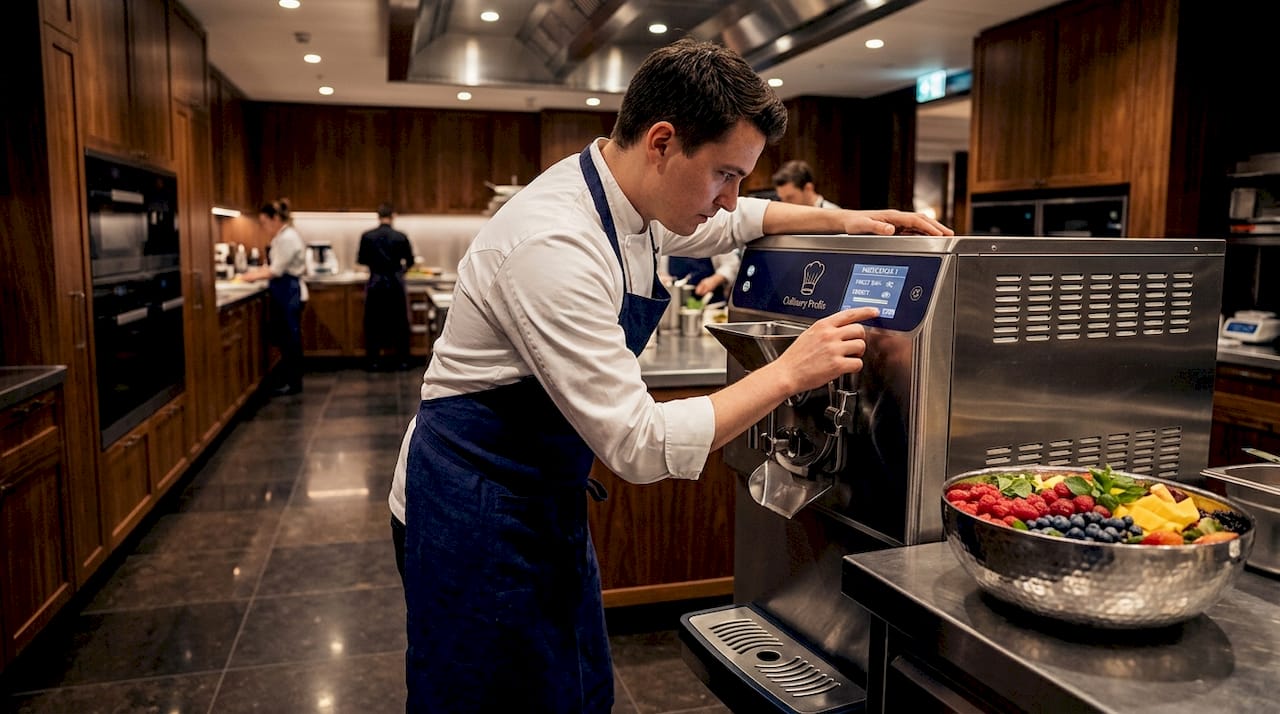
ETL certification matters here more than most operators realize. It confirms the machine meets North American electrical and safety standards, which affects your insurance coverage, health department compliance, and liability exposure.
What to look for in a professional-grade frozen dessert machine:
- ETL or equivalent certification: Confirms compliance with safety and electrical standards
- Output capacity of 12 to 15 gallons per hour: Aligns with peak service demand in high-traffic venues
- Reinforced door seals: Prevent leaks and maintain product temperature consistency during long production runs
- Multi-product capability: One machine producing gelato, sorbet, and water ice reduces capital expenditure
- Industrial-grade construction: Handles the thermal cycling and continuous operation of commercial environments
“For dessert-focused operations, a machine that cannot keep pace with service volume is not just an inconvenience. It is a direct revenue constraint.”
Beyond frozen desserts, let’s look at a summary comparison of the key high-volume cooking appliances discussed.
Comparing high-volume cooking appliance options
The table below gives you a direct side-by-side view of the three appliance categories covered, based on the specifications and performance data referenced throughout this article.
| Feature | Commercial griddle | Combi oven | Commercial gelato machine |
|---|---|---|---|
| Primary function | Flat-top cooking, searing | Multi-mode cooking | Frozen dessert production |
| Heat source | Gas or electric burners | Electric (steam + convection) | Refrigeration compressor |
| Max temperature | 500°F+ | Typically up to 575°F | N/A (freezing cycle) |
| Throughput capacity | High (surface area dependent) | High (rack capacity dependent) | 12 to 15 gallons per hour |
| Multi-functionality | Moderate (heat zone variation) | High (steam, convection, combo) | Moderate (gelato, sorbet, water ice) |
| Labor impact | Requires active monitoring | Reduces labor via programs | Minimal monitoring needed |
| Space requirement | Medium to large footprint | Medium (countertop or floor) | Medium footprint |
| Best for | Breakfast, burgers, high-volume searing | Diverse menus, batch cooking | Dessert programs, banquets |
| Key certification | NSF, ETL | NSF, ETL, CE | ETL |
A few points worth noting from this comparison:
- Multi-zone burners in griddles raise throughput without adding more cooktops, which is a significant space and cost advantage
- Combination cooking technology gives combi ovens the broadest application range of any single appliance in this category
- Gelato machines are the most specialized but deliver the highest per-unit margin potential for dessert-focused operations
For kitchens weighing between commercial griddles and commercial combi ovens, the decision often comes down to menu focus rather than volume alone.
With this comparison, we can now explore scenario-based recommendations to help you decide which appliance fits your kitchen needs best.
Which high-volume cooking appliance fits your commercial kitchen needs?
Matching equipment to your operation requires more than reading spec sheets. Selecting commercial food prep equipment that supports continuous use, high output, and organized preparation stations plays a critical role in maintaining kitchen efficiency and consistency.
Here is a practical framework based on kitchen type and menu focus:
- High-volume breakfast or burger operation: A multi-zone commercial griddle is your primary workhorse. Prioritize surface area, burner count, and carbon-steel durability. Pair with commercial deli slicers for prep efficiency.
- Full-service restaurant with a diverse menu: A combi oven delivers the broadest return. Programmable cycles, yield improvement, and labor reduction make it the highest-value single investment for mixed menus.
- Hotel banquet or catering operation: Consider both a combi oven for hot production and a high-capacity gelato machine if dessert volume justifies the capital. These two appliances together can handle the full production arc of a large event.
- Specialty dessert shop or gelateria: A certified ETL gelato machine with 12 to 15 gallons per hour output is non-negotiable. Size up based on your peak daily volume, not your average.
- Small high-volume kitchen with limited space: A countertop combi oven or countertop griddle maximizes output per square foot. Prioritize multi-functionality over raw size.
Pro Tip: When evaluating power sources, confirm whether your kitchen’s electrical panel can support the load of a combi oven before purchasing. Upgrading electrical infrastructure adds cost and lead time that can delay your opening or expansion.
Why versatility and certified durability often trump size in high-volume appliance selection
Here is the perspective that most equipment guides skip: bigger is not always better in high-volume commercial kitchens. A 60-inch griddle with uneven heat distribution will underperform a well-calibrated 36-inch unit with independent zone control every time. Raw size without engineering precision is just wasted surface area.
The value of innovation in combi ovens has never been more apparent as operators face operational pressures requiring consistent quality with less skilled labor. That observation applies across the entire category of high-volume appliances. The kitchens that run most efficiently are not necessarily the ones with the largest equipment. They are the ones with equipment that is certified, well-maintained, and matched precisely to their production demands.
Certification is also undervalued in purchasing decisions. ETL and NSF marks are not bureaucratic checkboxes. They directly affect your insurance premiums, your health inspection outcomes, and your liability exposure if equipment fails during service. Buying uncertified equipment to save upfront cost is a risk that rarely pays off over a three-to-five year operating cycle.
Ease of cleaning is another factor that gets treated as secondary but is operationally critical. An appliance that takes 45 minutes to clean between services creates a bottleneck that no amount of throughput capacity can offset. The best high-efficiency cooking tools are the ones your team can clean fast and put back into production without delay.
Find the right commercial cooking appliances at CulinaryProfis
Ready to upgrade your kitchen’s cooking capacity? CulinaryProfis offers a full selection of professional culinary equipment built for the demands of commercial kitchens, catering operations, and high-volume foodservice environments.
Browse commercial countertop griddles with multi-zone burner control, commercial convection ovens engineered for consistent high-output performance, and a wide range of certified appliances across every major kitchen category. Every product in the catalog is selected for durability, performance, and compliance with professional kitchen standards. Free shipping, a flexible return policy, and direct expert support are available to help you match the right equipment to your volume and menu. Contact the CulinaryProfis team to get specific product recommendations based on your kitchen layout and daily production targets.
Frequently asked questions
What are examples of high-volume cooking appliances used in professional kitchens?
Examples include commercial griddles with multi-zone burners, combination ovens (combi ovens), and high-capacity commercial gelato machines, all designed for continuous heavy use in professional settings.
Why are multi-zone burners important in high-volume griddles?
Multi-zone burners allow different heat levels on the same cooking surface, enabling simultaneous preparation of diverse dishes and increasing throughput without needing multiple cooktops.
How do combination ovens help with high-volume cooking efficiency?
They consolidate steam, convection, and humidity control into one appliance, and combination cooking technology reduces labor dependency, streamlines production, and ensures consistent quality across shifts.
What certifications should I look for when buying commercial cooking appliances?
Look for ETL or NSF certifications. ETL certification confirms that appliances meet North American electrical and safety standards, reducing liability and supporting regulatory compliance in professional kitchens.
Recommended
- CulinaryProfis - Professional Culinary Equipment & Commercial Kitchen
- Whynter TSO-488GB Grande 40 Qt Multi-Function Convection Steam Oven Air Fryer | CulinaryProfis
- Dukers DCCOG1 Gas Convection Oven - Commercial Kitchen | CulinaryProfis
- Pro-Cut KG-22W-SS #22 Stainless Steel 1 HP Meat Grinder | CulinaryProfis