

Call us NOW


Choosing the wrong commercial kitchen appliances can cost a restaurant far more than the price of the equipment itself. Poorly matched gear slows service, increases energy bills, creates sanitation violations, and forces expensive replacements within a few years. Yet many restaurant owners and kitchen managers still treat equipment purchasing as a one-time transaction rather than a long-term operational decision. This guide cuts through the noise and gives you a practical, step-by-step framework to choose commercial kitchen appliances for your restaurant with confidence, whether you are outfitting a new kitchen or replacing aging equipment.
| Point | Details |
|---|---|
| Assess before you buy | Evaluate kitchen size, menu demands, and workflow before selecting any appliance type or capacity. |
| Prioritize sanitation standards | Choose equipment that meets NSF/ANSI standards for corrosion resistance and cleanability to avoid compliance issues. |
| Match refrigeration to workflow | Multiple smaller reach-in units often outperform one large unit depending on how your team moves during service. |
| Factor in total cost | Purchase price is only part of the equation. Include energy costs, maintenance, and warranty coverage in your budget. |
| Integrate layout intentionally | Group appliances by process stage to reduce steps, improve speed, and minimize cross-contamination risk. |
Before you look at a single spec sheet, you need a clear picture of your kitchen’s actual requirements. Skipping this step is how restaurants end up with a 60-quart mixer they never fill or a convection oven that physically blocks the walk-in cooler door.
Start with your kitchen’s physical dimensions. Measure every wall, doorway, and utility connection point. Note where your gas lines, electrical panels, and water hookups are located. Many operators buy equipment, then discover it does not fit through the door or lacks the correct voltage connection on that side of the kitchen.
Next, map your menu to your appliance list:
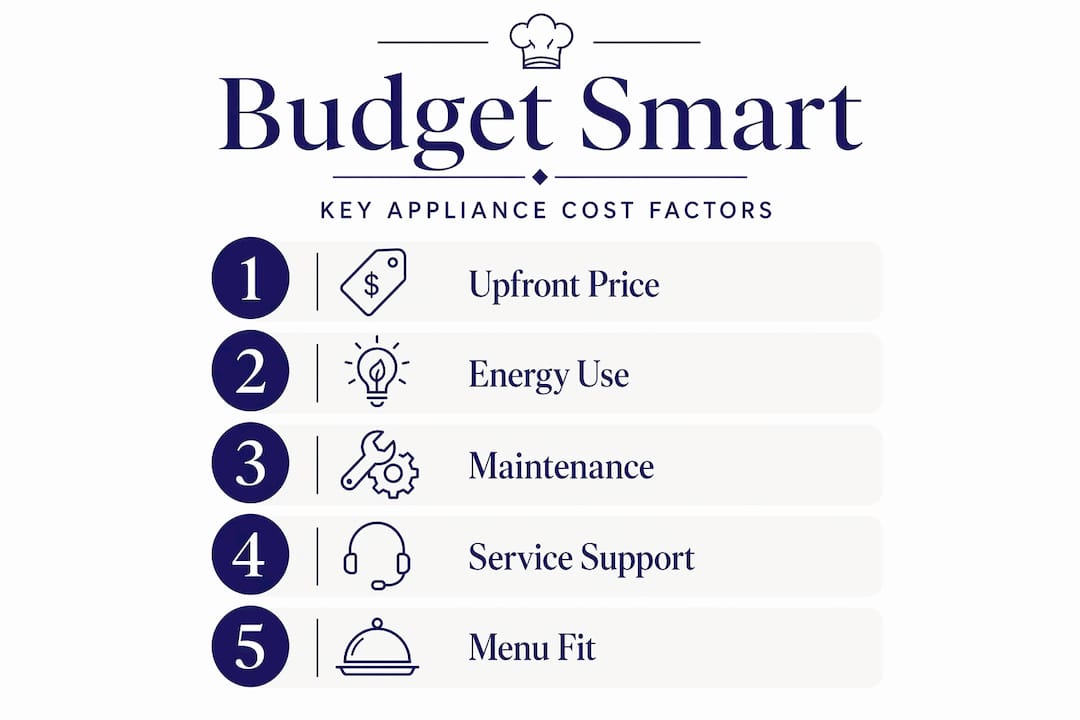
Budget is where most operators make their first critical error. The upfront cost rarely tells the full story. Energy-efficient appliances reduce long-term operational costs significantly, meaning spending more now can save you more over three to five years of operation. Factor in installation, maintenance contracts, and replacement part availability for every unit you consider.
Regulatory compliance is non-negotiable. The NSF/ANSI 4-2025 standard mandates that commercial cooking equipment be designed for food safety and sanitation, including corrosion-resistant materials and effective clean-in-place systems. Your local health department will check for this. Buy non-compliant equipment and you face failed inspections, fines, or forced replacement.
Pro Tip: Before finalizing any equipment list, run your menu through a peak-service simulation. Count every piece of food that needs simultaneous heat, cold storage, or prep. That number tells you the actual capacity you need, not the theoretical one.
This is where your research translates into specific purchasing decisions. Each category has distinct variables that matter more than brand name or price point.
The right refrigeration setup depends almost entirely on how your team moves during service. Multiple smaller reach-in fridges may better suit work patterns than a single large unit when your prep and cook stations are spread across the kitchen. Undercounter models are a practical solution for tight spaces. Compact units around 135-liter capacity fit under standard worktops without sacrificing meaningful storage volume.
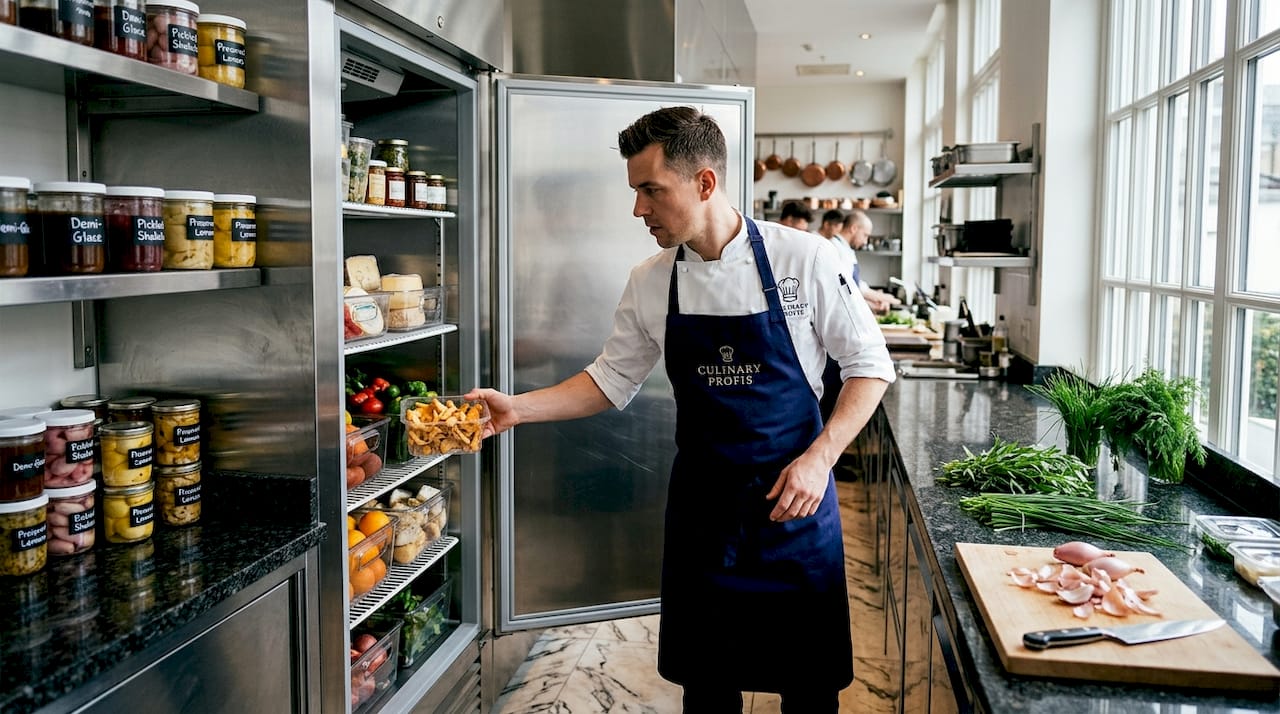
For larger operations, remote refrigeration systems locate the compressor outside the kitchen. This frees internal kitchen space and eliminates heat generated by on-site compressors, which matters in a kitchen already pushing ambient temperatures high during service.
| Refrigeration type | Best suited for | Key advantage |
|---|---|---|
| Undercounter reach-in | Small kitchens, tight spaces | Space efficiency under prep surfaces |
| Full-size reach-in | Medium to large operations | High capacity, accessible during service |
| Walk-in cooler | High-volume storage needs | Maximum volume, bulk ingredient storage |
| Remote system | Large multi-unit kitchens | Saves floor space, reduces kitchen heat load |
Ranges, ovens, fryers, and griddles each serve different menu functions. Resist the tendency to buy the most powerful version of everything. A 10-burner range in a sandwich concept is wasted capacity and wasted gas. For menus built around high-volume cooking, the right high-volume appliances are the ones sized to your actual cover count, not your aspirational one.
When selecting cooking equipment, consider:
Pro Tip: If a supplier offers a demo or a trial period on cooking equipment, take it. Run your actual menu through the unit during a simulated service. A range that looks right on paper often behaves differently under real kitchen conditions.
Mixers, slicers, food processors, and prep tables support everything your cooking equipment does. These are often under-budgeted and under-researched. The NSF/ANSI 2-2025 standard requires design features like coved corners, smooth angles, and cleanable fasteners in food handling equipment. Check that every prep unit you buy carries this certification before purchase. A prep table that is difficult to sanitize is a liability, not an asset.
Buying the right appliances and placing them correctly are two separate problems. A kitchen with great equipment arranged poorly will still underperform.
The standard approach is to group appliances by process stage:
Built-in appliances maximize space utilization and integrate with kitchen cabinetry for a cleaner workflow, which matters especially in smaller kitchens where every square foot counts. Stackable and undercounter units extend usable space vertically and under work surfaces without expanding your footprint.
| Kitchen size | Recommended layout approach | Space strategy |
|---|---|---|
| Under 500 sq ft | Linear or galley layout | Undercounter and stackable units |
| 500 to 1,000 sq ft | L-shaped or parallel layout | Zone separation with modular equipment |
| Over 1,000 sq ft | Island or zone-based layout | Dedicated stations with full-size equipment |
Ventilation is not optional. Every cooking appliance generating heat, steam, or grease must sit under a properly rated exhaust hood. Your local fire marshal and health inspector will verify this. Poor ventilation also degrades equipment faster by exposing electronics and gaskets to excessive heat and grease accumulation.
Learning from other operators’ purchasing errors is faster than making them yourself. Here are the mistakes that show up repeatedly in commercial kitchen procurement:
Pro Tip: Always ask the supplier: “If this unit fails during dinner service on a Saturday, how fast can you get a technician to my location?” Their answer tells you more about the real cost of ownership than any spec sheet.
I have seen operators spend $80,000 on a beautiful kitchen build-out and then lose money every month because the prep line backs up at 6 PM without fail. The equipment was fine. The placement was wrong, and two appliances that needed to share space during plating were on opposite ends of the kitchen.
My view is that workflow fit matters more than brand prestige. A mid-tier commercial range positioned correctly in your cooking zone will outperform a top-of-the-line unit placed as an afterthought near the back door. The spec that does not appear on any product page is how the equipment fits into your team’s movement during peak service.
The other lesson I keep coming back to is supplier reliability. A great appliance backed by a supplier who cannot get you parts in a reasonable timeframe is a liability. When you set up kitchen operations from scratch, the supplier relationship is as important as the product itself.
Choose equipment that your team can operate, clean, and maintain without advanced technical knowledge. Complicated features that never get used are not value-added. Durability, serviceability, and operational fit are the criteria that actually determine whether a piece of equipment earns its place in your kitchen.
— John
Culinaryprofis carries professional-grade commercial kitchen appliances for restaurants, catering operations, and serious culinary professionals. The catalog covers refrigeration, cooking equipment, food prep tools, and more, all from established brands built for the demands of daily commercial use.
For refrigeration, compact options like the Empura 18 cu ft reach-in and the Empura 23 cu ft model are practical choices for kitchens with limited floor space. Every product comes with expert support, warranty coverage, and free shipping. Browse the full selection at Culinaryprofis and match your next appliance purchase to your actual kitchen requirements.
The core appliances for any restaurant kitchen are commercial refrigeration, a range or oven, prep tables, and a food processor or mixer. The exact mix depends on your menu and service volume.
Reach-in units work best for line access and smaller storage needs, while walk-ins suit high-volume bulk storage. Operational fit and accessibility during service should drive this decision as much as capacity.
The NSF/ANSI 4-2025 standard covers commercial cooking equipment, requiring corrosion-resistant materials and cleanable surfaces. NSF/ANSI 2-2025 covers food handling equipment, specifying coved corners and cleanable fasteners for compliance.
Budget varies widely by concept and kitchen size, but plan to spend between $50,000 and $150,000 for a full restaurant kitchen build-out. Prioritize total cost of ownership over purchase price, including energy, maintenance, and parts availability.
Replace equipment when repair costs exceed 50% of replacement value, when energy consumption increases noticeably, or when the unit no longer meets current sanitation standards. Regular maintenance records help you track when that threshold is approaching.