Stand, Planetary or Spiral: Which Mixer Do You Actually Need?

Three machines, three different jobs. Buying the wrong one is the most expensive mistake in a bakery build — not because the machine breaks, but because it quietly limits what you can make.
The short answer
| Best at | Typical buyer | |
|---|---|---|
| Stand mixer | Everything, at home scale | Serious home bakers |
| Planetary mixer | Versatility — dough, batter, whip, sauce | Restaurants, cafés, small bakeries |
| Spiral mixer | Bread and pizza dough, at volume | Bakeries, pizzerias, commissaries |
If you take nothing else from this: a planetary is a generalist, a spiral is a specialist. Bakeries running serious bread volume usually end up owning both.
How each one actually works
The mechanical difference explains everything else, so it is worth thirty seconds.
A planetary mixer holds the bowl still and moves the agitator in two rotations at once — the attachment spins on its own axis while orbiting the bowl, like a planet around a sun. That path reaches every part of the bowl, which is why it copes with such different tasks. Change the attachment and the same machine goes from dough hook to flat paddle to wire whip.
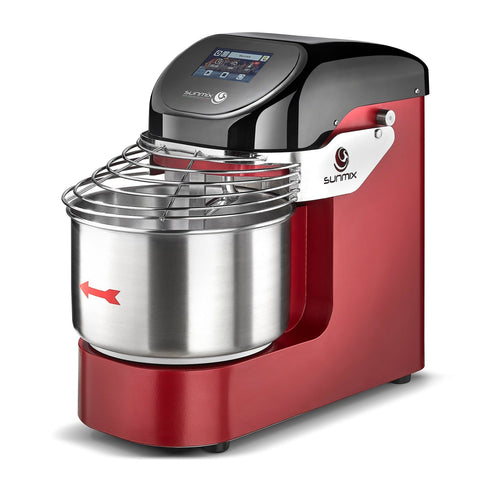
A spiral mixer does the opposite. The spiral-shaped arm stays on a fixed axis and the bowl rotates, usually with a central breaker bar dividing the dough. The dough is folded through the spiral repeatedly rather than dragged around a bowl.
A stand mixer is a planetary — just scaled for a countertop and a domestic duty cycle. The Ankarsrum is the interesting exception, and we come back to it below.
Why the difference matters: dough temperature
This is the part that gets skipped, and it is the reason bakers care.
Mixing puts energy into dough, and energy becomes heat. Push dough too warm during mixing and fermentation starts before you have control of it — the dough proofs unevenly, slackens, and the crumb suffers. Bakers track final dough temperature as closely as they track hydration.
A planetary works dough hard. The hook drags a mass of dough around a stationary bowl, and friction climbs. A spiral folds dough through itself with the bowl doing much of the movement, which develops gluten with markedly less friction heat and less time.
At home or on a restaurant line, that difference rarely matters. At 200 lbs of dough a day it decides how your bread turns out.
When to choose a planetary
Choose a planetary when the machine has to do more than one thing.
- A restaurant kitchen making bread and batters, sauces, mash and whipped cream
- A café or bakery whose output is skewed toward cakes, cookies, icing and fillings
- Any kitchen where counter or floor space allows exactly one machine
- Operations that want attachment versatility — meat grinders, vegetable slicers and pasta rollers commonly run off a planetary's hub
Planetary mixers run from 5-quart countertop units up to 140-quart floor machines. Most restaurants land between 20 and 60 quarts.
When to choose a spiral
Choose a spiral when bread or pizza dough is the business.
- Pizzerias mixing dough daily, especially high-hydration or long-ferment styles
- Bakeries producing bread at volume
- Anyone whose dough quality has plateaued and who suspects mixing is the limit
A spiral will not whip cream, will not make icing, and will not take a grinder attachment. It does one thing, and it does it better and faster than a planetary of the same capacity — typically developing dough in noticeably less time with a cooler finish.
Where the stand mixer fits
For a home kitchen, a stand mixer is the right answer — the question is which one.
Conventional stand mixers use the planetary layout with the motor in the head. It works well for batters and whipping. Stiff, low-hydration bread dough is where it struggles: the head takes the load, the machine rocks on the counter, and on a heavy dough it can overheat.
The Ankarsrum Original is built differently. The motor sits in the base, and the bowl rotates against a fixed roller and scraper — closer in principle to a spiral mixer than to a conventional stand mixer. That is why it handles bread dough that makes other home machines complain, and why it has been in production in Sweden since 1940.
If you bake bread regularly, it is worth the difference. If you mostly bake cakes, it honestly may not be — the conventional layout suits batters well and costs less.
Common mistakes
Buying a planetary for a bread-first bakery. It will work. It will also be slower, run the dough warmer, and wear faster doing a job a spiral does easily.
Buying a spiral as your only machine. The first time you need whipped cream or icing, you will be doing it by hand.
Sizing to today. Both machine types have a minimum batch below which they mix badly, and a maximum above which they fail early. Buying for exactly today's volume leaves no headroom; buying far too large means small batches never mix properly. Sizing deserves its own guide — see how to size a commercial mixer.
Still deciding?
Tell us what you make and how much of it, and we will tell you which of the three you need — including when the cheaper machine is the right call. Request a quote or call (914) 278-1007.