How to Size a Commercial Mixer Without Getting It Wrong

Undersized mixers burn out. Oversized ones mix badly. Here is how to land in the middle, using numbers you already have.
The rule to start from
A commercial mixer should run at roughly 60–80% of its rated capacity on a typical batch.
That band exists for two reasons, pulling in opposite directions:
- Too full and you are overloading the motor and gearbox on every single mix. It will cope, right up until it does not — usually out of warranty, usually mid-service.
- Too empty and the agitator cannot engage the batch. A small quantity of dough in a large bowl gets pushed around rather than worked, and mixes unevenly no matter how long you run it.
Most people size for the first risk and forget the second. Both are real.
Step 1: find your batch weight
Not your daily total — your single batch. That is what the machine actually has to handle at once.
If you already work from a recipe, add up the total weight of one batch including water. If you work in loaves or pizza balls, multiply:
- Pizza: dough balls typically 8–12 oz. 200 balls at 10 oz ≈ 125 lbs of dough.
- Bread: a standard loaf uses roughly 1–1.5 lbs of dough. 100 loaves ≈ 100–150 lbs.
- Batters and cakes: weigh a full mix once and use that number.
Then ask how many batches per day, and how many you want to run in one session. A machine that handles your batch in one go beats one that needs three passes, every single morning.
Step 2: understand what "capacity" means
Here is where sizing goes wrong. A mixer's quart rating describes bowl volume, not dough capacity, and the two are not close.
A 20-quart planetary does not mix 20 quarts of bread dough. Manufacturers publish separate dough capacities, and they vary with absorption ratio — the ratio of water to flour.
Stiff, low-hydration dough (bagels, some pizza styles) loads a motor far harder than slack, high-hydration dough. The same machine might be rated for 25 lbs of stiff dough and 40 lbs of soft. This is why two bakeries buy the same mixer and only one of them is happy.
Always size against the manufacturer's dough capacity at your hydration, not the quart number on the front. If a spec sheet only gives quarts, ask us — we will get the dough figure.
Step 3: pick the machine
Take your batch weight, divide by 0.7 (the middle of the 60–80% band), and you have your target dough capacity.
A 90 lb batch → 90 ÷ 0.7 ≈ 130 lbs of rated dough capacity.
Then check the machine's minimum batch. If you also make small specialty batches, confirm they are above that floor — or plan on a second smaller machine rather than mixing badly.
Step 4: check the things that stop the machine arriving
Sizing is only half the job. These kill more installations than capacity does.
Voltage and phase
Commercial floor equipment is frequently 208/240V and often three-phase. Most small premises have single-phase power. Converting is expensive; discovering this after delivery is worse. Check your panel before you order — and tell us what you have, because many machines are available in both.
Doorways and route
Measure the doorway, the corridor, any turn, and the crate — not just the machine. A 60-quart floor mixer that fits through the door uncrated may not fit crated, and uncrating outside in the rain is nobody's plan.
Floor loading and clearance
Large floor mixers are heavy. Check the floor can take it, especially above a basement. Leave clearance above the machine for the bowl to lift and for the agitator to be changed.
Dock access
No loading dock means you need liftgate delivery. Tell us at quote stage and it is priced in rather than surfacing as a surprise charge on delivery day.
Worked examples
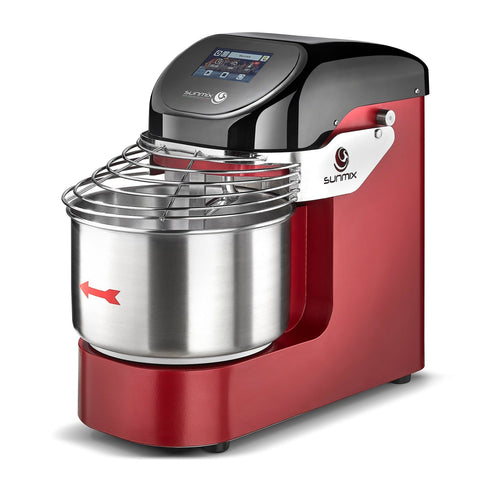
Pizzeria, 300 balls a day at 10 oz, one morning mix. 300 × 10 oz ≈ 187 lbs. Divided by 0.7 ≈ 265 lbs rated capacity. Pizza dough is stiff, so we size against the low-hydration figure — and a spiral, not a planetary, given it is dough all day. This is exactly what the Sunmix spiral range is built for, from countertop machines to industrial floor models, in stock in Miami.
Restaurant, mixed use, biggest batch ~25 lbs. 25 ÷ 0.7 ≈ 36 lbs. A 20–30 quart planetary covers it with headroom, and the attachment range earns its counter space.
Bakery, 120 loaves plus daily cakes and fillings. Roughly 150 lbs of bread dough → a spiral around 200+ lbs rated, plus a mid-size planetary for the sweet side. One machine will not do this well.
Buy for eighteen months out
The single most common regret we hear is not "I bought too big". It is a bakery that sized exactly to its opening volume, grew, and was mixing in two passes within a year.
Build in headroom — but stay inside the band. Doubling capacity "to be safe" leaves your normal batch under the minimum and mixing poorly every day.
Let us check your numbers
Send us your batch weight, hydration if you know it, what you are making and your voltage. We will come back with a specific recommendation within one business day — including telling you when a smaller, cheaper machine is the right answer.
Request a quote · (914) 278-1007 · Planetary mixers · Spiral mixers · Sunmix spiral mixers — new to the USA