Best Dough Mixer for a Micro Bakery

A mixer becomes a serious micro-bakery decision when mixing starts controlling the entire production day. If you are running repeated batches, waiting for dough to develop, or asking a home-style mixer to work continuously, the “best” mixer is not simply the one with the biggest bowl. It is the machine that fits your dough, electrical service, workspace and production rhythm.
For a bread-focused micro bakery, a spiral mixer is usually the best type of dough mixer. It is designed around dough production: the spiral tool works while the bowl rotates, developing gluten efficiently and keeping the dough moving as a single mass. A planetary mixer remains the better all-purpose choice when cakes, buttercream, whipped products and attachment work make up a large share of the menu.
There is no single mixer size for every micro bakery. A cottage baker making 20 loaves, a market baker making 80 loaves and a wholesale operation making several hundred pounds of dough need different machines. This guide compares compact countertop models through floor-standing production mixers so you can choose for the bakery you have now—and the growth you can realistically support.
Start With Your Production, Not the Mixer
Before comparing brands, calculate how much dough you actually mix on a production day:
Number of products × dough weight per product = total daily dough
If you make 40 loaves at 750 grams each, you need 30 kilograms (about 66 pounds) of dough. A mixer rated for 15 kilograms would require at least two full-capacity mixes. In practice, three more comfortable batches may give you better control over mixing, fermentation timing and dividing.
At 80 loaves weighing 800 grams each, daily demand reaches 64 kilograms (about 141 pounds). Even at a 15-kilogram maximum, that is at least five batches. At that point, the question is no longer only whether the dough fits—it is whether five mixing cycles fit your labor and fermentation schedule.
Spiral, Planetary or Home-Style Stand Mixer?
| Mixer type | Best for | Main trade-off |
|---|---|---|
| Spiral mixer | Bread, pizza, bagel and enriched dough production | Purpose-built for dough; usually less versatile for whipping and creaming |
| Planetary mixer | Mixed menus: dough, batter, frosting, cream and attachments | Versatility can come at the expense of dedicated dough performance |
| Home-style stand mixer | Testing recipes and very small production | Small batches and repeated cycles can become a production bottleneck |
The practical lesson in the micro-bakery video shared with us is familiar: growing producers often move through several home and commercial stand mixers as order volume increases. The important takeaway is not that one familiar mixer is “bad.” It is that a machine selected for occasional batches may no longer match a schedule built around repeated dough production.
Five Mixer Sizes for Different Micro Bakeries
| Model | Max dough | Power | Best fit |
|---|---|---|---|
| Sunmix EASY6 | 13 lb / 6 kg | 110 V | Cottage baker, testing and small batches |
| Sunmix EASY10 | 22 lb / 10 kg | 110 V | Growing market bakery needing simple controls |
| Sunmix EVO15 | 33 lb / 15 kg | 110 V | Bread-focused micro bakery running repeat recipes |
| Sunmix EVO20 | 44 lb / 20 kg | 220 V | Larger countertop batches and wholesale growth |
| Sunmix SMART40 | 88 lb / 40 kg | 220 V | High-output production bakery ready for a floor mixer |
These are maximum rated capacities, not a promise that every formula behaves identically. Hydration, flour strength, enrichments and inclusions affect the load. Share your actual formula before choosing a size.
Sunmix EASY6: Best for a Cottage Bakery or Small Runs
The EASY6 is the smallest option in this comparison: an 8.5-quart bowl, maximum 13 pounds of dough, variable 50–300 RPM speed and standard 110 V power. At 11 inches wide, it suits a home-based baker who wants spiral mixing without surrendering the entire prep counter.

Sunmix EASY10: Best Simple Step-Up Model
The EASY10 raises capacity to 22 pounds in a 13-quart bowl while remaining 12 inches wide and 110 V. It is a practical fit when the EASY6 would create too many cycles but touchscreen recipe storage is not essential. The physical speed dial and reverse rotation keep operation straightforward.
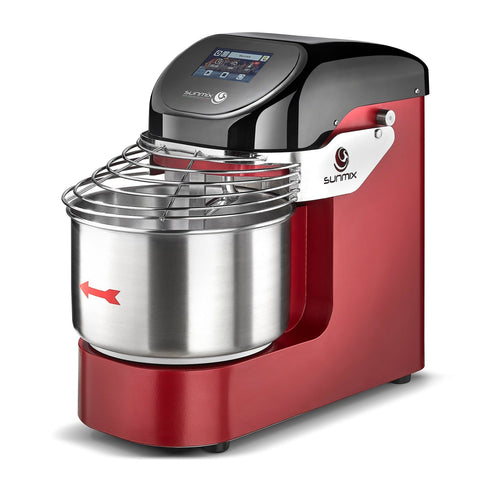
Sunmix EVO15: Best All-Around Micro-Bakery Choice
The EVO15 occupies a useful middle ground. It is substantially more production-oriented than a home stand mixer, but it does not demand the footprint or electrical installation of many larger bakery mixers.
- Maximum dough capacity: 15 kg / 33 lb
- Maximum flour capacity: 7 kg / 15 lb
- Bowl volume: 19 qt
- Recommended hydration: from 60%
- Variable speed: 50–300 RPM
- Electrical: 110 V, 60 Hz, single phase
- Dimensions: 14 × 20 × 21 in
- Machine weight: 92 lb

The touchscreen stores up to 20 recipes, which matters once more than one person mixes dough. Saved programs can make the sequence repeatable, while the baker still checks dough development and finished dough temperature rather than relying on time alone.
Reverse rotation can help bring ingredients together at the beginning of a mix. The infrared temperature sensor provides a live dough-temperature reference, and the LED bowl light improves visibility during development.

Sunmix EVO20: Best Countertop Model for Larger Batches
The EVO20 increases maximum dough capacity to 44 pounds in a 26-quart bowl. It carries the EVO touchscreen, 20-recipe memory, infrared dough-temperature sensor and variable 50–300 RPM control. The major planning difference is electrical: it requires 220 V single-phase power. It is the better fit when a 33-pound ceiling would still create too many batches, but the bakery is not ready for a floor mixer.

Sunmix SMART40: Best for the Move to Production Scale
The SMART40 is a different class of machine: a 58-quart floor model rated for up to 88 pounds of dough. It requires 220 V single-phase power, occupies 22 × 34 × 41 inches and weighs 363 pounds. This is for a bakery where repeated countertop batches have become the labor bottleneck and there is enough dividing, fermentation, oven and cooling capacity to use the larger mix efficiently.

Check the Smallest Batch, Too
Maximum capacity gets the attention, but minimum practical batch size can affect the bakery every day. Ask how the mixer handles your smallest production batch, starter builds, test recipes and low-volume flavors. A mixer that is excellent at the weekend maximum may be inconvenient for Tuesday’s smaller run.
When possible, give the equipment specialist your actual formula: flour weight, total dough weight, hydration, inclusions and expected number of consecutive batches. Capacity labels alone do not describe every dough.
Plan the Workflow Around the Mixer
A faster or larger mixer only helps if the rest of the bakery can keep up. Before ordering, map where ingredients are scaled, where mixed dough goes, how the bowl is cleaned, when each batch enters bulk fermentation and who divides it. Five tightly scheduled batches can create congestion even when the mixer itself is capable.
Also confirm the machine’s path into the bakery. The EVO15 weighs 92 pounds and ships by freight from the Sunmix U.S. warehouse in Miami. Measure doorways, stairs, counter height and the final operating space before delivery.

When the EVO15 Is Not the Best Choice
The EVO15 is not automatically right for every small bakery. Consider another category or size when:
- You make only a few loaves per bake; the smaller EASY6 may be the more practical spiral mixer.
- Your menu is dominated by cakes, frosting, whipped cream and batter; a planetary mixer may provide better everyday versatility.
- Your formulas regularly fall below the manufacturer’s recommended 60% hydration.
- Your daily demand would require too many 15-kilogram batches; the EVO20 or SMART40 may reduce labor.
- Your workspace cannot safely accommodate freight delivery, a 92-pound machine or the required operating clearance.
A Simple Buying Checklist
- Calculate total dough needed on your busiest realistic day.
- List your normal and smallest batch weights.
- Record hydration, flour type, enrichments and heavy inclusions.
- Estimate the number of consecutive batches and minutes available for mixing.
- Confirm voltage, circuit, footprint, clearances and delivery access.
- Decide whether you need a dough specialist or an all-purpose mixer.
- Confirm parts, service and warranty support before purchasing.
Our Recommendations by Bakery Stage
- Small cottage bakery: EASY6 for compact 13-pound batches.
- Growing market bakery: EASY10 when simple operation and 22-pound capacity are the priorities.
- Best all-around choice: EVO15 for 33-pound batches, 110 V convenience and repeatable recipe programs.
- Wholesale growth: EVO20 for 44-pound batches when 220 V is available.
- Production scale: SMART40 when an 88-pound floor mixer matches the rest of the bakery.
For many bread-focused micro bakeries moving beyond home-style equipment, the Sunmix EVO15 remains the strongest middle choice. But the best purchase is the smallest mixer that handles your busiest realistic batch without forcing an inefficient number of cycles.
The best purchase still begins with your formula and schedule. If your bakery’s needs are close to the limits—or you are choosing between a spiral and planetary mixer—call CulinaryProfis at (914) 278-1007. We can review the dough weight, hydration and expected daily batches before recommending a machine.
References and Further Viewing
- Sunmix EVO Line Specifications
- CulinaryProfis: Sunmix EVO15 (19 qt) Spiral Mixer
- Sunmix EASY Line Specifications
- Sunmix SMART Line Specifications
- The Ultimate Stand Mixer Review at Our Micro Bakery
- WheatBeat: Spiralmac Royal Queen SV12 Spiral Mixer Review
Equipment specifications and availability can change. Confirm current details before purchase. This guide was prepared by the CulinaryProfis Editorial Team.