Sunmix Mixer Power Requirements: 110V, 220V and Three-Phase

Before size, before price, before anything else: what power does your kitchen have? It is the first thing we check when we quote, because it decides which machines are on your list. It takes about ten minutes to establish, and it makes everything after it straightforward.
A note on the numbers. Sunmix lists power as 110V, 220V or 208–230V. American electricians usually say 120V and 240V for the same supplies — it is the same electricity, just a different convention. The data plate on the machine is the final authority on voltage, phase, amperage and whether it plugs in or is hard-wired. Never judge it from the shape of an outlet alone.
There are three kinds of power
Every mixer we sell runs on one of them. Which one tells you where to look in our range.

110 volts, single-phase
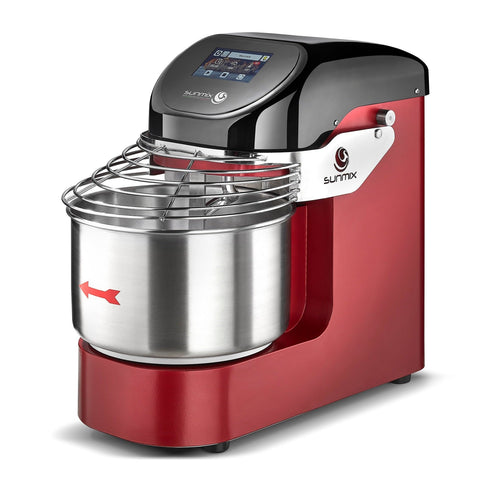
An ordinary wall socket. The same supply your kettle and your phone charger use. Sunmix lists the EASY 6, 10 and 15, the EVO 6, 10 and 15, and both MOON rounders for 110V.
One thing worth checking even so: the circuit still has to have enough amperage for the machine and not already be loaded with other equipment.
220 volts, single-phase
A larger socket with a different shape and a different plug. This is the same supply an electric clothes dryer or an electric range uses, so almost every building already has the capability even when the outlet is not where you need it.
If there is no outlet in the right place, an electrician runs a line and fits one. Normally a few hundred dollars and half a day.
An important distinction: spotting a dryer or range outlet tells you the building carries higher-voltage service. It does not mean the mixer should be plugged into that outlet. The receptacle type, the amperage and the circuit protection all have to match the machine.
208 to 230 volts, three-phase
Three-phase is the standard industrial supply, and it is what serious production equipment is built for. Rather than one stream of electricity arriving at the building, three arrive slightly out of step with one another. Large motors run smoother, cooler and more efficiently on it, which is why the highest-capacity machines are designed around it.
A great many commercial premises already have three-phase: bakeries, production kitchens, commissaries, and most units in industrial and mixed-use buildings. If your space was fitted out for food production, there is a good chance it is already there.
Three-phase machines are wired directly to a disconnect switch by an electrician rather than plugged into a socket. That is normal practice for equipment of this size and part of any commercial installation.
If your building does not have it yet, it is supplied by the utility company rather than added by your electrician, so it is worth pricing and scheduling early. Your electrician can quote it and handle the application, and if you are already planning a fit-out or a refit it is a routine line item. Once it is in, every future piece of equipment can use it. Tell us where you are with it and we will time the machine order to suit.
Volts, amps and watts, in one minute
- Volts is the pressure behind the electricity. 110V is a normal socket; 220V is the heavier supply a dryer or range uses.
- Amps is how much current flows while the machine runs. This is the number your electrician needs, because it sets the breaker size and the thickness of the wire.
- Watts is volts multiplied by amps — the total power the machine draws. A 3 kW motor is 3,000 watts.
You do not need to calculate anything yourself. Tell us which model you are considering and we will send the exact voltage, phase and amp draw for that machine, so your electrician has the right figures before any work is quoted.
What each Sunmix line needs
On any spec sheet, look for 1PH or 3PH. 1PH is single-phase. 3PH is three-phase.
| 110V single-phase | EASY 6, 10, 15 · EVO 6, 10, 15 · MOON 300 and MOON 1000 | up to 33 lbs per batch |
| 220V single-phase | EASY 20 · EVO 20 · Top Line SUN40, SUN50, SUN60 · SMART 40, SMART 50, SMART 60 | 44 to 132 lbs per batch |
| 208–230V three-phase | All Classic Line · All QUEEN Line | 132 lbs and above |
Capacity and power at a glance
|
Countertop EASY and EVO 6, 10, 15, 20 |
13, 22, 33 or 44 lbs | 0.37 – 1.1 kW | 110V, or 220V on the 20 |
|
Floor, single-phase Top Line and SMART 40, 50, 60 |
88, 110 or 132 lbs | 3 – 4 kW | 220V single-phase |
|
Floor, industrial Classic and QUEEN |
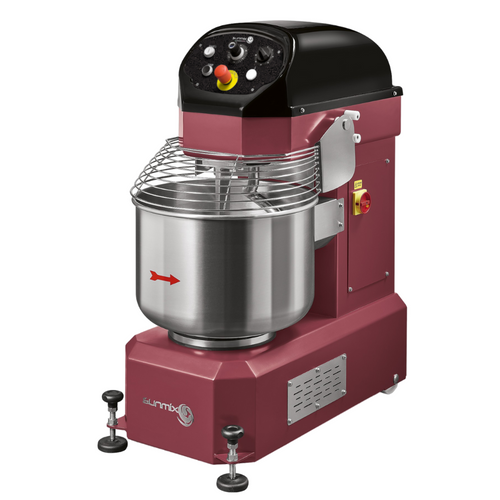
132 lbs up to 661 lbs | up to 15 kW, plus a bowl motor | Three-phase |
The largest single-phase machines we stock are the SUN60 Top Line and the SMART 60. Both mix 132 lbs of dough a batch on an ordinary 220V supply, which covers most pizzerias comfortably.
From 132 lbs upward, the Classic and QUEEN lines take over and run all the way to 661 lbs, handling dough up to 100% hydration. The QUEEN adds two independent motors with separately variable bowl and spiral speeds. Both lines are three-phase.
How to check the power in your kitchen
You can gather everything needed for a first recommendation in about ten minutes:
- Photograph the electrical panel. Include the main breaker and the panel label.
- Photograph where the mixer will stand, including any outlet nearby and the markings on it.
- Ask your landlord or building manager for the voltage, phase and panel capacity of your unit.
- Have a licensed electrician confirm it — particularly for 220V machines, anything three-phase, or a new circuit.
Send us these four things and we will do the rest:
- A photo of your electrical panel
- A photo of the outlet where the mixer will go
- Your dough weight per batch
- How many batches a day
Stepping up from a 10 or a 15
The EASY and EVO lines come in sizes 6, 10, 15 and 20. The 6, 10 and 15 run on 110V and plug into an ordinary socket. The 20 runs on 220V.
It is the one point in the countertop range where the power changes, so it is worth planning for if you are moving up from a smaller machine you already own. It takes you to roughly 44 lbs a batch, and an electrician fits the outlet in about half a day.
Why an adapter or transformer is not the answer
A plug adapter changes only the shape of the connection. It does not change the voltage, the phase, the circuit capacity or the protection behind it. A transformer does not turn single-phase service into true three-phase power either.
Sunmix builds each machine for a specific voltage at the factory in Italy, and there is no selector switch inside. So the machine that arrives needs to match the supply you have — which is exactly why we confirm it with you before an order goes in. If you think an electrical workaround might suit your site, let us check it with the manufacturer and your electrician first.
Common questions
Can I plug a 220V Sunmix into my dryer outlet?
Not as a matter of course. The voltage may match, but the receptacle type, amperage, circuit protection and grounding all have to suit the machine. Have an electrician check the machine documentation against that circuit.
Can an electrician just add three-phase?
They can assess the site and manage the work, but new three-phase service comes from the utility company and usually needs the property owner involved too. Availability and timing depend on the building, so it is worth asking early.
Will a 110V Sunmix work in any American outlet?
It still needs a properly grounded circuit with enough amperage that is not already loaded with other equipment. Check the machine's data plate and manual before installing.
Should I choose the mixer first, or call the electrician first?
Narrow the machine down by batch size first, then hand your electrician that model's specification so the circuit can be planned properly. We will help you get to the shortlist before that visit.
Tell us what you have and we will match the machine to it
Send us your available power, your batch size, your hydration if you know it, and how much you make in a day. We will come back with the models that suit your kitchen and confirm the electrical specification before anything is ordered. We reply within one business day.
If you are working toward a three-phase installation, tell us that too — we will help you line the machine up with the electrical work so the two arrive together.
Sizing is the other half of this decision — our guide on how to size a commercial mixer covers batch weights, hydration and the 60–80% rule.
Request a quote · (914) 278-1007 · Sunmix spiral mixers · Single-phase floor mixers · QUEEN Line industrial mixers
Electrical specifications reflect Sunmix USA information current at the time of writing, and configurations can change. Always confirm the individual machine's data plate, current specification sheet, installation manual and your local electrical requirements before purchase or installation.