
How Open Kitchen Design Works: A Practical Guide

Open kitchen design is a layout that dissolves walls separating the kitchen from dining and living areas to create an integrated, fluid space that enhances both functionality and social connectivity. Professionally, this concept is called open-plan or open-concept kitchen design, and understanding how open kitchen design works means grasping three core mechanics: spatial zoning, structural modification, and workflow preservation. When executed correctly, the result is a kitchen that functions as the social and culinary center of a home rather than an isolated utility room. This guide covers every layer of that process, from tearing out walls to choosing the right exhaust rate.
How open kitchen design works through zoning
Open kitchens eliminate or minimize walls to blend the kitchen with living and dining spaces, but that openness does not mean the space is undivided. Zoning is the mechanism that makes open kitchens functional. Without it, cooking smells, noise, and visual clutter overwhelm the adjacent living areas.
The most effective zoning tools in open kitchen layout ideas are:
- Islands and peninsulas as spatial anchors that physically define the cooking zone without blocking sightlines
- Flooring transitions such as switching from tile to hardwood at the kitchen boundary to signal a change in function
- Layered lighting with independent dimmers for the cooking zone, dining area, and seating space
- Ceiling details like a coffered section or dropped soffit above the cooking area to visually contain it
- Furniture placement using a dining table or sofa back to mark the edge of the living zone
Zoning uses islands, flooring transitions, and layered lighting to define functional areas without walls. This matters because a kitchen island placed without clearance planning becomes an obstacle rather than an asset. The minimum circulation space around islands is 35 to 39 inches, and dropping below that figure creates bottlenecks during meal prep and entertaining.
Lighting deserves special attention as a zoning tool. Pendant lights over an island, recessed task lighting above the range, and a warmer chandelier over the dining table each signal a different zone to anyone in the room. Ceiling clusters and independent dimmers help maintain comfort and zone separation without physical barriers. This approach also lets you shift the mood from bright and functional during cooking to warm and relaxed during dinner without changing the furniture arrangement.
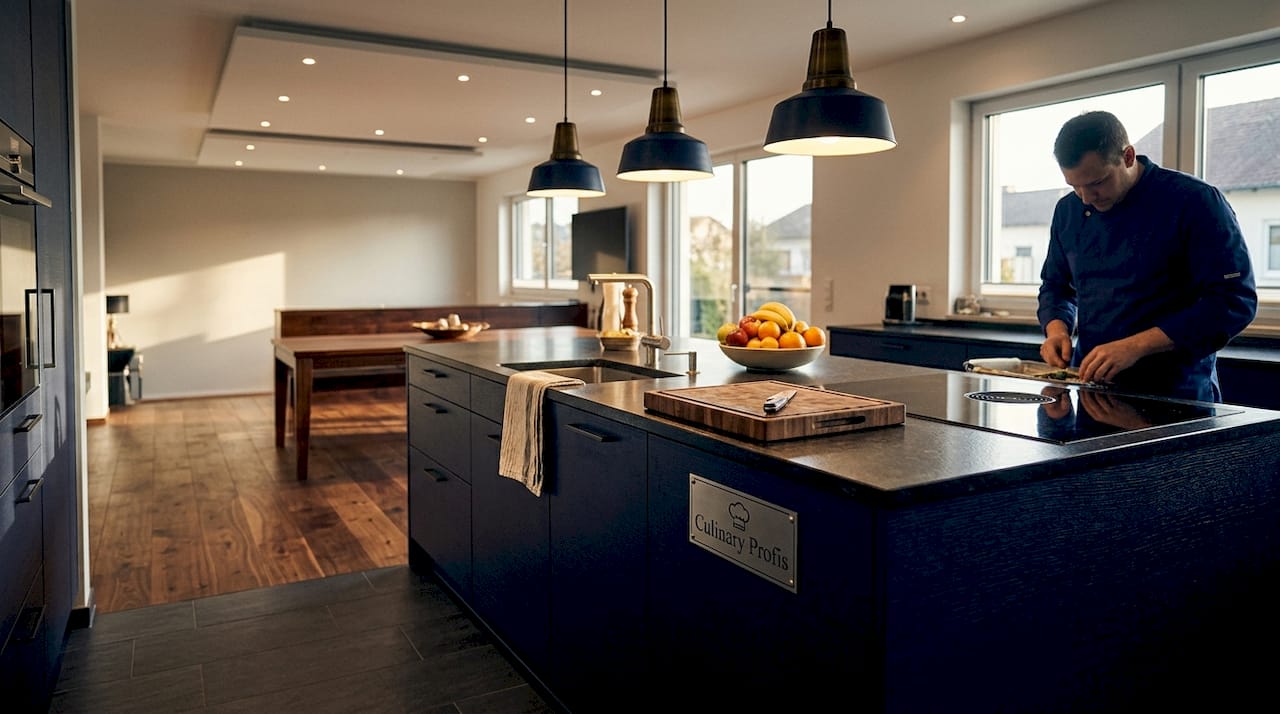
Pro Tip: Install dimmer switches on separate circuits for each zone before drywall goes up. Retrofitting independent lighting controls after construction costs two to three times more.
What structural work does opening a kitchen wall require?
Removing a kitchen wall is not a weekend project. The structural and regulatory requirements are the most underestimated part of any open kitchen remodel, and they directly affect your budget and timeline.
Here is the standard sequence for a wall removal project:
- Identify the wall type. A structural engineer or licensed contractor must determine whether the wall is load-bearing. Load-bearing walls carry the weight of the floor or roof above and cannot simply be removed.
- Commission an engineering assessment. For load-bearing walls, a structural engineer specifies the beam size and support column placement needed to transfer the load.
- Pull permits. Building permits and inspections are mandatory for structural modifications. Skipping this step creates liability issues and complicates future home sales.
- Reroute utilities. Walls often contain electrical circuits, plumbing supply or drain lines, and HVAC ducts. Each trade requires its own subcontractor and inspection.
- Install the beam and supports. Beam installation costs range from $3,000 to $15,000 depending on span length, beam material, and local labor rates. Steel beams cost more than engineered lumber but allow longer spans.
- Complete finish work. Patching floors, ceilings, and adjacent walls after utility rerouting often takes as long as the structural work itself.
“Typical remodeling timelines run 6 to 16 weeks for open-concept kitchen projects, and most homeowners underestimate the utility rerouting phase by at least two weeks.”
The utility rerouting step surprises most homeowners. A single kitchen wall can contain a 20-amp circuit for the refrigerator, a gas line, and a return air duct. Each of those requires a licensed trade and a separate inspection before the wall can close. Removing walls involves complex structural, electrical, plumbing, and code considerations, and the permit process alone can add two to four weeks to a project in dense urban markets. Budget for it from day one.
How does the kitchen work triangle apply to open layouts?
The kitchen work triangle is defined as the path connecting the three primary work stations: the sink, the stove, and the refrigerator. In a closed kitchen, walls naturally contain this triangle. In an open layout, the triangle can sprawl or get interrupted by foot traffic from the adjacent living area.
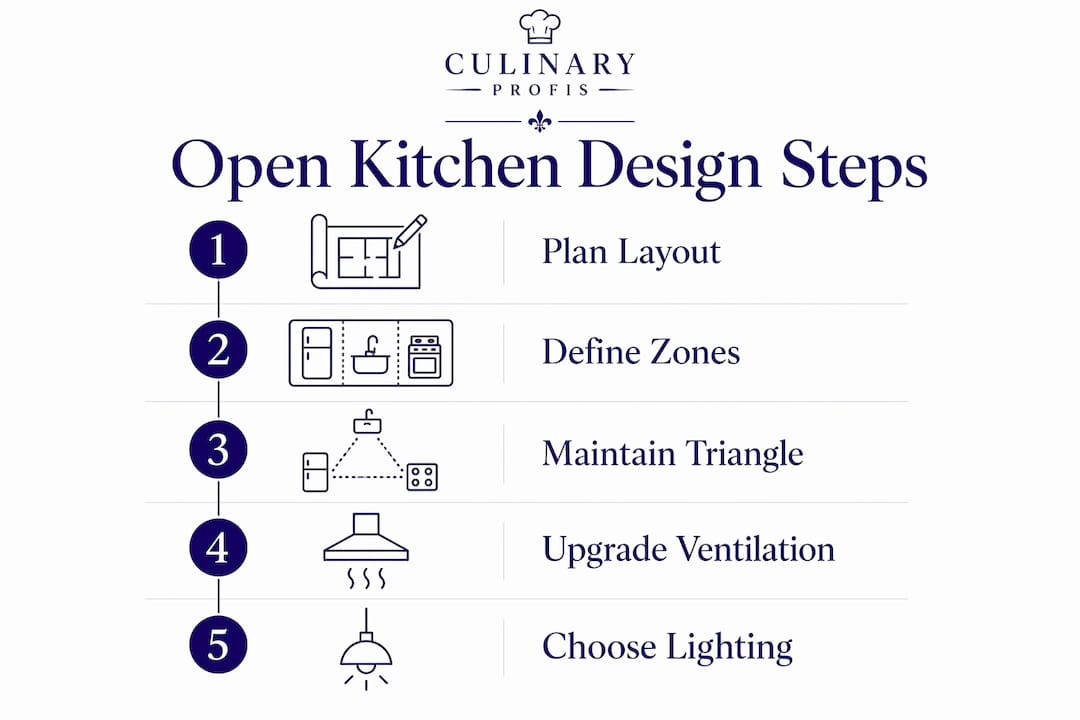
Work triangle side lengths of 4 to 9 feet with 42 to 48 inch walkway clearances optimize cooking workflow. That clearance figure is not arbitrary. It accommodates two adults passing each other and allows oven and dishwasher doors to open fully without blocking movement. The kitchen work triangle is a flexible tool, and real-life measurements matter more than the theoretical ideal.
| Layout type | Triangle fit | Key clearance note |
|---|---|---|
| L-shaped open kitchen | Strong fit | Keep island outside the triangle path |
| U-shaped open kitchen | Compact and efficient | Watch for traffic cutting through the base |
| Galley open kitchen | Linear, works well | Minimum 48 inches between parallel counters |
| Island-centered layout | Flexible | Island should not bisect sink-to-stove path |
Islands placed inside the main cooking path are the most common workflow mistake in open kitchen design. The island is a prep and social surface, not a waypoint between the stove and sink. Islands placed inside main pathways disrupt workflow and force cooks to walk around their own workspace during service. Position the island parallel to, not across, the primary work triangle.
Pro Tip: Before finalizing island placement, walk the sink-to-stove-to-refrigerator path with a tape measure. If any leg exceeds 9 feet or drops below 4 feet, adjust the layout before cabinetry is ordered.
For open kitchens with larger footprints, a secondary work zone near the island handles prep tasks like chopping and plating. This keeps the primary triangle clear for active cooking and reduces congestion when multiple people are in the kitchen. Culinaryprofis covers commercial kitchen zoning methods in detail, and many of those principles translate directly to residential open layouts.
What ventilation and noise management does an open kitchen need?
Ventilation is where open kitchen design principles diverge most sharply from closed kitchen standards. In a closed kitchen, walls contain cooking odors and grease particles. In an open layout, those particles travel freely into the living and dining areas unless the exhaust system is sized correctly.
Key ventilation requirements for open kitchens include:
- 150 to 200 CFM exhaust rates as the recommended minimum for open-concept layouts, compared to 100 CFM for standard closed kitchens
- Make-up air systems required when exhaust exceeds 400 CFM to prevent negative pressure that pulls combustion gases back into the home
- Duct material selection using smooth-bore metal ducts rather than flexible vinyl to prevent grease buildup and reduce fire risk
- Hood placement at 24 to 30 inches above the cooking surface for wall-mount hoods and 26 to 36 inches for island hoods
- Noise-rated fans with sone ratings below 3.0 for residential use, since open layouts amplify mechanical noise into living areas
Ventilation in open kitchens requires 150 to 200 CFM exhaust rates and mandatory make-up air above 400 CFM. That make-up air requirement catches many homeowners off guard. A high-performance range hood pulling 600 CFM in a tightly sealed modern home creates enough negative pressure to backdraft a gas water heater, which is a code violation and a safety hazard.
One emerging solution for odor and sound management is the broken floor plan concept, which uses partial walls, soffits, or ceiling drops to contain the cooking plume without fully closing the space. Open kitchens also benefit from dual behavior zones: a visible social cooking area near the island and a concealed prep or service area behind cabinetry where messy prep work and strong odors stay out of sightlines. Ventless condensing hood systems, such as those available through Culinaryprofis, offer a practical solution where duct runs are not feasible.
How lighting and materials create visual cohesion
Lighting in an open kitchen is not a single design decision. It is a layered system that must serve three different functions across one continuous space: task performance in the cooking zone, ambient comfort in the dining area, and accent or mood lighting in the living space.
The practical approach to lighting an open kitchen:
- Task lighting at 50 to 75 foot-candles directly over the range, sink, and prep surfaces using recessed LED fixtures or under-cabinet strips
- Pendant lights over the island at a color temperature of 2700K to 3000K to match the warmth of dining and living area fixtures
- Chandelier or semi-flush fixture over the dining table on its own dimmer circuit, separate from kitchen task lighting
- Accent lighting inside glass-front cabinets or along toe kicks to add depth without adding glare
Lighting must balance functional brightness and mood lighting to avoid discomfort and maintain visual cohesion. Mismatched color temperatures are the most common lighting mistake in open kitchens. A 5000K cool-white recessed fixture above the range next to a 2700K warm pendant over the island creates a jarring visual break that undermines the sense of a unified space.
Material continuity reinforces what lighting establishes. Running the same flooring material from the kitchen through the dining area signals one connected space. Matching cabinet hardware finishes to light fixture metals, such as brushed brass pendants with brass drawer pulls, creates visual rhythm without requiring identical materials throughout. Ceiling junctions and coordinated lighting controls are critical finishing details that prevent zone discomfort and glare in open kitchen designs.
Key takeaways
Open kitchen design works when zoning, structural planning, workflow preservation, ventilation sizing, and lighting cohesion are treated as a single integrated system rather than separate decisions.
| Point | Details |
|---|---|
| Zoning replaces walls | Use islands, flooring transitions, and layered lighting to define functional areas without physical barriers. |
| Structural work requires permits | Load-bearing wall removal needs an engineer, a beam, and mandatory inspections before any finish work begins. |
| Work triangle clearance is non-negotiable | Maintain 42 to 48 inch walkway clearances and keep islands outside the primary cooking path. |
| Ventilation must be upsized | Open layouts require 150 to 200 CFM exhaust rates and make-up air systems above 400 CFM. |
| Lighting cohesion unifies the space | Match color temperatures across zones and put each lighting circuit on an independent dimmer. |
Why most open kitchens underperform their potential
I have reviewed dozens of open kitchen remodels, and the pattern is consistent: the ones that disappoint share a single flaw. The homeowner or designer treated “open” as the destination rather than the starting point. They removed the wall, added an island, and called it done. What they skipped was the zoning work that makes the openness livable.
The ventilation piece is where I see the most serious oversights. A 900 CFM island hood in a sealed modern home without a make-up air system is not just ineffective. It is a code violation waiting to be discovered during a home inspection. Specifying ventilation for an open kitchen requires the same rigor you would apply to a commercial installation.
The work triangle advice I give most often is this: design for the cook who will actually use the kitchen, not for the floor plan that photographs well. A 10-foot island looks stunning in a listing photo and creates a miserable cooking experience when the sink is 12 feet from the stove. Real workflow testing, with a tape measure and a walk-through, catches these problems before cabinetry is ordered.
Open kitchen design principles are not complicated, but they require discipline. Every decision, from beam sizing to dimmer placement, connects to the others. The kitchens that work best are the ones where the designer treated the space as a system.
— John
Outfit your open kitchen with professional-grade equipment
Open kitchens demand appliances that perform under visibility. Every piece of equipment is on display, and performance gaps are immediately obvious to guests.

Culinaryprofis carries commercial-grade ranges, ventilation systems, and prep equipment built for exactly this kind of high-visibility, high-performance environment. Whether you need a ventless hood solution for an island installation or are outfitting a full open kitchen from the ground up, the Culinaryprofis catalog covers professional specifications at accessible price points. Browse the full selection at Culinaryprofis and get direct support from equipment specialists who understand both commercial and residential kitchen demands.
FAQ
What is an open kitchen concept?
An open kitchen concept is a layout that removes or minimizes walls between the kitchen and adjacent living or dining spaces to create a connected, multifunctional area. It relies on zoning tools like islands, flooring transitions, and layered lighting rather than walls to define functional areas.
How much does it cost to open up a kitchen wall?
Beam installation for a load-bearing wall removal costs between $3,000 and $15,000, with total project costs rising significantly when electrical, plumbing, and HVAC rerouting are included. Permits, inspections, and finish work add further to the budget and timeline.
What CFM rating does an open kitchen hood need?
Open kitchens require a minimum of 150 to 200 CFM exhaust capacity, compared to roughly 100 CFM for closed kitchens. Any system exceeding 400 CFM requires a make-up air system to prevent negative pressure and code violations.
How do you maintain workflow in an open kitchen layout?
Keep the work triangle (sink, stove, refrigerator) with side lengths between 4 and 9 feet and maintain 42 to 48 inch walkway clearances throughout. Position islands parallel to the cooking path rather than across it to avoid disrupting movement during meal preparation.
Do open kitchens require special permits?
Yes. Any structural wall removal requires building permits and inspections in virtually every jurisdiction. Load-bearing wall modifications also require a structural engineer’s assessment and approved drawings before work begins.