

Call us NOW


Commercial kitchen layout is not just about fitting equipment into a room. It is the spatial and functional organization of your entire operation, designed to control workflow, safety, and compliance from the moment food enters your receiving dock to the moment clean dishes return to service. Get it wrong, and no amount of high-end equipment fixes the bottlenecks, safety violations, or failed inspections that follow. Get it right, and your kitchen becomes a machine your staff can operate faster, cleaner, and with fewer errors every shift.
| Point | Details |
|---|---|
| Layout is about workflow, not just equipment | A commercial kitchen layout controls how food, staff, and dishes move through your entire operation. |
| Seven zones form the foundation | Every effective kitchen follows a functional sequence from receiving through warewashing to reduce cross-traffic. |
| Layout type must match your operation | Assembly line, island, galley, and zone layouts each serve different service volumes and menu types. |
| Workflow planning comes before equipment selection | Mapping staff and food movement before choosing equipment prevents costly layout friction. |
| Compliance is non-negotiable in 2026 | Aisle widths, NSF standards, ventilation, and local health codes directly shape every layout decision. |
Commercial kitchen layout refers to the deliberate organization of physical space into functional zones, each serving a specific stage of food production. Most professional kitchens follow a seven-zone sequence: receiving, dry storage, cold storage, prep, hot cooking, plating, and warewashing. This sequence is not arbitrary. It mirrors the natural path food travels from delivery to the plate, and then dishes travel from the table back through cleaning.
The core principle behind this structure is unidirectional flow. Staff and product should move in one direction whenever possible, which cuts cross-contamination risk and reduces the number of times a cook has to backtrack. Effective design maps task sequences to avoid backtracking and maintain this one-directional movement throughout peak service.
The square footage you assign to your kitchen is a direct business decision. Full-service restaurants typically require about 5 square feet of kitchen space per dining seat, and the kitchen overall should represent 25 to 35 percent of your total restaurant footprint. A 200-seat full-service restaurant generally needs at least 1,000 square feet of kitchen, storage included.
Here is how the seven zones break down in a well-organized layout:
Pro Tip: Place your warewashing station near a separate service entrance if possible. Keeping dish return traffic out of the main kitchen flow prevents the single most common bottleneck in high-volume kitchens.
Regulatory considerations are built into every zone decision. Aisle widths must provide 36 to 48 inches minimum for staff safety and ADA compliance. NSF-certified equipment is required by most local health departments, and ventilation and plumbing must be pre-planned before any construction begins.
| Zone | Primary function | Key placement rule |
|---|---|---|
| Receiving | Inspect and log incoming product | Near rear entrance, accessible to delivery vehicles |
| Dry storage | Store non-perishables | Adjacent to receiving, controlled humidity |
| Cold storage | Refrigerate perishables | Between receiving and prep zone |
| Prep | Cut, portion, and mix ingredients | Central, near cold storage and cooking line |
| Hot cooking | Full cooking operations | Along wall or island with overhead ventilation |
| Plating | Final presentation before service | Adjacent to cooking, facing front-of-house pass |
| Warewashing | Clean and sanitize ware | Separated from food prep, near service return |
Commercial kitchen layouts fall into five primary configurations, plus hybrid combinations. Each one optimizes differently for space, staff count, menu complexity, and service volume. Choosing the wrong type is expensive to fix after construction.
| Layout type | Best for | Key advantage | Key limitation |
|---|---|---|---|
| Assembly line | High-volume, limited menu (QSR, fast casual) | Maximum throughput speed | Poor flexibility for complex menus |
| Island | Full-service with experienced team | Central supervision, team communication | Requires larger footprint |
| Zone/station | Complex or multi-concept menus | Task specialization, reduced cross-traffic | Demands strong expediting coordination |
| Galley | Small footprints, food trucks, ghost kitchens | Space-efficient, low buildout cost | Limited staff capacity, linear bottleneck risk |
| Open | Experiential dining, chef’s table concepts | Customer engagement, transparency | Noise and heat management challenges |
| Hybrid | Mixed-use or multi-daypart operations | Adaptable to changing service needs | Complex to plan and build correctly |
The assembly line layout is built for repetition. Think fast-casual operations where every ticket follows the same path through the same stations. Speed is maximized because staff do not move from their position. The tradeoff is rigidity. If your menu changes, the layout may not adapt without significant rework.
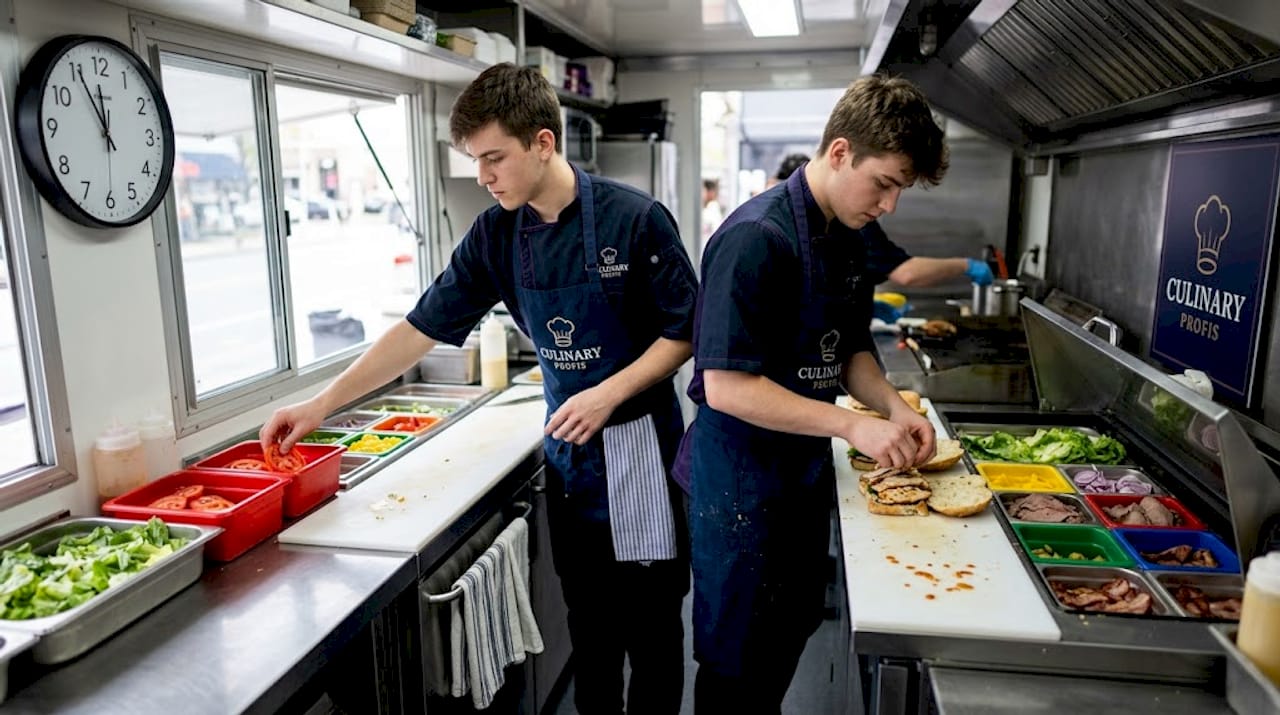
The island layout places a central cooking block in the middle of the kitchen, with prep and storage running along the perimeter walls. This gives the executive chef a direct sightline to every station. It works well in full-service restaurants with a confident brigade. It does require a larger square footage than a galley or assembly line configuration.
The zone/station layout is the workhorse of complex-menu operations. Each station handles a specific category: sauté, grill, pastry, garde manger. Workflow efficiency determines kitchen success more than equipment quality alone, and station-based layouts are built on that principle. The downside is coordination. Without a strong expeditor, tickets pile up at one station while others sit idle.

The galley layout runs two parallel lines of equipment facing each other or along a single wall. It is the default choice for space-constrained kitchens: ghost kitchens, food trucks, and commissary prep rooms. It is also the most prone to bottlenecks when more than two or three cooks work simultaneously.
Most operators make the same mistake: they pick equipment first, then try to fit a workflow around it. Workflow-first planning reduces cross-traffic and improves service speed. The right sequence is the opposite of what most people follow.
Here is a practical, step-by-step approach to planning your commercial kitchen flow:
Pro Tip: Use a scaled floor plan with paper cutouts or digital layout software before committing to any equipment purchase. Walking through your menu on paper takes less than an hour and prevents thousands of dollars in post-construction changes.
For guidance on equipment startup planning, Culinaryprofis offers detailed resources that align equipment selection directly with workflow requirements.
Regulatory compliance is not optional, and in 2026 it is more specific than most operators realize going in. Every layout decision you make either opens or closes the door to passing inspections and operating legally.
Here are the core compliance areas that directly affect your layout:
Treat your local health department as a design consultant, not an adversary. Request a pre-inspection meeting before construction begins. Inspectors will identify compliance gaps in your layout plan at no cost, and that conversation prevents the much higher cost of a failed opening inspection.
Understanding foodservice equipment sanitation standards is a prerequisite for any layout that passes its first health inspection without a corrective action list. These standards influence not just what equipment you buy, but how you space it, clean under it, and position it relative to walls and drains. You can also learn more about setting up institutional kitchen operations to see how zone-based planning applies at scale.
I have reviewed enough kitchen builds to know where the consistent failures happen. Most of them have nothing to do with the equipment.
The most expensive mistake I see is operators who fall in love with a piece of equipment before they have drawn a single traffic line. They buy a 10-burner range, position it against a wall for aesthetic reasons, and then discover their expediting station is on the opposite side of the kitchen. Every plate travels 15 feet more than it needs to, every service. Over a year, that is thousands of unnecessary steps and slower ticket times.
What I have found actually works is planning from clearances outward rather than from equipment inward. Start with your aisle paths, your door swings, your hood positions. The equipment fills in around those fixed constraints. This produces kitchens that feel like they have room to breathe even when fully staffed.
Ventilation and lighting are the two most overlooked elements in the early planning phase. Operators focus on cooking stations and refrigeration, which are visible and tangible. But a poorly placed hood means the chef standing at position three gets no capture, and the grease builds up in places it should not. Poor task lighting at prep stations leads to slower prep and more cutting errors. These are not finish decisions. They are structural decisions that must happen early.
The other thing I tell operators consistently: build for the kitchen you will have in three years, not just the one you are opening with. Catering trends and operational demands evolve, and a layout that has zero room to adapt forces an expensive remodel the moment your concept shifts. Leave intentional flex space. It costs very little upfront and pays back significantly when your menu or volume changes.
— John
If your layout planning has surfaced the equipment gaps in your current kitchen, Culinaryprofis has the professional-grade solutions to fill them.

From commercial combi ovens that fit both island and zone-station configurations to refrigeration units scaled for galley and full-service kitchens, the Culinaryprofis catalog is built for operators who know what they need. The AMPTO Rotorbake E2 combi oven delivers 16kW of output suited to high-volume cooking lines, while the AMPTO BISTROT 10T countertop combi handles 10-tray capacity in a compact footprint ideal for galley or space-constrained kitchens. Browse the full selection at Culinaryprofis and connect with their equipment support team to match your layout to the right gear.
A commercial kitchen layout is the planned spatial and functional organization of a kitchen into zones, designed to control food flow, staff movement, and compliance with safety standards. It covers everything from receiving and storage through cooking, plating, and warewashing.
Full-service restaurants typically allocate about 5 square feet of kitchen space per dining seat, with the kitchen representing 25 to 35 percent of total restaurant floor space. The actual requirement depends on menu complexity, service model, and staff count.
The primary layout types are assembly line, island, zone/station, galley, open, and hybrid. Each suits a different operation scale and menu type, from high-volume fast casual to complex full-service dining.
Minimum aisle width is 36 to 48 inches for general compliance, but 48 to 60 inches is the practical standard for aisles where two staff members need to pass simultaneously. Narrower aisles create safety hazards and bottlenecks during peak service.
Always plan your workflow and zone structure first, then select equipment to fit that plan. Choosing equipment first routinely leads to layout friction where food paths, staff movement, and waste routes intersect or force unnecessary backtracking.