
Why Induction Cooktops Dominate Professional Kitchens

Gas has ruled commercial kitchens for decades. But the argument for why induction cooktop professional kitchens represent the smarter choice is now backed by hard data, not just preference. Top-tier restaurants including The French Laundry have made the switch, and the numbers explain why: energy efficiency, precision temperature control, faster service, and measurable safety improvements. If you are evaluating your kitchen’s cooking technology or planning a capital equipment upgrade, this article covers the operational case for induction in detail, with the data to support each claim.
Table of Contents
- Key takeaways
- Why induction cooktop professional kitchens are winning on energy
- Speed, precision, and what they mean for kitchen flow
- Health, safety, and environmental impact in commercial settings
- Cleaning, maintenance, and daily operational savings
- My take on transitioning professional kitchens to induction
- Upgrade your commercial kitchen with Culinaryprofis
- FAQ
Key takeaways
| Point | Details |
|---|---|
| Energy efficiency is dramatic | Induction transfers 84 to 95% of energy to food versus 32 to 45% for gas burners. |
| Speed directly impacts productivity | Induction boils water 30 to 40% faster and delivers 3 to 5% productivity gains in busy kitchens. |
| Safety improvements are measurable | Induction reduces cooking-related fire risk by 89% and produces zero combustion emissions. |
| Cleaning time drops significantly | One documented case shows cleaning time cut from 24 minutes to 21 seconds per service. |
| Environmental compliance is easier | In 45 of 50 US states, induction cooking now produces fewer source emissions than gas. |
Why induction cooktop professional kitchens are winning on energy
The core reason induction outperforms gas starts at the physics level. Gas burners create an open flame that heats the air around the pan as much as the pan itself. Induction works differently: it generates an electromagnetic field that heats the ferrous metal in the cookware directly, with no intermediate step. Nothing is wasted heating the air.
The numbers are not marginal. Commercial induction cooktops achieve 84 to 95% energy transfer efficiency, compared to 32 to 45% for gas burners. Across a full kitchen operation, that gap compounds into real money. The same research shows induction reduces primary energy consumption per meal by 50 to 60%.
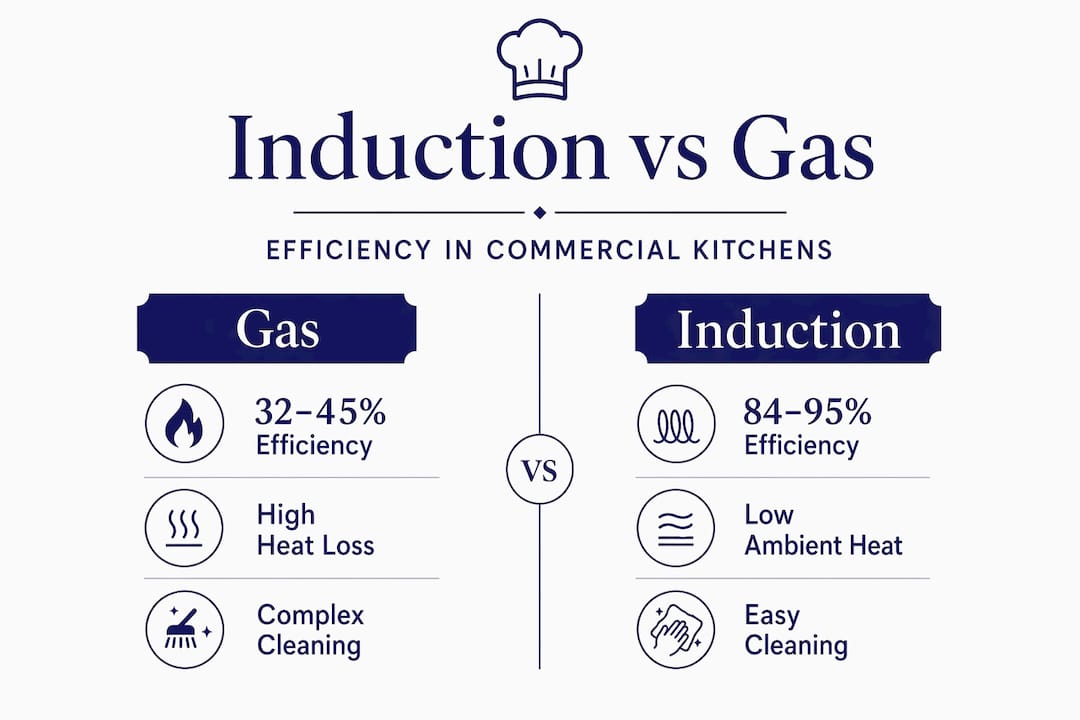
There is a secondary benefit that most operators overlook: ambient heat load. Kitchen heat output for gas runs at 3,000 to 5,000 Btu per hour per burner. For induction, that figure drops to 300 to 600 Btu per hour. With induction, kitchen ambient temperature stays up to 85% cooler, which directly cuts HVAC costs and makes the kitchen a more functional work environment during peak service hours.
| Metric | Gas | Induction |
|---|---|---|
| Energy transfer efficiency | 32–45% | 84–95% |
| Heat output (Btu/hr per burner) | 3,000–5,000 | 300–600 |
| Energy reduction per meal | Baseline | 50–60% less |
| Ambient temperature impact | High heat load | 85% cooler ambient |
Pro Tip: When switching to induction, audit your cookware first. Only ferromagnetic materials work: cast iron, carbon steel, and most stainless steel pans. Copper, aluminum, and glass will not heat. Replacing incompatible cookware before your first service saves time and avoids mid-shift problems.
Speed, precision, and what they mean for kitchen flow
Speed matters in commercial kitchens because every minute of lag costs money and affects the guest experience. Induction closes the gap in several ways that compound across a full service.
Water boils 30 to 40% faster on induction compared to gas, with documented times of 5 to 6 minutes versus 8 to 11 minutes for gas. That is not just a boiling water benchmark. It applies to sauces, stocks, and blanching operations that happen dozens of times per service. The sub-second response time means when you drop cold protein into a pan, heat recovery is near-instant instead of waiting for a flame to stabilize.
Precision is where induction separates itself from every gas burner on the market. Induction offers fine power adjustments from 100W to 3,700W with a response time of less than 0.1 seconds, compared to a thermal lag of 2 to 5 seconds for gas. The result is the ability to hold a delicate simmer at plus or minus 5°F accuracy. Chefs at top restaurants use this to replicate results across shifts without relying on individual cook intuition. The French Laundry uses temperature precision of ±0.5°C on induction versus ±8°C on gas.
Key operational benefits this delivers:
- Consistent output across shifts. When temperature is precise and repeatable, training new cooks becomes faster and quality control becomes measurable.
- Reduced chef interventions. Induction reduces cognitive load by eliminating flame-height estimation, cutting mental demand by 37% in workflow studies.
- Faster service completion. The same studies show 11.3% faster service completion and 44% fewer corrective actions compared to gas.
- Productivity gains at scale. Busy kitchens see 3 to 5% productivity gains from induction’s consistent heat recovery during high-frequency cooking.
Pro Tip: Use induction’s instant response to your advantage during protein cookery. Sear at full power, then drop the burner to 20 to 30% in under a second to rest the protein on the same surface. No moving pans, no resting on a cooler part of the range. It shortens plating time and keeps proteins juicier.
For a broader look at high-volume cooking performance across commercial equipment types, the data consistently points toward induction as the speed leader.
Health, safety, and environmental impact in commercial settings
This is where the case for induction becomes most urgent. Gas cooking is not just inefficient. It creates measurable health and safety risks that affect your staff every single day.
Gas stoves emit nitrogen dioxide at levels exceeding WHO guidelines in 78% of kitchen setups. In commercial kitchens, which are typically smaller and more densely occupied than residential spaces, those concentrations are higher and exposure is longer. Induction produces zero combustion byproducts. There is no flame, no combustion, no emissions inside the kitchen.
The fire risk reduction is equally significant. Induction reduces cooking-related fire risk by 89%. In a commercial context, that translates directly to lower insurance premiums, fewer incident reports, and reduced liability exposure. Burns from contact with heated surfaces are also cut sharply: induction surfaces remain below 200°F outside the cookware footprint, which means accidental contact with the cooktop surface does not produce the same injury as a gas range or traditional electric coil.
“Chefs switching to induction report not only speed benefits but improved kitchen comfort, safety, and cleaner air quality, leading to better staff wellbeing.” — British Safety Council
The environmental case has also strengthened over time. As the grid decarbonizes, induction’s carbon advantage grows. In 45 of 50 US states, induction cooking now produces fewer lifecycle emissions than gas when source emissions are counted. Regulatory momentum in several cities and states is already pushing foodservice operators toward electrification. Getting ahead of that curve with induction infrastructure positions your kitchen well for future compliance requirements, and it signals to environmentally conscious guests and staff that your operation is serious about its impact.
Equipment like the AccuTemp tilting skillet demonstrates how modern electric commercial equipment integrates precision and safety without compromising output capacity.
Cleaning, maintenance, and daily operational savings
Time spent cleaning gas equipment is a genuine operational cost. Gas burners have grates, multiple ports, drip pans, and igniter components. Each of these requires regular disassembly, scrubbing, and reassembly. Multiply that across a busy service and the labor cost is significant.
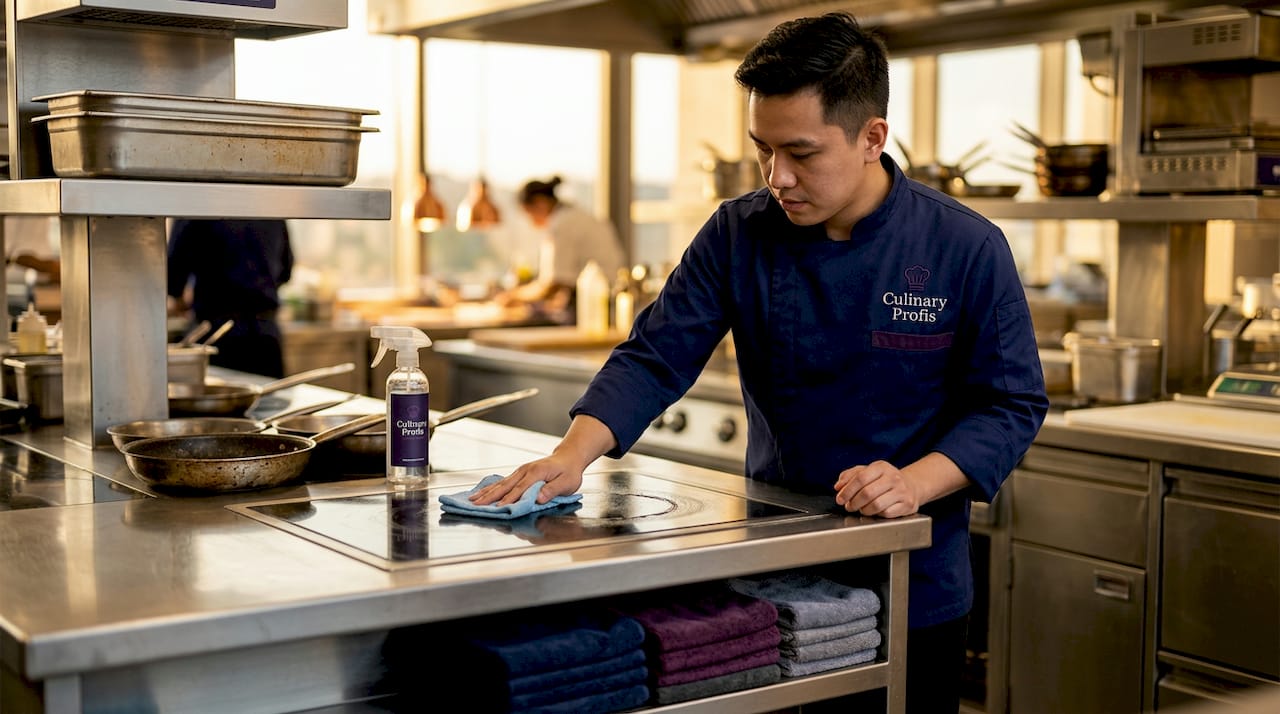
Induction surfaces are flat glass ceramic. Spills do not bake on because the surface adjacent to the cookware never gets hot enough to cook food onto it. The documented difference is stark: one chef reduced cleaning time from 24 minutes per service on gas to 21 seconds on induction. Over a full year, this particular case study calculated savings of over £15,000 in cleaning labor costs alone.
Beyond cleaning, maintenance intervals on induction equipment are longer. Electronic controls have fewer moving mechanical parts than flame-based systems. There are no thermocouples to replace, no gas jets to clean, and no igniter systems to troubleshoot. For kitchen managers, this means fewer equipment-related service calls and more predictable maintenance schedules.
| Task | Gas | Induction |
|---|---|---|
| Post-service surface cleaning | 20 to 30 minutes per unit | Under 1 minute per unit |
| Burner component disassembly | Required regularly | Not applicable |
| Ignition system maintenance | Periodic replacement | Not applicable |
| HVAC load contribution | High | Significantly lower |
| Burn injury risk from surface contact | High | Minimal |
Understanding how duty cycles and equipment load affect long-term costs is equally relevant to commercial oven selection and can inform how you plan an induction integration alongside other equipment upgrades.
My take on transitioning professional kitchens to induction
I’ve spoken with kitchen professionals at every level about induction, and the pattern is consistent. Initial skepticism followed by reluctant adoption followed by genuine advocacy.
The most common objection I hear is about control: chefs trained on gas trust the visual feedback of a flame. What they discover after a few weeks on induction is that precision controls give them more real control, not less. Flame height is an approximation. A power setting with a sub-second response is not.
What gets underestimated most is the staff impact. Cooler kitchens, cleaner air, fewer burns. That directly affects retention, which is one of the most expensive problems in commercial foodservice right now. I’ve seen operations justify the entire cost of an induction conversion through reduced staff turnover in the first year.
The investment is real. Cookware replacement, electrical infrastructure upgrades, and staff retraining all carry costs. But the operational savings stack quickly: lower energy bills, lower HVAC costs, lower cleaning labor, lower insurance premiums, and fewer equipment service calls. The kitchens I’ve watched make the switch stop asking whether it was worth it within the first six months.
The ones who wait longest are usually the ones who stay closest to the assumption that gas is the professional standard. The data says otherwise.
— John
Upgrade your commercial kitchen with Culinaryprofis

Culinaryprofis stocks a full range of commercial-grade electric and induction cooking equipment built for professional kitchens. Whether you are equipping a new restaurant, replacing aging gas equipment, or expanding a catering operation, the product catalog includes options across every service volume and kitchen footprint.
For bulk procurement or multi-unit buildouts, Culinaryprofis provides expert support to help you spec equipment correctly the first time. The team is available to walk you through product options, compatibility requirements, and procurement timelines.
Explore the full range at Culinaryprofis and find commercial electric cooking equipment including tilting kettles from AccuTemp Edge Series for high-volume operations. For larger kitchen projects, review the bulk appliance procurement guide before you begin sourcing. Free shipping and flexible return policies apply across orders. Call Culinaryprofis NOW to speak with a kitchen equipment specialist.
FAQ
Why do professional kitchens use induction cooktops?
Professional kitchens use induction for its energy efficiency (84 to 95% energy transfer), faster boil times, precise temperature control down to ±0.5°C, and significant reductions in fire risk and kitchen heat load.
How does induction compare to gas for speed and precision?
Induction boils water 30 to 40% faster than gas and responds to power changes in under 0.1 seconds versus a 2 to 5 second thermal lag for gas, allowing far more precise heat management during service.
Is induction cooking safer for kitchen staff?
Yes. Induction produces zero combustion emissions, reduces cooking-related fire risk by 89%, and keeps surface temperatures low outside the cookware footprint, cutting burn injury risk significantly.
What does induction save on cleaning and maintenance?
One documented case study shows cleaning time dropping from 24 minutes per service on gas to 21 seconds on induction, with annual cleaning labor savings exceeding £15,000 in that operation.
Is induction better for the environment than gas in commercial kitchens?
In 45 of 50 US states, induction cooking now generates fewer lifecycle emissions than gas when grid source emissions are included, and the advantage grows as electrical grids continue to decarbonize.