

Call us NOW


The food prep tools every home cook needs are defined by one standard: they must earn their place on the counter every single day. A sharp chef’s knife, a stable cutting board, reliable storage containers, and a digital kitchen scale form the non-negotiable core of any serious home kitchen. Multipurpose tools drive efficiency far better than drawers full of single-use gadgets. The difference between a frustrating cooking session and a smooth one almost always comes down to whether your prep equipment is up to the task.
A sharp chef’s knife is the one piece of food preparation equipment that replaces more single-use gadgets than anything else in the kitchen. It minces, slices, dices, breaks down poultry, and crushes garlic with the flat of the blade. Food & Wine recommends investing in a quality chef’s knife and Dutch oven over any collection of marketing-driven unitaskers, and that advice holds up in practice every time.
When selecting a knife, weight, balance, and grip matter as much as blade steel. A well-balanced 8-inch chef’s knife in high-carbon stainless steel handles the widest range of tasks for most home cooks. For guidance on choosing the right knife, prioritize full-tang construction, a comfortable handle material, and a blade that holds an edge through regular use.
Pro Tip: A sharp knife is safer than a dull one. A dull blade requires more force, which increases the risk of slipping. Sharpen before you need to, not after you notice the problem.
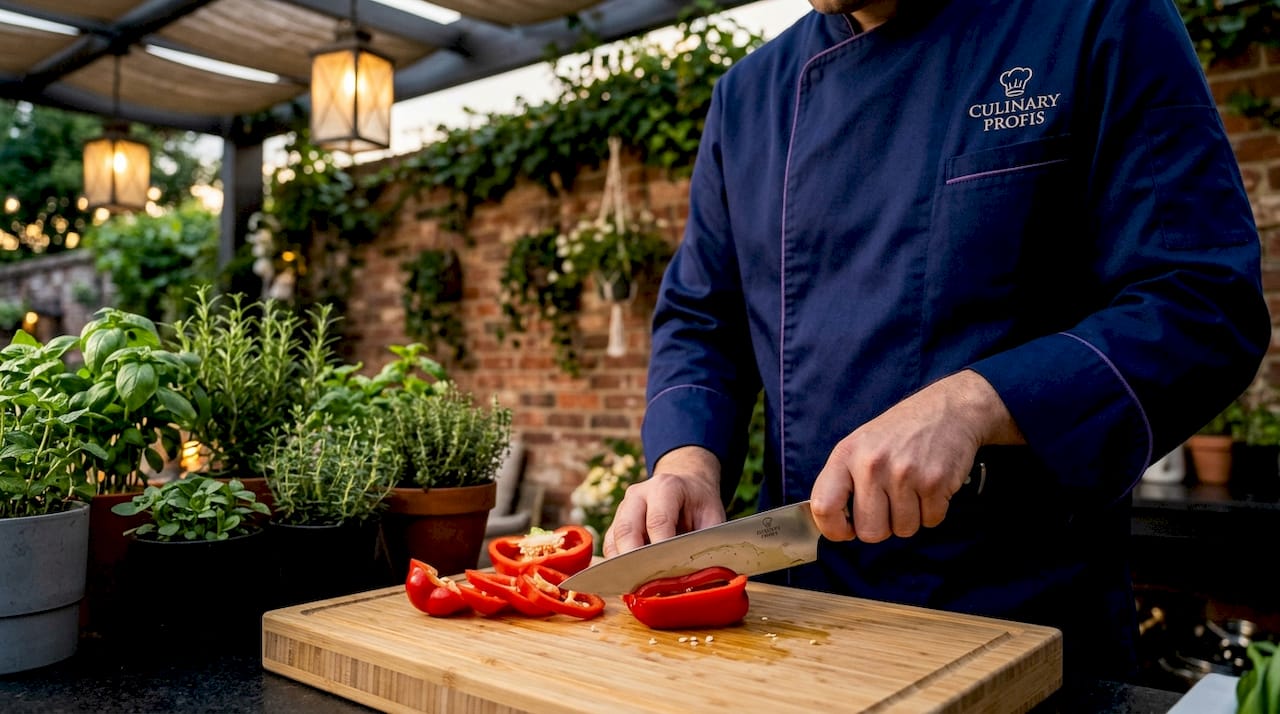
A cutting board is not a passive surface. It directly affects knife performance, prep speed, and food safety. Wood and plastic boards each have clear use cases: end-grain wood boards are gentle on knife edges and self-healing over time, while plastic boards are dishwasher-safe and better suited for raw meat to prevent cross-contamination.
The board must be large enough to work without ingredients falling off the edge. A minimum of 12 by 18 inches gives you room to prep multiple components without stopping to clear the surface. Pair your board with a damp towel underneath to prevent sliding, which is one of the most common causes of prep-related injuries at home.
Hartford Hospital recommends sturdy, tightly sealing food storage containers as a core part of any meal prep setup, alongside measured cups, spoons, and prep tools like sharp knives. The container you choose should handle the full cycle from fridge to freezer to microwave without requiring you to transfer food between vessels. IKEA’s 365+ containers document microwave, freezer, dishwasher, and oven-safe ratings separately, which is the right way to evaluate any container before buying.
Stackability reduces clutter and makes refrigerator organization practical rather than aspirational. Glass containers add weight but offer better odor resistance and visibility. BPA-free plastic containers are lighter and more practical for packed lunches or on-the-go meal prep. Buy containers certified for full use cycles to avoid owning multiple sets for different stages of food storage and reheating.
Pro Tip: Glass containers with snap-lock lids are worth the extra cost if you reheat food directly in the container. They eliminate the transfer step and reduce dishes.
A digital kitchen scale removes the single biggest source of inconsistency in home cooking: eyeballing measurements. Serious Eats endorses scales for reliable meal prep portioning across multiple days, specifically highlighting digital designs with pull-out displays for better usability. This matters most when you are cooking proteins to specific weights, baking, or dividing meals into equal portions for the week.
The ThermoWorks Gravitas addresses one of the most overlooked ergonomic problems in kitchen scales. Its wireless, removable backlit display solves the obstructed-view problem that occurs when a large mixing bowl blocks the readout. That single design feature makes consistent weighing far more practical in real kitchen conditions. Look for a scale with a minimum resolution of 1 gram, a capacity of at least 11 pounds, and a tare function that resets to zero with each addition.
Measured cups and spoons remain the most practical tools for liquid and small-quantity measurements in everyday cooking. A full set of dry measuring cups (1/4, 1/3, 1/2, and 1 cup) plus a set of measuring spoons handles the majority of recipe requirements. Stainless steel sets outlast plastic versions and resist warping from repeated dishwasher cycles.
Liquid measuring cups with clear markings at eye level, such as those from OXO or Pyrex, prevent the parallax error that causes inaccurate readings when you look down at an angle. For baking, a scale is more accurate than cups for flour and sugar. For spices, herbs, and small liquid additions, measured spoons remain the fastest and most practical option.
These three tools address specific prep bottlenecks that slow down cooking sessions more than most home cooks realize.
A mandoline produces uniform slices in seconds that would take minutes with a knife, but it demands respect. Delish’s food director advises always using the safety guard and cut-resistant gloves, applying light pressure for control. Treat the safety guard as part of the tool itself, not an optional accessory. A mandoline without its guard in use is a liability, not an asset.
An instant-read thermometer is the single most reliable tool for confirming doneness and food safety. USDA temperature guidelines require thermometer validation because visual cues like color are unreliable indicators of safe internal temperature. A chicken breast that looks done can still be undercooked at the center, and a steak that looks overcooked may still be at the correct temperature for carryover cooking.
Thermometers with 2 to 4 second read times are far more practical than slower models because they support frequent checks without disrupting cooking flow. The ThermoWorks Thermapen is the benchmark for speed and accuracy in this category. Check temperature in the thickest part of the protein, away from bone, and take readings in multiple spots for large cuts.
“The best thermometer is the one you actually use. If it’s slow, awkward, or hard to read, you’ll skip the check and guess instead.” — Sobremesa Press
Sur La Table’s chef-recommended essentials include silicone spatulas, tongs, whisks, a microplane, a bench scraper, and a spice mill as the core utensil set for daily cooking. Each of these tools handles multiple tasks. A bench scraper transfers chopped vegetables from board to pan, portions dough, and cleans the board surface in one motion. A microplane zests citrus, grates hard cheese, and shaves chocolate with equal precision.
Silicone spatulas in two sizes (small and large) cover folding, scraping bowls, and stirring sauces without scratching nonstick surfaces. Tongs function as an extension of your hand for turning proteins, tossing pasta, and plating. A balloon whisk handles vinaigrettes, eggs, and sauces. These are the tools that support daily cooking efficiency without adding clutter to the drawer.
The most practical way to evaluate any kitchen tool is to ask how many tasks it handles and how often you will reach for it.
| Tool | Tasks covered | Daily use? | Replaces |
|---|---|---|---|
| Chef’s knife | Slicing, dicing, mincing, breaking down | Yes | Mezzalunas, choppers, slicers |
| Dutch oven | Braising, soups, frying, baking bread | Yes | Slow cookers, fryers, stockpots |
| Sheet pan | Roasting, baking, broiling | Yes | Roasting pans, pizza stones |
| Mandoline | Uniform slicing only | Occasional | None |
| Avocado slicer | One task | Rarely | Chef’s knife handles it |
Food & Wine warns against accumulating unitaskers driven by marketing rather than genuine need. The Dutch oven and sheet pan are the two most underrated multitaskers in the home kitchen. A quality sheet pan from Nordic Ware or USA Pan handles everything from roasted vegetables to sheet-cake baking without requiring a separate tool for each task.
Pro Tip: Before buying any new kitchen gadget, ask whether your chef’s knife, a sheet pan, or a Dutch oven can do the same job. If the answer is yes, skip the gadget.
The most effective home kitchen toolkit is built on multipurpose tools used daily, not a collection of specialized gadgets used rarely.
| Point | Details |
|---|---|
| Start with a sharp chef’s knife | A quality 8-inch chef’s knife in high-carbon stainless steel handles more tasks than any other single tool. |
| Use containers rated for full use cycles | Buy containers certified for fridge, freezer, microwave, and oven to eliminate redundant sets. |
| Weigh ingredients for consistency | A digital scale with a tare function removes guesswork from portioning and improves recipe repeatability. |
| Always use a thermometer | USDA safe temperatures require thermometer validation because color and texture are unreliable doneness indicators. |
| Prioritize multitaskers over unitaskers | A Dutch oven, sheet pan, and chef’s knife cover more workflows than a drawer full of single-use gadgets. |
The most common mistake I see home cooks make is buying tools reactively, after a specific recipe calls for something. That approach fills drawers with items used once and forgotten. The better method is to identify the three or four prep tasks that slow you down most and solve those gaps with quality tools that earn daily use.
A sharp knife and a reliable thermometer have prevented more cooking failures in my experience than any other two tools combined. The knife because prep speed and precision set the tone for everything that follows. The thermometer because confidence in doneness removes the guesswork that leads to overcooked proteins and food safety risks.
I also think home cooks underestimate the value of a good bench scraper and a digital scale. Neither looks impressive, but both remove friction from repetitive tasks in ways that compound over hundreds of cooking sessions. Thoughtful kitchen toolkits grow by addressing specific gaps rather than chasing trends. Buy fewer tools, buy better ones, and use them until they become second nature.
The goal is not a fully equipped kitchen. The goal is a kitchen where every tool you reach for is exactly right for the task.
— John

Culinaryprofis carries commercial-grade food prep equipment built for cooks who take their kitchen seriously. From professional chef’s knives and precision scales to heavy-duty cutting boards and smallwares, the catalog covers the full range of essential prep equipment that serious home cooks and foodservice professionals rely on daily. Every product is selected for durability, performance, and daily use, not for shelf appeal. Free shipping, a flexible return policy, and expert support make it straightforward to build the toolkit you actually need. Browse the full catalog at Culinaryprofis and find the tools that match your cooking workflow.
A sharp chef’s knife is the most important food prep tool for home cooks. It handles more tasks than any other single piece of equipment and directly affects prep speed, safety, and cooking quality.
Choose containers rated for fridge, freezer, microwave, and oven use to cover the full food storage and reheating cycle without needing multiple sets. Rectangular shapes stack more efficiently than round ones.
A digital kitchen scale removes measurement inconsistency by replacing volume estimates with precise weights. Serious Eats recommends scales specifically for meal prep portioning because they produce consistent results across multiple cooking sessions.
Mandolines are safe when used with the safety guard and cut-resistant gloves on every pass. Delish’s food director states that the guard is not optional. Treating it as an integral part of the tool prevents the majority of mandoline injuries.
A multipurpose tool handles several cooking tasks and earns daily use, such as a Dutch oven or chef’s knife. A unitasker performs one function and sits unused most of the time. Food & Wine recommends building a kitchen around multipurpose classics to reduce clutter and improve daily cooking efficiency.