

Call us NOW


Equipment depreciation is one of the most misunderstood financial tools in the restaurant industry. Most owners treat it as a bookkeeping formality. In reality, understanding why equipment depreciation matters for restaurants has a direct effect on your tax bill, cash flow, and capital planning. The IRS gives restaurant operators real opportunities to write off major equipment costs faster than ever, especially under current 2026 tax rules. If you are not actively managing depreciation, you are almost certainly leaving money on the table.
| Point | Details |
|---|---|
| Depreciation drives tax savings | Accelerated deductions under Section 179 and bonus depreciation can eliminate large portions of your taxable income in year one. |
| Placed-in-service date controls timing | The IRS starts the depreciation clock when equipment is ready for use, not when you buy or receive it. |
| Cost segregation speeds deductions | Reclassifying remodel assets into shorter-lived categories significantly increases first-year write-offs. |
| Bonus depreciation beats Section 179 at a loss | Unlike Section 179, bonus depreciation can create a net operating loss, giving you more flexibility in lean years. |
| Tracking depreciation protects your finances | Accurate depreciation schedules support lender confidence, replacement budgeting, and accurate profit reporting. |
Depreciation, in formal accounting terms, is the method of allocating the cost of a tangible asset over its useful life. For restaurant owners, the more practical definition is this: depreciation is how you convert a large capital purchase into a series of deductions that reduce your taxable income year after year. Or, under accelerated methods, all at once.
The IRS uses the Modified Accelerated Cost Recovery System (MACRS) to assign recovery periods to different asset types. Restaurant-specific capital assets such as kitchen equipment, point-of-sale systems, furniture, and qualified improvement property mostly fall into shorter MACRS categories, meaning faster deductions.
Two tools speed this up further:
This distinction matters more than most owners realize. Bonus depreciation can create a net operating loss, which you can carry forward to offset future income. Section 179 cannot. If your restaurant had a rough year, bonus depreciation may still deliver value. Section 179 may not.
Pro Tip: Track your asset purchases by category from day one. Kitchen equipment, POS hardware, and fixtures each fall under different MACRS classes. Mixing them together under a single line item makes accurate depreciation almost impossible later.
The IRS defines the placed-in-service date as the point when equipment is ready and available for use. Not when you ordered it, not when it arrived on a truck. Depreciation begins at placed-in-service, and this distinction has real financial consequences.
Here is why timing controls so much of the benefit:
Pro Tip: Keep a placed-in-service log for every asset. Record the purchase date, delivery date, installation completion date, and the date the unit passed any required safety or commissioning checks. This documentation is your defense in an audit and your roadmap for accurate deduction timing.
Most restaurant owners are familiar with standard depreciation schedules. Fewer know about cost segregation, and that gap is expensive.
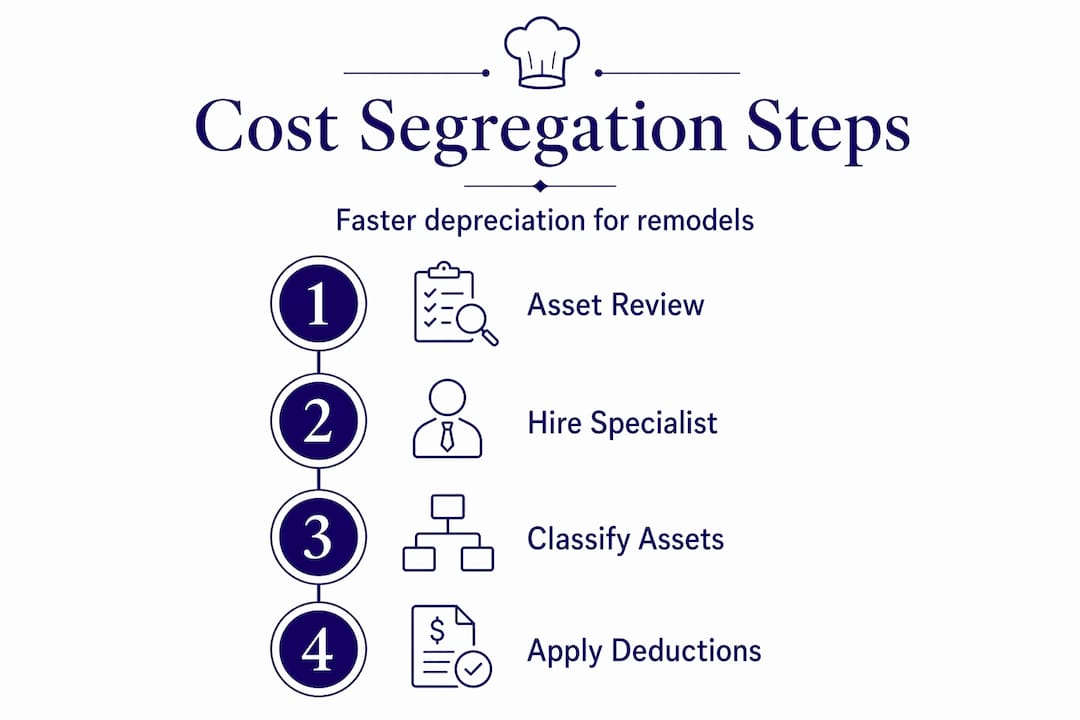
Cost segregation is a tax strategy that involves hiring a qualified engineer or tax professional to reclassify portions of a building or remodel project into shorter-lived asset categories. Instead of depreciating everything over 39 years as standard commercial real property, you identify components that qualify as 5-year, 7-year, or 15-year property and apply bonus depreciation to them immediately.
Cost segregation studies can shift 40% or more of remodel assets into shorter-lived property classes. For a $500,000 remodel, that means $200,000 or more in assets could qualify for year-one expensing rather than 39-year straight-line depreciation.
| Asset type | Standard depreciation | With cost segregation |
|---|---|---|
| Kitchen equipment | 5-7 years (MACRS) | Qualifies for 100% bonus depreciation |
| Restaurant fixtures and millwork | 39 years (building) | Reclassified to 15-year property |
| Decorative lighting and flooring | 39 years (building) | Reclassified to 5 or 7-year property |
| Qualified improvement property | 15 years | Eligible for bonus depreciation |
| HVAC and plumbing (dedicated to kitchen) | 39 years (building) | Reclassified to 15-year property |
The key to maximizing this strategy during a remodel is planning before construction starts. Once assets are in place, reclassification is still possible but harder to document. Knowing which components will be segregated lets your contractor track costs in a way that supports the study.
When you pair cost segregation with bonus depreciation under the current rules, even a mid-size restaurant renovation can produce significant first-year federal deductions. That is real cash returned to the business faster.
Depreciation is not only a tax tool. It is a fundamental part of accurate financial reporting, and ignoring it distorts the numbers you and your lenders rely on.

When you purchase a $60,000 walk-in refrigeration unit, the cash leaves your account. But the economic benefit of that unit stretches across years of operation. Depreciation aligns equipment costs with the revenue periods they support, giving you a more accurate picture of actual profitability rather than a dramatic dip in the year of purchase.
Here is what proper depreciation tracking supports in day-to-day restaurant financial management:
For practical guidance on planning equipment expenses from the start, the restaurant equipment planning guide from Culinaryprofis walks through how to align capital purchases with your financial structure.
Several persistent misunderstandings prevent restaurant operators from getting full value from their depreciation strategy.
Depreciation planning should reflect real operational upgrades. Purchasing equipment primarily for the tax deduction, without a genuine operational need, is a strategy that professional advisors caution against.
Good recordkeeping is the foundation of all of this. Maintain purchase invoices, delivery confirmations, installation records, and any commissioning documentation for every asset. If the IRS questions a placed-in-service date, your records are your evidence. When the numbers get complex, particularly for multi-location operators or large remodels, a qualified CPA with restaurant industry experience is worth the fee many times over.
I have seen restaurant owners treat depreciation like a line item that exists to satisfy the accountant. That framing costs real money.
The operators who get this right think about placed-in-service dates the same way they think about food cost percentages. They plan for it, track it, and act on it before the tax year closes. A kitchen remodel that finishes in late December with careful asset-by-asset tracking looks very different on a tax return than one where someone just picked an arbitrary completion date in January.
What I have observed is that the timing of deductions has the most outsized impact in tight-margin years, which describes most restaurants most of the time. Recovering $30,000 in federal tax savings from a well-timed equipment purchase is not theoretical. It is real working capital that can fund a second prep cook, a refrigeration repair, or a deposit on a second location.
The restaurants I have seen mismanage this almost always have the same problem: they make purchase decisions and call the accountant afterward. Depreciation planning does not work that way. You have to decide which method applies, confirm the placed-in-service date in writing, and document the asset classification before you file.
View depreciation as a proactive tool. Not a compliance checkbox.
— John
Culinaryprofis supplies commercial-grade kitchen equipment built for restaurant operations, including ovens, refrigeration units, meat processing machinery, and cooking appliances designed to meet professional performance standards. Every piece of equipment you purchase and place in service correctly becomes an asset you can depreciate, and under current rules, potentially write off in full in year one.
Explore the commercial kitchen equipment catalog to find appliances that fit your operation and your replacement schedule. For high-output kitchens, the AMPTO Rotorbake E2 combi oven and the Pro-Cut KG-32-XP meat grinder are both qualifying assets under current bonus depreciation rules. Need help selecting the right equipment? Culinaryprofis expert support is available to guide your procurement decisions. Call us now.
Depreciation is the process of deducting the cost of equipment across its useful life, or all at once under accelerated methods like bonus depreciation. For restaurants, it reduces taxable income and supports accurate financial reporting.
The placed-in-service date is when equipment is ready and available for use, not when it was purchased or delivered. The IRS uses this date to determine which tax year a depreciation deduction applies to.
Bonus depreciation allows a 100% first-year deduction with no income limit and can generate a net operating loss. Section 179 is capped by your taxable income for the year, making it less useful for restaurants with low or negative profits.
Yes. Through cost segregation, remodel assets can be reclassified into shorter-lived property categories and paired with bonus depreciation for large first-year deductions, potentially covering 40% or more of total project costs.
Most states do not conform to the federal 100% bonus depreciation or elevated Section 179 limits. Multi-state restaurant operators should model both federal and state outcomes separately before relying on a depreciation strategy.