

Call us NOW


Kitchen small wares are defined as the hand-held, non-electrical tools and supplies that form the operational backbone of any professional kitchen. These are the items that directly touch food, determine prep speed, and control contamination risk on every shift. A restaurant startup equipment plan that overlooks small wares in favor of large appliances will produce a kitchen that stalls at service. The small wares every professional kitchen needs include knife sets, color-coded cutting boards, precision thermometers like the ThermoWorks Thermapen ONE, mixing bowls, sheet pans, and NSF-certified storage containers. Get these right, and the rest of the kitchen functions.
A complete commercial kitchen requires a defined set of small wares before service can begin. These are not optional upgrades. They are the tools that determine whether prep runs on schedule, food safety standards hold, and staff can work without interruption.
The non-negotiable list includes:
Pro Tip: Plan a 15 to 20% reserve on high-breakage items like thermometers, mixing bowls, and cutting boards. Running out mid-service because a board cracked or a thermometer failed is an avoidable operational failure.
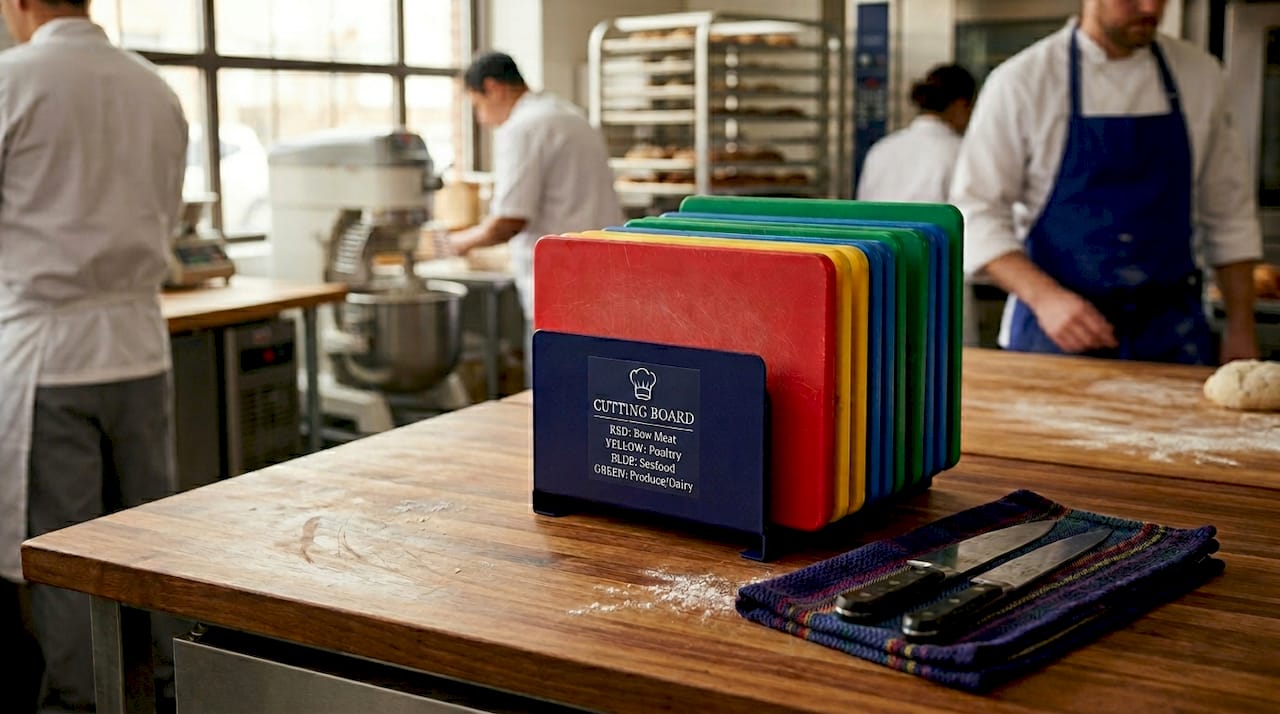
Color-coded cutting board systems reduce cross-contamination risk by up to 85% when properly implemented. That figure reflects the difference between a kitchen that assigns boards by color and one that relies on staff memory or visual inspection alone. The color system removes ambiguity from one of the highest-risk steps in food prep.
The standard six-color system works as follows: red for raw beef, yellow for raw poultry, blue for raw seafood, green for produce, white for dairy and bread, and brown for cooked meats. Each color maps to a dedicated zone in the kitchen, which aligns directly with HACCP zoning requirements. HACCP-guided stations use this zoning to prevent pathogen transfer between raw and ready-to-eat foods. The system only works when the zoning is enforced, not just labeled.
Board material matters as much as color. HDPE boards resist knife scarring better than wood, do not absorb moisture, and can be sanitized in commercial dishwashers. Boards should be at least half an inch thick to resist warping under heavy use. Size selection should match the task: a 12x18 inch board for individual prep work, an 18x24 inch board for breaking down whole proteins.
Storage protocol is where most kitchens fail. Wet stacking or improper storage after cleaning recontaminates boards before the next service. Each color should have a dedicated vertical rack, positioned away from raw protein zones, with boards stored face-out and air-dried completely before reuse.
Pro Tip: Label the storage rack with the same color coding as the boards. New staff can follow the system correctly from day one without requiring verbal instruction on every shift.
The ThermoWorks Thermapen ONE is the industry standard for professional kitchens because it delivers ±0.5°F accuracy with a one-second read time and carries a NIST-traceable calibration certificate. That calibration certificate matters during health inspections. An inspector who asks for proof of thermometer accuracy gets a documented answer, not a verbal assurance.
The Thermapen ONE covers a temperature range of -58°F to 572°F, which covers every cooking application from frozen storage checks to searing verification. Its IP67 waterproof rating means it survives full submersion, a realistic scenario in a busy kitchen. The rotating probe and automatic backlight address the practical realities of working in tight spaces and low-light conditions during service.
“Fast, accurate thermometers are as vital to staff efficiency as to compliance with safety standards.” — ThermoWorks
Having at least two thermometers per station eliminates the bottleneck that occurs when one unit is in use and another cook needs a temperature check. During peak service, a 30-second wait for a thermometer translates directly into overcooked proteins and delayed tickets. Multiple units on hand function as throughput tools, not just safety instruments.
Cheaper thermometers with 5 to 10 second read times and ±2°F accuracy create compounding errors across a service. A cook checking 40 proteins per shift loses significant time and risks serving food outside safe temperature ranges. The upfront cost of a professional-grade thermometer pays back within weeks of consistent use.
Comprehensive utensil selection starts with function, not brand. Every station needs peelers, box graters, ladles in graduated sizes, fish spatulas, rubber spatulas, and balloon whisks. These are the professional cooking utensils that execute the actual work of a recipe. Gaps in this list force cooks to improvise, which slows service and increases error rates.
Food storage containers require NSF certification and stackable lids. The most practical system uses clear polycarbonate containers in 1/6, 1/3, 1/2, and full pan sizes, which fit directly into standard prep table inserts. This eliminates the transfer step between prep and service. Lids should be interchangeable across the same brand line.
The table below compares the two most common storage container materials used in professional kitchens:
| Feature | Polycarbonate | Stainless Steel |
|---|---|---|
| Visibility | Clear, easy to identify contents | Opaque, requires labeling |
| Durability | Resists cracking, not heat-proof | Withstands high heat and impact |
| Weight | Lightweight, easy to handle | Heavier, more durable long-term |
| Cost | Lower upfront cost | Higher upfront, longer lifespan |
| Best use | Cold prep, line service | Hot holding, stock storage |
Standardizing brands and models across your small wares inventory reduces confusion during replacement ordering and simplifies staff training. When every ladle in the kitchen is the same brand and size, a new cook does not need to recalibrate portion expectations. Consistency in tools produces consistency in output.
Pro Tip: Assign dedicated storage zones for each utensil category and label the zone, not just the tool. When a tool is missing from its zone during prep, the gap is visible immediately. This prevents the mid-service scramble that costs time and focus.
Front-of-house small wares directly represent the restaurant’s identity to every guest. Dinnerware, glassware, and flatware are not afterthoughts. They communicate service level before a single dish is tasted.
Key front-of-house small wares include:
Replacement scheduling prevents service interruptions. Track breakage by category monthly and reorder before stock drops below a two-week buffer. Front-of-house and back-of-house small wares should be sourced from the same supplier where possible. This simplifies ordering, reduces lead times, and gives your team a single point of contact for restocking. Coordinating kitchen equipment essentials across both sides of the operation produces a more organized and cost-efficient supply chain.
Professional kitchens require NSF-certified small wares, redundancy planning, and strict color-coded zoning to maintain food safety, throughput, and operational consistency across every service.
| Point | Details |
|---|---|
| Start with the non-negotiables | Knife sets, cutting boards, thermometers, sheet pans, and cookware must be in place before service begins. |
| Color-coding prevents contamination | A six-color HDPE board system reduces cross-contamination risk by up to 85% when paired with dedicated storage racks. |
| Thermometer accuracy is compliance | The ThermoWorks Thermapen ONE provides ±0.5°F accuracy and NIST-traceable calibration for HACCP inspections. |
| Standardize for consistency | Matching brands and sizes across utensils and storage containers reduces training time and reorder errors. |
| Plan for redundancy | A 15 to 20% reserve on high-breakage items prevents mid-service shortages that disrupt output and safety. |
Most kitchen operators spend months selecting their range, oven, and refrigeration units, then rush the small wares order in the final week before opening. That sequence is backwards. The tools that touch food on every single ticket are the ones that determine whether your kitchen runs or stalls.
The single most impactful change I have seen in kitchen operations is standardization. When every station uses the same ladle sizes, the same cutting board system, and the same thermometer model, the kitchen becomes self-correcting. Staff know where tools belong, how they perform, and how to replace them. Variation in tools creates variation in output.
Redundancy is not waste. A spare set of color-coded boards and two extra thermometers per station cost less than one failed health inspection or one service where the line stops because a thermometer battery died. The kitchens that run smoothly are the ones that planned for failure before it happened.
My recommendation: source your small wares from a supplier who stocks the same models consistently. Chasing substitutes every time you reorder is a hidden operational cost that most operators do not track until it becomes a real problem.
— John
Culinaryprofis carries a full range of NSF-certified small wares built for professional kitchen demands. From complete knife sets and color-coded cutting boards to precision thermometers and commercial-grade cookware, the catalog covers every item on your must-have kitchen supplies list. Products are sourced from trusted brands and stocked for consistent availability, so your reorder process stays simple. The team provides expert support to help you spec the right tools for your operation, whether you are outfitting a new restaurant or replacing worn inventory. Visit Culinaryprofis to shop professional kitchen equipment with free shipping and a flexible return policy.
Kitchen small wares are the hand-held, non-electrical tools and supplies used in food preparation and service, including knives, cutting boards, thermometers, utensils, and storage containers. They are distinct from large equipment like ovens and refrigeration units.
A professional kitchen needs at least one board per color in the six-color system, plus a 15 to 20% reserve for breakage. High-volume stations benefit from two boards per color to maintain workflow during peak service.
HACCP requires documented proof that food reaches safe internal temperatures. The ThermoWorks Thermapen ONE provides ±0.5°F accuracy and a NIST-traceable calibration certificate, which satisfies inspection requirements and reduces liability.
High-density polyethylene (HDPE) is the preferred material for professional cutting boards. It resists knife scarring, does not absorb moisture, and withstands commercial dishwasher sanitization cycles without warping.
High-use items like cutting boards and thermometers should be inspected monthly and replaced when physical damage, deep scarring, or calibration drift is detected. Flatware and dinnerware replacement should be tracked against breakage logs and restocked before inventory drops below a two-week buffer.