
Negotiate Bulk Kitchen Equipment Pricing in 2026

Bulk kitchen equipment pricing negotiation is the practice of securing volume-based discounts, favorable contract terms, and direct-source pricing on commercial kitchen purchases. For restaurant owners and managers, it is one of the most direct ways to cut capital costs without sacrificing equipment quality. Standard volume discount tiers run from 4% on orders of 5–9 units up to 20% below wholesale on container loads. Beyond price, skilled negotiators also lock in payment terms, price caps, and substitution rules that protect margins over the life of a contract. This guide covers how to negotiate bulk kitchen equipment pricing from preparation through contract execution.
What volume-based discounts exist for commercial kitchen equipment?
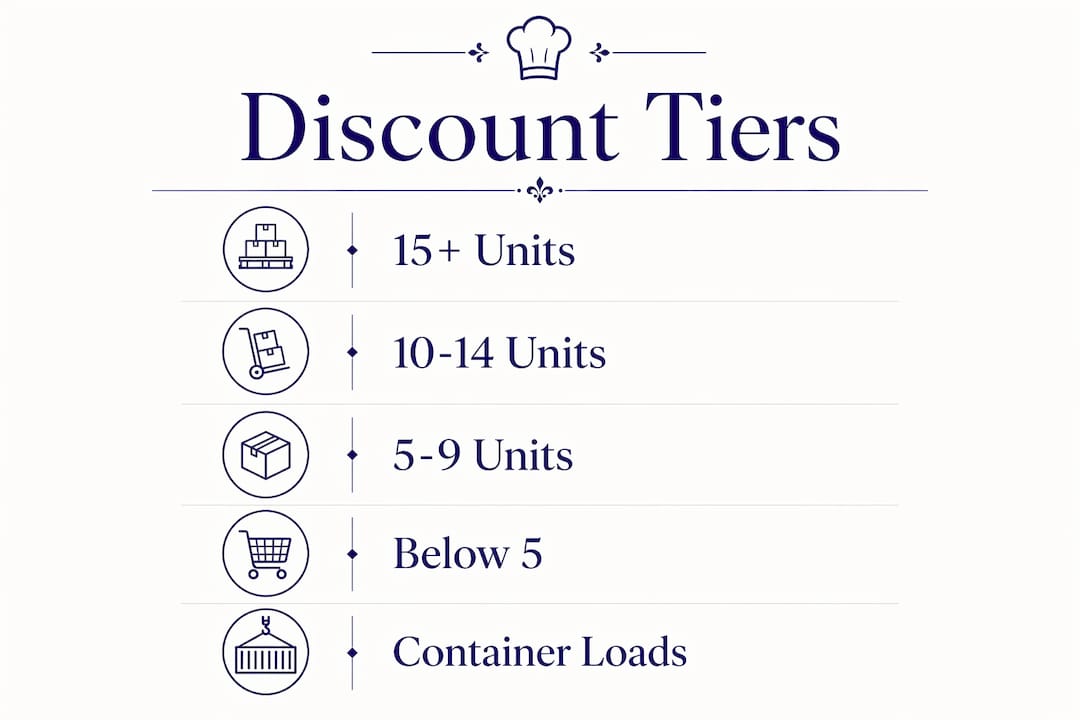
Volume-based pricing tiers are the foundation of any bulk equipment deal. Suppliers structure discounts by unit count, and knowing the exact thresholds gives you a clear target before you place a single call.
Standard discount tiers by unit count break down as follows:
| Order Size | Typical Discount |
|---|---|
| 5–9 units | 4% below wholesale |
| 10–14 units | 8% below wholesale |
| 15+ units | 12% below wholesale |
| Container load | 15–20% below wholesale |
These tiers matter because crossing a single threshold can shift your unit cost meaningfully on high-ticket items. A 12% discount on a $4,500 commercial convection oven saves $540 per unit. Multiply that across a 15-unit order and you recover over $8,000 before you negotiate anything else.
Direct sourcing amplifies those savings further. Distributor markups run 15–25% and retailer margins add another 20–35% on top. That same $4,500 oven can be sourced directly from a manufacturer or B2B platform for $2,800–$3,200. The gap between retail and direct pricing is not a rounding error. It is a structural cost difference that compounds across every item in a full kitchen build-out.
For large project orders, suppliers will often move beyond published tiers into custom pricing. This opens the door to negotiated payment terms, phased delivery schedules, and extended warranties. The key is framing your order as a project, not a one-time purchase, from the first conversation.
When you purchase kitchen equipment in bulk, the pricing channel matters as much as the quantity. Retail, distributor, and direct manufacturer pricing are three distinct markets with different cost structures. Buying direct or through a B2B platform with manufacturer relationships is the most reliable path to wholesale kitchen equipment deals at scale.
How to prepare for negotiation: research and buyer pack
Preparation is the single biggest factor separating operators who get discounts from those who pay list price. Suppliers test buyer price thresholds constantly. Walking in with data shifts that dynamic immediately.
Build a buyer pack before any negotiation. A buyer pack is a spreadsheet that lists every item you need, the current quoted price, the specs, and at least two alternative supplier quotes for each line item. Sharing a buyer pack with multiple suppliers converts a one-sided sales conversation into a competitive bid. Suppliers respond to documented alternatives. They do not respond to vague claims that you “got a better price somewhere else.”
Follow these steps to build a buyer pack that creates real leverage:
- List every SKU you need with full specifications, including brand, model number, and required certifications such as NSF or UL.
- Collect at least three quotes per item from different sourcing channels: a local distributor, a B2B platform, and a direct manufacturer inquiry.
- Calculate total landed cost for each quote. For imported equipment, landed costs add 20–40% to the product price through freight, duties ranging from 0–25%, and customs fees of $150–$350 per shipment. A lower unit price from an overseas supplier can easily become the more expensive option once you account for these costs.
- Identify volume tier break points for each supplier. Ask directly what their pricing looks like at 5, 10, 15, and container-load quantities.
- Document your timeline and payment capacity. Suppliers offer better terms to buyers who can commit to a clear delivery window and demonstrate financial reliability.
Pro Tip: Request pricing at multiple volume tiers in your first inquiry. Factories quote separate prices for sample, small batch, wholesale, and container load volumes. Getting all four numbers upfront reveals the supplier’s break-even structure and shows you exactly where the best value sits.
The buyer pack also serves a second purpose. It signals to suppliers that you are a serious, organized buyer. That perception alone shifts how aggressively they price your order.

What negotiation tactics secure the best contract terms?
Price is only one variable in a well-negotiated contract. The operators who consistently get the best prices for kitchen appliances over time are the ones who also lock in protective contract language from the start.
Use quarterly rebids on high-value skus
Annual price reviews leave money on the table. Quarterly bidding on your top 20–30 SKUs captures 6–12% in additional savings annually compared to a single yearly review. That cadence keeps suppliers competitive and prevents the gradual price drift that erodes negotiated rates between review cycles.
Lock in price caps and review notices
Contracts should include a price holding period of 60–90 days and require 14–30 days advance notice before any price increase takes effect. Price review cadence clauses prevent unplanned cost inflation and give you time to source alternatives if a supplier raises rates. Without this language, a supplier can adjust pricing mid-contract with little recourse for you.
Negotiate non-price contract terms
The following contract terms reduce risk and hidden costs beyond the unit price:
- Substitution rules: Define what happens if a specified item is unavailable. Without this, suppliers can substitute lower-quality alternatives at the same price.
- Credit windows: Negotiate net-30 or net-60 payment terms. Non-price contract terms like extended credit windows improve cash flow and can be traded against price concessions.
- Price cap clauses: Cap annual price increases at a fixed percentage, typically tied to a published index like the Producer Price Index.
- Delivery guarantees: Specify lead times and penalties for late delivery on large orders.
- Warranty and service terms: For commercial-grade equipment, negotiate on-site service response times rather than depot repair.
Pro Tip: Use non-price concessions as trading chips. If a supplier will not move on unit price, push for better payment terms, extended warranties, or free delivery. These concessions have real dollar value and are often easier for suppliers to grant than a direct price cut.
Reviewing your restaurant equipment leasing options alongside outright purchase can also strengthen your negotiating position. Suppliers who offer both purchase and lease structures are often more flexible on pricing when you present both options as live alternatives.
What are the most common bulk negotiation mistakes?
Most operators leave money on the table not because they lack leverage, but because they make predictable mistakes that suppliers are trained to exploit.
- Accepting the first offer. Distributor pricing models are designed to test your price threshold. Persistent negotiation unlocks 6–12% better pricing in most cases. The first quote is a starting position, not a final offer.
- Ignoring total landed cost. Comparing unit prices without factoring in freight, duties, and customs fees produces misleading results. A $200 unit that costs $280 landed is not cheaper than a $240 unit with free domestic shipping.
- Relying on volume alone. Volume is leverage only when paired with data. A large order without a buyer pack gives the supplier no competitive pressure to sharpen their price.
- Skipping contract protections. Operators who focus only on the initial unit price and ignore contract terms often face price drift within 6 months. A 5% price increase on a $50,000 annual equipment budget costs $2,500 per year with no recourse.
- Treating negotiation as a one-time event. Supplier relationships compound over time. Operators who maintain consistent communication, pay on time, and provide volume forecasts get better pricing on future orders without having to fight for it each cycle.
Building a relationship with your supplier contact also matters practically. Buyers who are known, reliable, and organized get faster responses, priority allocation during supply shortages, and informal advance notice of price changes.
Key takeaways
Effective bulk kitchen equipment negotiation requires volume data, a structured buyer pack, and contract terms that protect pricing over time.
| Point | Details |
|---|---|
| Know your discount tiers | Orders of 15+ units unlock 12% discounts; container loads reach 15–20% below wholesale. |
| Build a buyer pack | Document specs, three competing quotes, and landed costs before any supplier conversation. |
| Run quarterly rebids | Rebidding top SKUs every quarter captures 6–12% more savings than annual reviews. |
| Lock in contract protections | Price caps, substitution rules, and 14–30 day increase notices prevent cost drift. |
| Persist past the first offer | Suppliers test price thresholds; persistent negotiation typically unlocks 6–12% better terms. |
What i’ve learned after years of watching operators negotiate
Most restaurant managers treat equipment purchasing as a procurement task. The ones who consistently pay less treat it as an ongoing commercial relationship with structured review cycles.
The biggest shift I’ve seen is operators moving from annual to quarterly rebids. It sounds like more work. In practice, it takes one hour per quarter and captures savings that dwarf any other cost-control measure short of renegotiating rent. The suppliers who know you rebid quarterly also price more carefully the first time.
The second lesson is that contract language matters more than the initial discount. I’ve watched operators celebrate a 10% price reduction and then absorb three unannounced price increases over 18 months that wiped out the savings entirely. A price cap clause and a 30-day notice requirement cost nothing to negotiate and protect every dollar of the discount you worked to secure.
The last point is counterintuitive: the best negotiators I’ve seen are also the easiest suppliers to work with. They pay on time, communicate clearly, and provide volume forecasts. Suppliers prioritize those buyers. That relationship equity translates directly into better pricing, faster service, and first access to new product lines. Negotiation is not adversarial. It is account management from the buyer’s side.
— John
How Culinaryprofis supports bulk equipment sourcing
Culinaryprofis stocks commercial-grade kitchen equipment across every major category, from gas ranges and convection ovens to refrigeration units and meat processing machinery. The platform works directly with manufacturers to offer volume-based pricing on bulk orders, with expert support available to help you identify the right specifications and quantities for your operation.
Whether you are outfitting a new restaurant or upgrading an existing kitchen, Culinaryprofis provides the product depth and sourcing expertise to support structured procurement at scale. Free shipping, a flexible return policy, and direct access to product specialists make it a practical starting point for any bulk equipment purchase. Visit Culinaryprofis to request volume pricing on your next order.
FAQ
What discount can i expect when buying kitchen equipment in bulk?
Standard volume discounts run from 4% on orders of 5–9 units to 12% on orders of 15 or more. Container load orders typically reach 15–20% below wholesale pricing.
How does direct sourcing reduce kitchen equipment costs?
Direct sourcing cuts out distributor markups of 15–25% and retailer margins of 20–35%. A commercial oven priced at $4,500 retail can cost $2,800–$3,200 when sourced directly from a manufacturer or B2B platform.
What contract terms should i negotiate beyond unit price?
Negotiate price cap clauses, substitution rules, net-30 or net-60 payment terms, and a requirement for 14–30 days advance notice before any price increase. These terms prevent cost drift after the initial deal is signed.
How often should i rebid kitchen equipment contracts?
Quarterly rebids on your top 20–30 SKUs capture 6–12% more savings annually compared to a single yearly review. That cadence keeps suppliers competitive and prevents gradual price increases between review cycles.
What is total landed cost and why does it matter in negotiation?
Total landed cost includes the unit price plus freight, import duties of 0–25%, and customs fees of $150–$350 per shipment. For imported equipment orders in the $5,000–$10,000 range, landed costs add 20–40% to the base price, which can make a lower-priced overseas quote more expensive than a domestic alternative.