
Why Catering Buffet Equipment Sizing Matters in 2026

Catering buffet equipment sizing is the process of matching buffet gear, station counts, and counter space to guest volume so that service runs without delays, food stays at safe temperatures, and guests move through the line without congestion. Get it wrong, and you face cold food, long queues, and wasted spend. Get it right, and you deliver a service that runs itself. This guide covers the industry standards, the Rule of 30 and Rule of 50 for chafing dishes, realistic budget ranges, and replenishment tactics that separate average buffet operations from excellent ones.
Why catering buffet equipment sizing is the foundation of event success
Buffet equipment sizing is not a setup detail. It is the operational framework that determines whether your event runs on schedule or collapses under its own weight. The right sizing decisions affect service speed, food safety compliance, and the guest experience from the first plate to the last.
The industry term for this discipline is buffet line planning. It combines spatial planning, equipment selection, and replenishment scheduling into a single system. Caterers who treat each piece of equipment as a separate purchase, rather than part of a coordinated setup, consistently run into mismatched sizes, temperature failures, and bottlenecks at peak service.
Three outcomes depend directly on correct sizing:
- Service speed: Undersized stations create queues. A single buffet line serving 200 guests without a secondary line will back up within the first 15 minutes of service.
- Food safety: Equipment that is too large for the volume of food being served causes food to sit in pans longer, dropping into unsafe temperature zones.
- Guest satisfaction: Proper catering layout planning removes friction. Guests who move through a buffet line quickly and find full, fresh pans rate events higher.
The financial case is equally clear. Oversized setups waste food and labor. Undersized setups damage your reputation. Correct sizing is the only configuration that pays for itself.
What are the industry guidelines for buffet line length and station setup?
The standard planning rule is one running meter of buffet counter space per 40–60 guests. That ratio keeps guest flow moving without creating crowding at the line. For a 120-guest event, you need at least 2 meters of counter space, and ideally closer to 3 meters to account for peak arrival patterns.
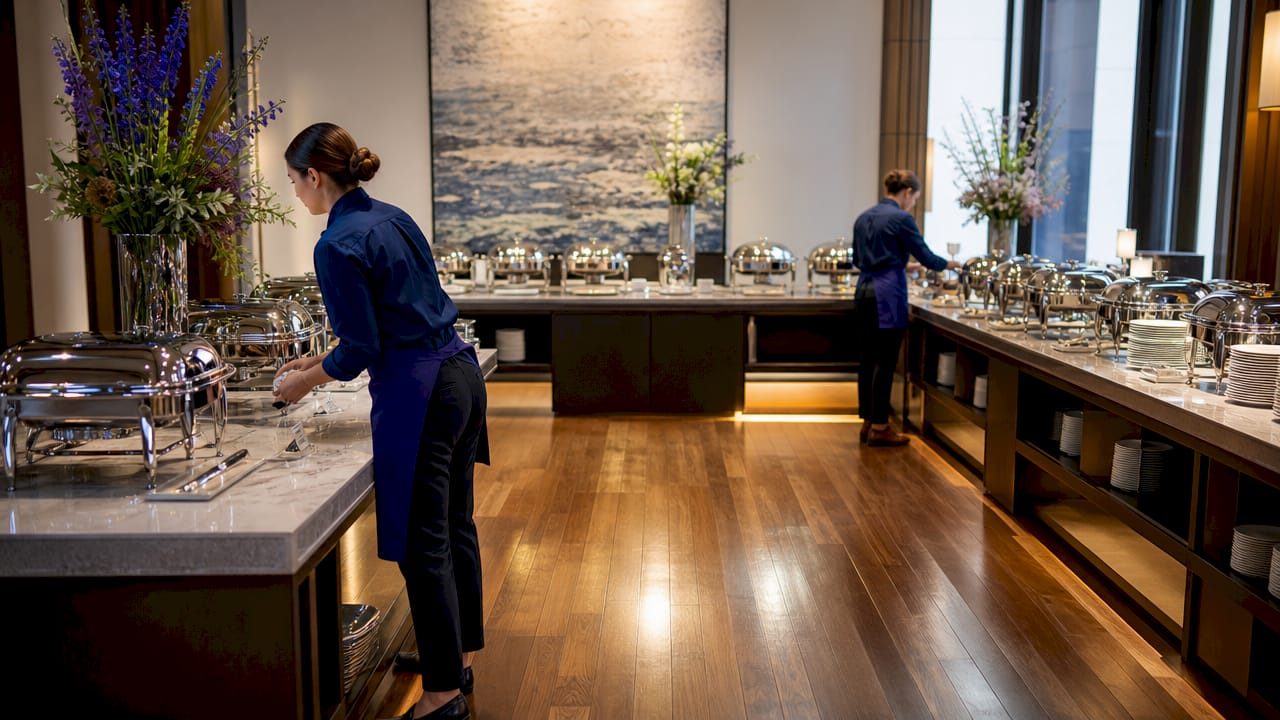
Station separation is the next layer of planning. For every 80 guests beyond the base count, the standard calls for adding dedicated stations for hot food, cold food, beverages, and desserts. Combining all food categories onto a single counter works for small groups. At 80 guests and above, it creates traffic jams and cross-contamination risks.
For events serving 200 or more guests, a single buffet line is not sufficient. Adding a secondary parallel line cuts wait times and prevents the temperature degradation that happens when food sits in open pans while a long queue moves slowly. The secondary line does not need to mirror the full menu. A duplicate hot food station and a beverage station handle the majority of the congestion.
Key station planning benchmarks to follow:
- Under 80 guests: One combined line with hot, cold, and beverage sections is workable.
- 80–150 guests: Separate hot, cold, beverage, and dessert stations.
- 150–300 guests: Two parallel lines minimum, with dedicated stations for each food category.
- 300+ guests: Multiple lines with staggered service windows to manage flow.
Pro Tip: Place beverage and dessert stations at least 3 meters away from the main hot food line. This prevents guests from stopping mid-line to pour drinks, which is the single most common cause of buffet congestion.
How to apply the Rule of 30 and Rule of 50 for sizing chafing dishes
The Rule of 30 and Rule of 50 are the standard formulas for calculating chafing dish counts in buffet service. They are not suggestions. They are the baseline every professional caterer uses to avoid running out of food or letting pans run dangerously low.
The Rule of 30 for mains: Plan one full-size chafing dish per 30 guests for each main course item. For a 120-guest event with two mains, you need four full-size chafers on the line at any given time.
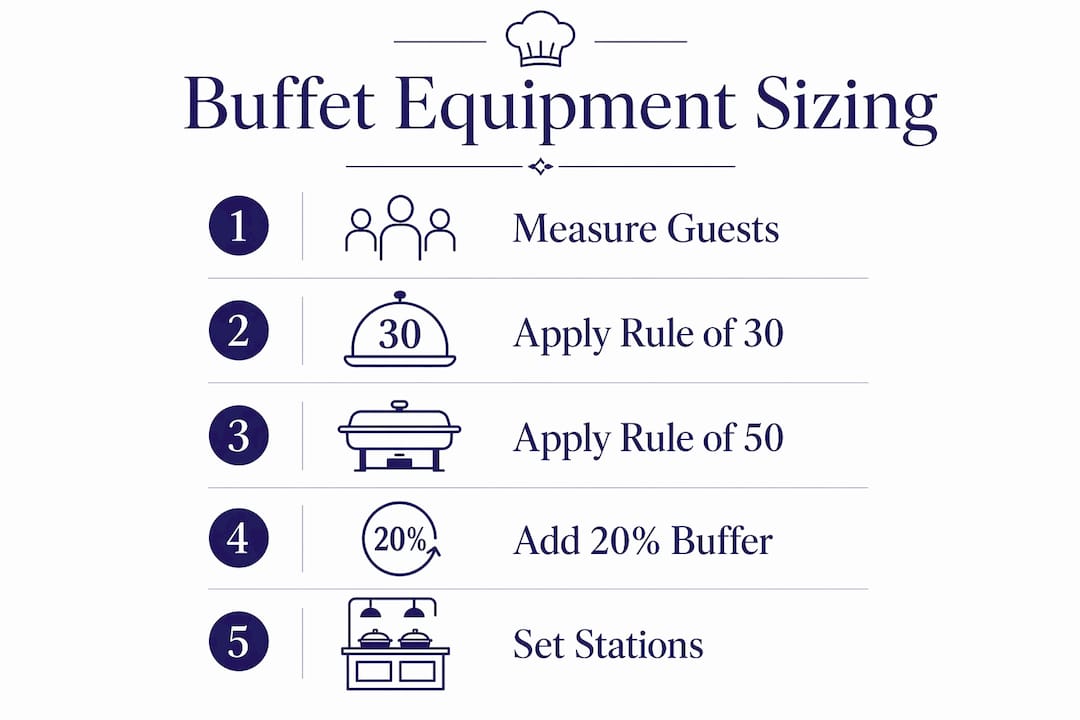
The Rule of 50 for sides: Plan one full-size chafing dish per 50 guests for each side dish. For the same 120-guest event with three sides, you need three full-size chafers for sides, giving you seven chafers total on the line.
Applying both rules together for a 100-guest event looks like this:
- Two main dishes: four full-size chafers total (two per main).
- Three side dishes: two full-size chafers total (one per side, rounded up).
- Total on the line: six full-size chafers running simultaneously.
- Duplicate set ready in the kitchen: six additional chafers preloaded and held at temperature.
- Grand total chafers needed: twelve full-size units for a 100-guest event with two mains and three sides.
The case for multiple smaller pans over fewer large pans is practical. Smaller pans cycle through faster, which means food spends less time on the line before being replaced with a fresh pan. That directly improves food quality and reduces the risk of temperature violations. A full-size chafer holding a half-portion of food loses heat faster than a correctly loaded pan. Sizing down to half-size chafers for lower-volume items keeps food at the right temperature longer.
Pro Tip: Always calculate your chafer count based on the Rule of 30 and Rule of 50, then add 20% to that number for your duplicate set. Running out of preloaded pans mid-service is the most avoidable failure in buffet operations.
What are the cost considerations and budget ranges for buffet equipment setups?
Buffet equipment investment scales directly with event size and service tier. A full hotel-grade buffet package for 150–300 covers runs between $55,000 and $95,000. That figure covers chafers, bain-maries, serving utensils, risers, sneeze guards, and the supporting infrastructure for a complete buffet line. Five-star operations with live cooking stations regularly exceed $150,000.
That range reflects the full spectrum of catering equipment requirements. Entry-level packages for smaller operations start around $18,000. The gap between $18,000 and $150,000 comes down to three variables: equipment quality, station count, and feature complexity.
| Event scale | Guest count | Estimated equipment budget |
|---|---|---|
| Small catering operation | Under 80 guests | $18,000–$35,000 |
| Mid-tier banquet setup | 80–150 guests | $35,000–$55,000 |
| Hotel-grade buffet | 150–300 guests | $55,000–$95,000 |
| Five-star or live cooking | 300+ guests | $150,000+ |
The most common budgeting mistake is purchasing equipment in phases. Caterers who buy chafers from one source, bain-maries from another, and risers from a third end up with mismatched sizes, inconsistent finishes, and incompatible configurations. Buying modular, matched sets from a single source saves up to 30% on procurement costs and eliminates compatibility problems before they happen.
Pro Tip: Build your equipment budget around your highest-volume event of the year, not your average event. Equipment that handles your peak load will perform reliably at every other event. Equipment sized for your average event will fail at your most important one.
How do replenishment strategy and buffet line configuration affect service efficiency?
Replenishment strategy is more critical than initial buffet capacity. A correctly sized line that runs out of preloaded pans at the 90-minute mark delivers a worse guest experience than a slightly undersized line with a disciplined swap system. The goal is never to let a pan drop below one-third full before replacing it.
Duplicate chafing dishes are the operational tool that makes replenishment work. One set runs on the line. A second set sits in the kitchen, preloaded and held at serving temperature. When a pan on the line drops, the kitchen team swaps the entire pan, not just the food. That swap takes under 30 seconds and keeps the line moving without interruption.
Line configuration choices also affect efficiency in ways that go beyond counter length:
- Multiple smaller stations reduce queue congestion more effectively than one long line. Guests self-sort by food preference, which distributes traffic naturally.
- Tiered risers improve guest reach and sight lines, which speeds up decision-making at the line and reduces hesitation-related slowdowns.
- Electric bain-maries maintain a tighter temperature range than chafing dishes. For fixed hotel buffet lines where food safety compliance is non-negotiable, electric units are the correct choice. Chafing dishes are mobile and cost less, but they do not hold temperature as consistently as electric bain-maries. A detailed breakdown of HACCP-compliant equipment choices explains the regulatory implications of each option.
Risers do more than improve flow. Tiered buffet displays increase the perceived value of the food being served, which supports premium pricing at high-end events. A flat buffet line looks institutional. A tiered setup looks curated.
Key Takeaways
Correct buffet equipment sizing, built on the Rule of 30 for mains and Rule of 50 for sides, is the single most reliable way to maintain food quality, guest flow, and food safety compliance across any event scale.
| Point | Details |
|---|---|
| Counter space standard | Plan one running meter of buffet counter per 40–60 guests to prevent congestion. |
| Chafing dish formula | Use the Rule of 30 for mains and Rule of 50 for sides to calculate chafer counts. |
| Replenishment over capacity | Keep duplicate preloaded pans ready to swap before any pan drops below one-third full. |
| Budget by peak volume | Size your equipment investment around your highest-volume event, not your average event. |
| Buy matched sets | Consolidated procurement of modular equipment saves up to 30% and prevents compatibility failures. |
What I’ve learned from watching caterers get buffet sizing wrong
Most buffet failures I’ve seen come down to one decision made too early: buying equipment before finalizing the guest count and menu structure. Caterers lock in a chafer order based on a rough headcount, then the event grows by 40 guests and the whole setup is suddenly undersized. The fix is always to calculate equipment needs last, after the menu and confirmed guest count are set.
The second pattern I see repeatedly is treating replenishment as a backup plan rather than a primary system. The caterers who run the smoothest buffets are the ones who treat the kitchen prep area as a second buffet line. Every pan on the floor has a twin in the kitchen, preloaded and ready. That discipline is what separates a buffet that looks professional at the two-hour mark from one that looks depleted.
Piecemeal equipment sourcing is the third mistake. I’ve watched operations spend more money buying mismatched chafers from four different suppliers than they would have spent buying a matched modular set from one source. The mismatches show up in pan sizes that don’t fit the frames, finishes that clash under event lighting, and lids that don’t seal properly. None of that is recoverable on the day of the event. A solid catering equipment checklist built before any purchase is made prevents all three of these problems.
— John
Culinaryprofis: equipment sourcing for serious catering operations
Culinaryprofis carries commercial-grade buffet equipment built for the demands of professional catering at scale. From chafing dishes and bain-maries to full buffet line configurations, the catalog is built around durability and performance at high guest volumes.

Caterers who need to size equipment correctly before an event can use the Culinaryprofis product selection alongside the sizing rules in this guide to build a complete, matched setup. Free shipping, a flexible return policy, and direct expert support make it straightforward to source the right gear without guesswork. Visit Culinaryprofis to review the full catalog and get equipment matched to your event scale.
FAQ
What is the standard buffet counter length per guest?
Plan one running meter of buffet counter space per 40–60 guests. Add separate stations for hot, cold, beverage, and dessert categories for every 80 additional guests.
How many chafing dishes do I need for 100 guests?
For 100 guests with two mains and three sides, plan four full-size chafers for mains and two for sides, plus a duplicate set in the kitchen ready to swap. That totals twelve chafers for the event.
When should I use electric bain-maries instead of chafing dishes?
Use electric bain-maries for fixed hotel buffet lines where consistent temperature control and food safety compliance are required. Chafing dishes work well for mobile or outdoor setups where electrical access is limited.
How much does a full buffet equipment setup cost?
A hotel-grade buffet package for 150–300 guests typically costs between $55,000 and $95,000. Five-star operations with live cooking stations regularly exceed $150,000.
How do tiered risers improve buffet service?
Tiered risers improve guest reach and sight lines, which speeds up decision-making at the line. They also increase the perceived value of the food display, which supports premium event pricing.