
The Role of Commercial Food Processor in Pro Kitchens

A commercial food processor is a high-capacity, professional kitchen appliance designed to perform large-scale food preparation tasks quickly and consistently. The industry standard term for this equipment category is “food processing equipment,” and it covers everything from batch bowl processors to vertical cutter mixers (VCMs). The role of commercial food processor units in a professional kitchen goes far beyond simple chopping. These machines automate slicing, dicing, shredding, mixing, and pureeing at volumes no manual prep team can match. NSF and ETL certification standards govern the safety and sanitation requirements for this equipment in commercial foodservice environments.
What types of commercial food processors are available?
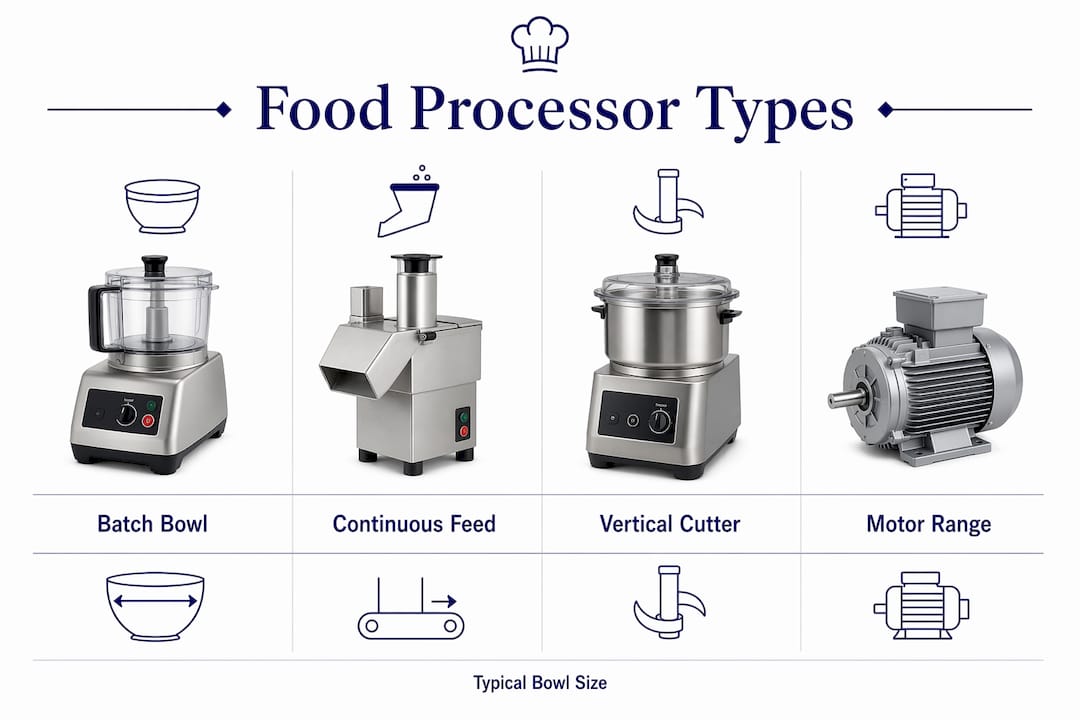
Commercial food processors fall into four main categories, each built for a different workload and kitchen type.
Batch bowl processors handle small to medium daily volumes. Bowl sizes range from 2.6 to 8 quarts, making them the right fit for restaurants serving under 150 daily covers. They excel at versatile tasks: pureeing soups, mixing doughs, and chopping aromatics in controlled quantities.
Continuous feed processors are built for volume. These machines slice over 200 kg of vegetables per hour, making them the standard choice for banquet kitchens and central commissaries. Ingredients feed in one side and exit the other, so output never stops between batches.
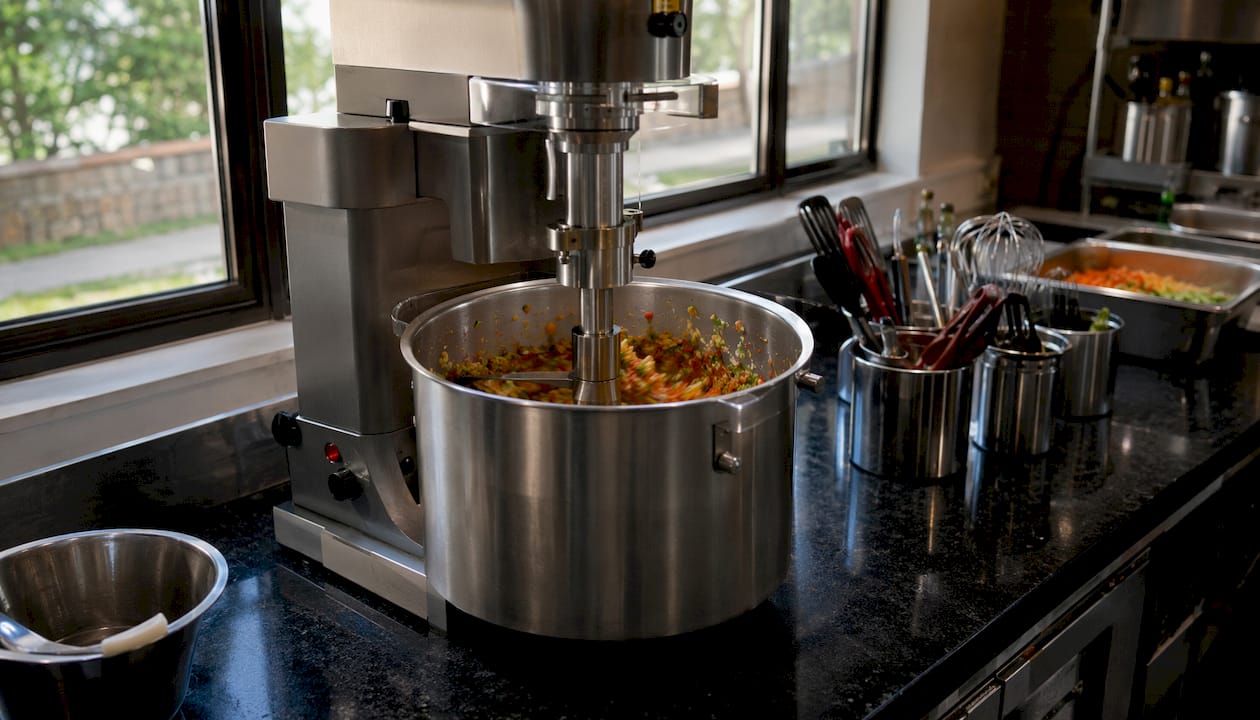
Vertical cutter mixers (VCMs) combine cutting and mixing in a single unit. VCMs offer bowl sizes from 25 to 80 quarts with motors ranging from 5 to 20 HP. They handle fine emulsions, coarse chopping, and large-batch mixing in baking and food processing operations.
Combination models sit between batch and continuous feed designs. They suit mid-size kitchens that need flexibility without the footprint of a full VCM.
Motor power scales with workload across all categories:
- Light tasks (herbs, soft vegetables): 0.5–1 HP
- Medium prep (proteins, root vegetables): 1–3 HP
- High-volume slicing and dicing: 3–5 HP
- Large-scale meat and vegetable processing: 5–16+ HP
| Processor type | Best use case | Typical bowl size | Motor range |
|---|---|---|---|
| Batch bowl | Restaurants under 150 covers | 2.6–8 quarts | 0.5–3 HP |
| Continuous feed | Banquet and commissary kitchens | No bowl (continuous) | 1–5 HP |
| Vertical cutter mixer | Large-batch emulsions and mixing | 25–80 quarts | 5–20 HP |
| Combination model | Mid-size, multi-task kitchens | 4–12 quarts | 1–4 HP |
How to match a food processor to your kitchen volume
Choosing the wrong size processor creates two equally costly problems. Under-sizing creates prep bottlenecks during peak service. Over-sizing wastes energy, counter space, and capital on capacity you never use.
The right approach is to match capacity to peak daily covers, not average volume. A restaurant that serves 80 covers on a Tuesday but 200 on a Saturday night needs equipment sized for Saturday.
Follow these steps to size correctly:
- Count your busiest-day covers. Use your POS data from the last 90 days. Identify the single highest-volume service period, not the weekly average.
- List every prep task the processor will handle. Separate tasks by food type: soft vegetables, root vegetables, proteins, doughs. Each category has different motor and blade demands.
- Calculate total prep volume per task. Estimate kilograms or pounds per service. A 100-cover dinner service with a salad course may require 15–20 kg of sliced vegetables alone.
- Select bowl capacity at 60–70% fill. Overfilling a batch bowl reduces cut quality and strains the motor. A 6-quart bowl works best at 4 quarts of product.
- Decide between batch and continuous feed. If the same ingredient type repeats in large quantities (sliced cucumbers, shredded cabbage), continuous feed wins on speed. If you need variety across small batches, a batch bowl gives more control.
Menu style also drives the decision. A high-volume sandwich operation needs a continuous feed processor for consistent, fast slicing. A fine-dining kitchen running daily specials benefits more from a batch bowl’s precision and flexibility. For kitchens scaling up, high-volume cooking appliances guidance from Culinaryprofis covers how to plan equipment selection around realistic workload growth.
Pro Tip: Run a 30-day prep log before purchasing. Track the time your team spends on each cutting task. The data will tell you exactly which processor type and capacity pays back fastest.
What operational and maintenance factors affect long-term performance?
The purchase price of a food processor is only part of the cost. The total cost of ownership includes installation, maintenance, downtime, utilities, and staff time. Cheaper models frequently cost more over three years because they fail during peak service when repair costs and lost revenue are highest.
Four factors determine whether a processor performs reliably over its full lifecycle:
- Ease of cleaning. Smooth, crevice-free surfaces and accessible service points reduce daily sanitation time and prevent health code violations. Machines that take 20 minutes to disassemble will not get cleaned properly between batches.
- Safety interlocks. Commercial processors must include bowl-lock mechanisms that prevent the blade from spinning unless the unit is fully assembled. This protects staff and is a standard NSF requirement. For a full breakdown of required safety features, the food safety equipment guide from Culinaryprofis covers what restaurants must have in 2026.
- Stainless steel construction. Bowls, blades, and housing built from commercial-grade stainless steel resist corrosion, handle daily sanitizer exposure, and meet NSF/ETL standards for food contact surfaces.
- Parts availability. A processor is only as reliable as the availability of its replacement blades, seals, and drive couplings. Before purchasing, confirm that the manufacturer stocks parts domestically and that lead times are under one week.
Practitioners consistently find that hygienic design matters more than maximum motor power. A machine that cleans in five minutes and runs reliably for five years outperforms a high-HP unit that creates sanitation bottlenecks every service. Prioritizing NSF and ETL certifications during equipment selection protects both staff safety and compliance standing.
Pro Tip: Schedule a monthly blade sharpening check. Dull blades increase motor strain, reduce cut quality, and are the leading cause of premature motor failure in batch bowl processors.
What are the key benefits of commercial food processors?
Commercial food processors deliver measurable operational advantages that directly affect labor costs, food quality, and kitchen capacity.
The most significant benefit is time savings. Food processors reduce vegetable and protein prep time by 70–80% compared to hand cutting. That reduction frees skilled cooks to focus on cooking rather than repetitive knife work, which is where their labor cost is best justified.
The second major benefit is consistency. Commercial processors produce uniform cuts and textures across every batch. Uniform cuts matter for presentation in plated dishes and for even cooking times in high-volume production. A hand-cut carrot varies in thickness; a processor-cut carrot does not.
Additional benefits include:
- Reduced food waste. Precision cutting produces fewer unusable scraps than hand prep. Consistent slice thickness means fewer pieces discarded for being too thin or too thick.
- Menu flexibility. A single processor with multiple blade attachments handles slicing, shredding, dicing, and pureeing. That range supports menu changes without adding equipment.
- Scalability. As covers grow, prep volume scales with the processor rather than with headcount. A kitchen adding 50 covers per service does not need to hire an additional prep cook if the processor has remaining capacity.
- Labor cost control. Automating repetitive prep tasks reduces the total hours needed in the prep kitchen. This directly affects the labor cost percentage on the P&L.
The functions of food processing equipment extend beyond speed. They create the operational foundation that lets a kitchen grow its menu and volume without proportionally growing its staff.
Key takeaways
Commercial food processors are the highest-ROI prep investment in a professional kitchen when matched correctly to volume, menu type, and cleaning requirements.
| Point | Details |
|---|---|
| Match size to peak volume | Size bowl capacity to your busiest service day, not your weekly average. |
| Choose type by task | Use continuous feed for high-volume slicing; use batch bowl for varied, small-batch prep. |
| Prioritize hygienic design | Crevice-free surfaces and fast disassembly prevent health code violations and reduce downtime. |
| Factor total cost of ownership | Cheap models cost more long-term when failures occur during peak service. |
| Train staff from day one | Proper training protects performance, reduces accidents, and extends equipment life. |
What I’ve learned about buying food processors the hard way
Kitchens consistently make the same mistake: they buy the largest processor available because it feels like the safe choice. It is not. A 60-quart VCM in a 100-cover restaurant sits mostly empty, takes 30 minutes to clean properly, and gets skipped on sanitation between services because the cleaning burden is too high. That is how health code violations happen.
The real decision is not about maximum capacity. It is about what fits your actual daily workflow. I have seen kitchens where a well-chosen 6-quart batch bowl processor, cleaned in under five minutes, outperforms a much larger machine because the staff actually uses it correctly every service.
Training staff on standard use and cleaning procedures is not optional. It is the single factor that separates a processor that pays back in six months from one that sits broken in the corner after a year. Invest in a 30-minute onboarding session for every new prep cook. Write the cleaning steps on a laminated card and mount it on the machine.
Viewing the processor as part of a kitchen system, not a standalone purchase, changes how you evaluate it. Ask how it fits into your prep station workflow before you ask about its motor size. The right machine for your kitchen is the one your team will use correctly every day, not the one with the most impressive spec sheet.
— John
Culinaryprofis has the equipment your kitchen needs
Culinaryprofis stocks commercial-grade food preparation equipment built for professional kitchens and serious operators. Whether you are outfitting a new restaurant or replacing aging prep equipment, the Culinaryprofis catalog covers the full range of capacity and function.
The Culinaryprofis team provides direct support to help you match equipment to your kitchen’s volume, menu type, and workflow. Free shipping, a flexible return policy, and expert guidance are standard. If you are evaluating whether your current setup is holding your kitchen back, the replace aging equipment guide is a practical starting point. Browse the full selection at Culinaryprofis and contact the team with your kitchen specs for a direct recommendation.
FAQ
What is the role of a commercial food processor?
A commercial food processor automates high-volume food preparation tasks including chopping, slicing, dicing, shredding, mixing, and pureeing. Its primary role is to reduce prep time and labor costs while delivering consistent results across every batch.
How do I choose the right size food processor for my kitchen?
Size your processor to your busiest service day, not your average volume. Batch bowl processors suit kitchens under 150 daily covers, while continuous feed models and VCMs are necessary for higher-volume operations.
What is the difference between a batch bowl and a continuous feed processor?
A batch bowl processor handles one measured quantity at a time and suits varied, small-batch prep tasks. A continuous feed processor accepts ingredients without stopping and is built for high-volume, single-ingredient slicing and dicing.
How much prep time do commercial food processors save?
Commercial food processors reduce vegetable and protein prep time by 70–80% compared to hand cutting. That time savings frees skilled kitchen staff for cooking tasks that require more judgment and technique.
What certifications should a commercial food processor have?
Look for NSF and ETL certifications, which confirm the equipment meets food safety, sanitation, and electrical safety standards required for commercial kitchen use in the United States.