
Replace Aging Restaurant Cooking Equipment: 2026 Guide

Replacing aging restaurant cooking equipment is the single most direct way to improve kitchen output, food consistency, and safety compliance in one move. Outdated ranges, fryers, and ovens force your kitchen staff to compensate for equipment failures rather than focus on food quality. ENERGY STAR certified replacements deliver measurable energy savings, and compliance standards like NFPA 96 make timely upgrades a legal necessity, not just a business preference. This guide gives restaurant owners and chefs a clear, practical path through assessment, compliance, equipment selection, and installation.
When should you replace aging restaurant cooking equipment?
Equipment replacement in commercial kitchens follows a recognized industry standard: when repair costs exceed 50% of the replacement cost, replacement beats repair every time. That threshold exists because older equipment rarely fails once. It fails repeatedly, and each repair adds labor cost, parts cost, and lost production time. Chefs working on aging equipment spend mental energy managing inconsistency rather than executing recipes.
The most reliable warning signs that your kitchen equipment needs replacing include:
- Uneven cooking temperatures on ranges or ovens that calibration cannot fix
- Pilot light failures or ignition problems recurring more than twice in six months
- Fryer oil degrading faster than normal due to inconsistent heat cycling
- Visible corrosion or warping on cooking surfaces that affect food contact safety
- Parts that are no longer manufactured, making repair impossible or prohibitively expensive
Age is a practical benchmark. Equipment beyond 10 years generally warrants planned replacement rather than continued repair cycles. That does not mean every 10-year-old piece of equipment fails on schedule. It means the probability of compounding failures rises sharply, and the cost-benefit math shifts toward replacement.
Pro Tip: Track repair invoices by equipment unit, not by total kitchen maintenance spend. When any single unit accumulates repair costs above half its current replacement value, flag it for replacement in the next budget cycle.

Downtime is the hidden cost most operators underestimate. A fryer that goes down during a Friday dinner service costs far more than its repair bill. Factor lost revenue into your repair-versus-replace calculation, not just parts and labor.
What compliance rules apply when you replace kitchen equipment?
NFPA 96 governs ventilation control and fire protection for all commercial cooking operations, covering hood design, grease containment, and cleaning schedules. When you swap out a cooking appliance, NFPA 96 does not treat that as a neutral event. A new fryer or range may produce different heat output, grease volume, or exhaust characteristics than the unit it replaces. That change can trigger a required review of your hood and suppression system.
The compliance steps to follow when replacing cooking equipment are:
- Notify your hood suppression contractor before installation, not after. Changing equipment type or BTU output may require suppression system recalibration.
- Review NFPA 96 Table 11.4 with your contractor to confirm your cleaning frequency classification still applies after the equipment change.
- Schedule a hood inspection to coincide with the equipment installation date.
- Update your maintenance documentation to reflect the new equipment specs, installation date, and any suppression system adjustments.
- Confirm with your insurer that the replacement is documented. Fire authorities and insurers expect NFPA 96 and NFPA 17A-aligned records during replacement projects.
Hood exhaust inspection frequency is set by cooking volume, not by calendar preference. Monthly inspections apply to solid-fuel cooking operations. Quarterly inspections apply to high-volume kitchens. Semiannual inspections cover moderate-volume operations, and annual inspections apply to low-volume kitchens. Replacing equipment does not reset that clock. It may accelerate it if the new unit produces more grease-laden exhaust.
Wet-chemical fire suppression systems inside hoods must be inspected every six months by certified contractors, with fusible links replaced annually. Missing this schedule during an equipment transition is one of the most common causes of failed health and fire inspections.
Integrating fire suppression and ventilation upgrades early in your replacement planning avoids costly retrofits and inspection delays. Operators who treat hood compliance as a separate project from equipment replacement consistently face scheduling conflicts and documentation gaps.
How do you choose energy-efficient cooking equipment for your kitchen?
ENERGY STAR certified commercial kitchen equipment uses 10–30% less energy than standard models while delivering equivalent cooking performance. That range matters because the actual savings depend on equipment category and usage volume. A high-output fryer running 12 hours a day generates far more savings from certification than a low-use holding cabinet.
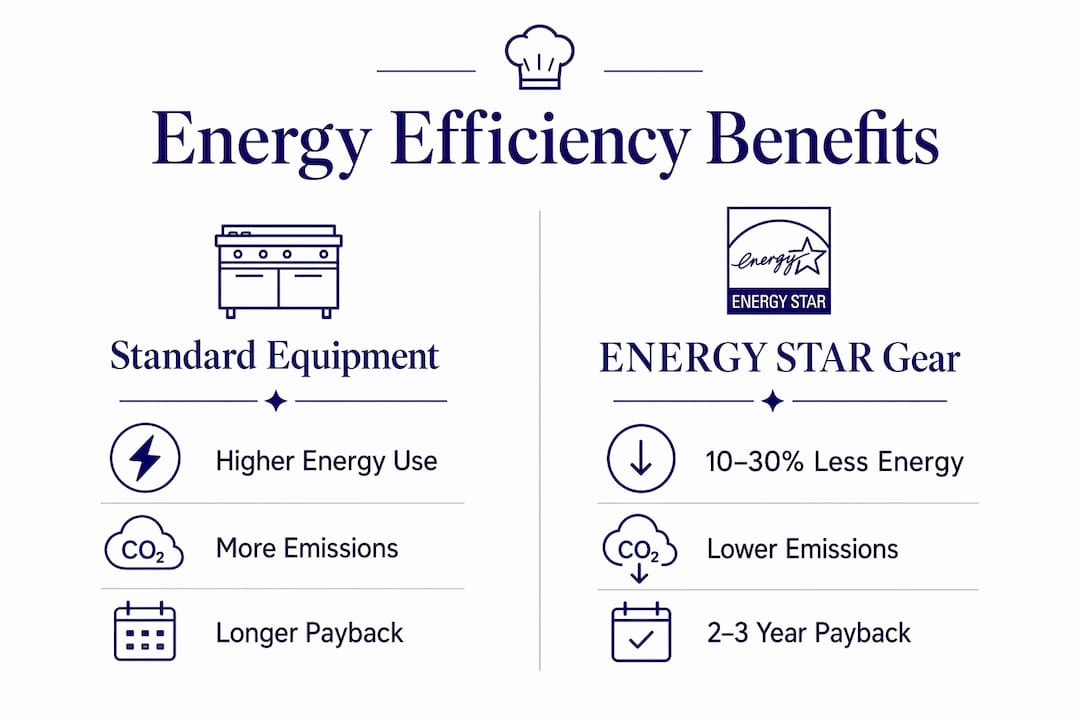
The equipment categories most commonly available with ENERGY STAR certification include fryers, steam cookers, and hot food holding cabinets. Utility rebates tied to certified purchases improve payback periods to roughly 2–3 years for most certified models. That payback timeline makes the upgrade cost-effective even for operators working with tight capital budgets.
Brand selection directly affects long-term value. Vulcan, Hobart, Pitco, and Frymaster are the benchmark names in commercial cooking equipment. Durable brands like these deliver parts availability and service networks that support equipment lifespans of 15 or more years. Choosing an unfamiliar brand to save upfront cost often results in parts scarcity within five years.
| Equipment category | ENERGY STAR available | Typical payback period |
|---|---|---|
| Commercial fryers | Yes | 2–3 years |
| Combination steam ovens | Yes | 2–3 years |
| Hot food holding cabinets | Yes | 2–3 years |
| Gas ranges | Limited | Varies by model |
| Griddles | Limited | Varies by model |
Pro Tip: Contact your local utility provider before purchasing. Many offer direct rebates for ENERGY STAR certified commercial kitchen equipment, and some programs require pre-approval before installation to qualify.
Reviewing a commercial kitchen appliances guide before finalizing your equipment list helps you match energy ratings to your actual cooking volume and menu demands. Buying a certified unit that is undersized for your output defeats the purpose of the upgrade.
How do you plan a kitchen equipment replacement with minimal downtime?
Minimizing downtime during a kitchen equipment replacement requires scheduling and coordination, not just speed. The most effective approach is to treat the replacement as a project with defined phases, not a single installation event.
Your pre-replacement checklist should cover:
- Confirm equipment specifications match your existing utility connections, gas line capacity, and electrical service
- Assess hood system impact by consulting your suppression contractor before ordering
- Coordinate delivery timing with your supplier to avoid equipment sitting uninstalled in your kitchen
- Brief kitchen staff on the installation schedule and any temporary menu adjustments needed
- Verify permit requirements with your local health and fire authority before work begins
Scheduling replacement during low-volume periods is the most practical way to protect revenue. For most restaurants, monday through wednesday midday service represents the lowest risk window. Avoid scheduling installations in the two weeks before a major holiday period or a known high-volume event.
Post-installation testing is non-negotiable. Every replaced unit needs a full operational test before it enters service. Test temperature calibration on ovens and ranges. Run fryers through a complete heat cycle. Verify that suppression system nozzles are correctly positioned relative to the new equipment. A comprehensive maintenance plan that syncs equipment replacement with hood contractor schedules prevents compliance gaps and reduces the risk of failed inspections.
Using a restaurant kitchen equipment checklist during the planning phase keeps the project on track and prevents overlooked details from causing delays. The checklist approach also creates a documented record that supports compliance verification after installation.
For kitchens with limited floor space or temporary service needs, portable commercial cooking equipment can bridge the gap during a phased replacement, keeping service running while permanent units are installed.
Key takeaways
Replacing aging restaurant cooking equipment pays off fastest when you combine a clear repair-versus-replace threshold with ENERGY STAR certified selections and coordinated compliance planning.
| Point | Details |
|---|---|
| Repair-versus-replace threshold | Replace any unit when repair costs exceed 50% of its current replacement value. |
| NFPA 96 compliance | Notify your hood suppression contractor before installing any replacement unit. |
| ENERGY STAR savings | Certified equipment delivers 10–30% energy savings with payback periods of 2–3 years. |
| Brand longevity | Vulcan, Hobart, Pitco, and Frymaster offer 15-plus-year lifespans and reliable parts availability. |
| Downtime planning | Schedule installations during low-volume periods and run full operational tests before returning to service. |
What I have learned from watching kitchens upgrade their equipment
Most restaurant owners treat equipment replacement as a crisis response. A fryer breaks down on a Thursday night, and by friday morning they are calling suppliers in a panic. That reactive approach costs more money and creates more compliance risk than any planned replacement ever would.
The kitchens I have seen run most efficiently are the ones that build replacement planning into their annual maintenance calendar. They track equipment age, log repair costs by unit, and set a review date for anything approaching the 10-year mark. That discipline is not complicated. It is just consistent.
The compliance piece surprises operators more than any other part of the process. Chefs and owners understand that a new fryer costs money. They do not always understand that installing it without notifying their hood suppression contractor can trigger an inspection failure. NFPA 96 is not optional, and insurers are paying closer attention to documentation gaps than they were five years ago.
The energy efficiency argument is stronger than most operators realize. A kitchen running three ENERGY STAR certified fryers instead of three aging standard models is not just saving on utility bills. It is reducing heat load in the kitchen, which affects staff comfort and HVAC costs. Those secondary savings rarely appear in the initial ROI calculation, but they are real.
My honest advice: treat your next equipment replacement as a systems project, not a single purchase. Coordinate with your hood contractor, check your utility rebate programs, and use the installation as an opportunity to update your compliance documentation. The upfront effort is modest. The long-term payoff in reduced repairs, lower energy costs, and cleaner inspections is substantial.
— John
Culinaryprofis: commercial kitchen equipment for your next upgrade
Culinaryprofis carries a full range of commercial-grade cooking equipment suited for restaurant kitchens, catering operations, and food service businesses. The catalog includes gas ranges, combination ovens, fryers, griddles, and refrigeration units from established brands built for professional performance and long service life.
Restaurant owners and chefs ready to upgrade their kitchens can browse the full commercial kitchen equipment catalog at Culinaryprofis. The platform offers free shipping, a flexible return policy, and direct expert support for operators sourcing replacement equipment. Whether you are replacing a single aging fryer or outfitting an entire line, Culinaryprofis provides the product range and brand selection to match your kitchen’s specific demands.
FAQ
When should a restaurant replace cooking equipment instead of repairing it?
Replace equipment when repair costs exceed 50% of the current replacement value. Units older than 10 years generally warrant planned replacement rather than continued repair cycles.
Does replacing a fryer or range require a hood inspection?
Yes. Changing cooking equipment type or BTU output can affect grease exhaust volume and suppression system coverage. NFPA 96 requires coordinating equipment changes with your hood suppression contractor.
What is the payback period for ENERGY STAR certified kitchen equipment?
ENERGY STAR certified fryers, steam cookers, and hot food holding cabinets typically reach payback in 2–3 years, especially when utility rebates are applied at purchase.
Which brands offer the best lifespan for commercial cooking equipment?
Vulcan, Hobart, Pitco, and Frymaster are the benchmark brands for commercial kitchen longevity, with documented service lifespans of 15 or more years and reliable parts availability.
How often must commercial kitchen hood suppression systems be inspected?
Wet-chemical suppression systems require inspection by a certified contractor at least every six months, with fusible links replaced annually per NFPA 96 requirements.