

Call us NOW


Outdoor catering cooking is the process of building a fully functional, temporary kitchen at an outdoor venue to prepare and serve food at scale. Unlike restaurant service, the outdoor catering process requires constructing infrastructure from scratch: power, water, waste management, and weather protection. Caterers deploy portable grills, ovens, refrigeration units, and hot-holding equipment to maintain food quality from prep through service. Food safety protocols based on HACCP frameworks govern every stage, from transport to teardown. Understanding how catering works outdoors helps event planners make smarter decisions about site selection, vendor requirements, and menu design.
The foundation of any outdoor catering operation is a temporary kitchen infrastructure built specifically for the venue. Power, water, waste, and weather protection are not optional add-ons. They are the kitchen itself.
Power is the first constraint to solve. Most outdoor venues lack sufficient electrical capacity for commercial cooking equipment, so caterers rely on diesel generators or staged electrical distribution panels. A single 30kW commercial grill requires dedicated power that a standard venue outlet cannot supply. Backup power options, including secondary generators, are standard practice for events serving more than 200 guests.
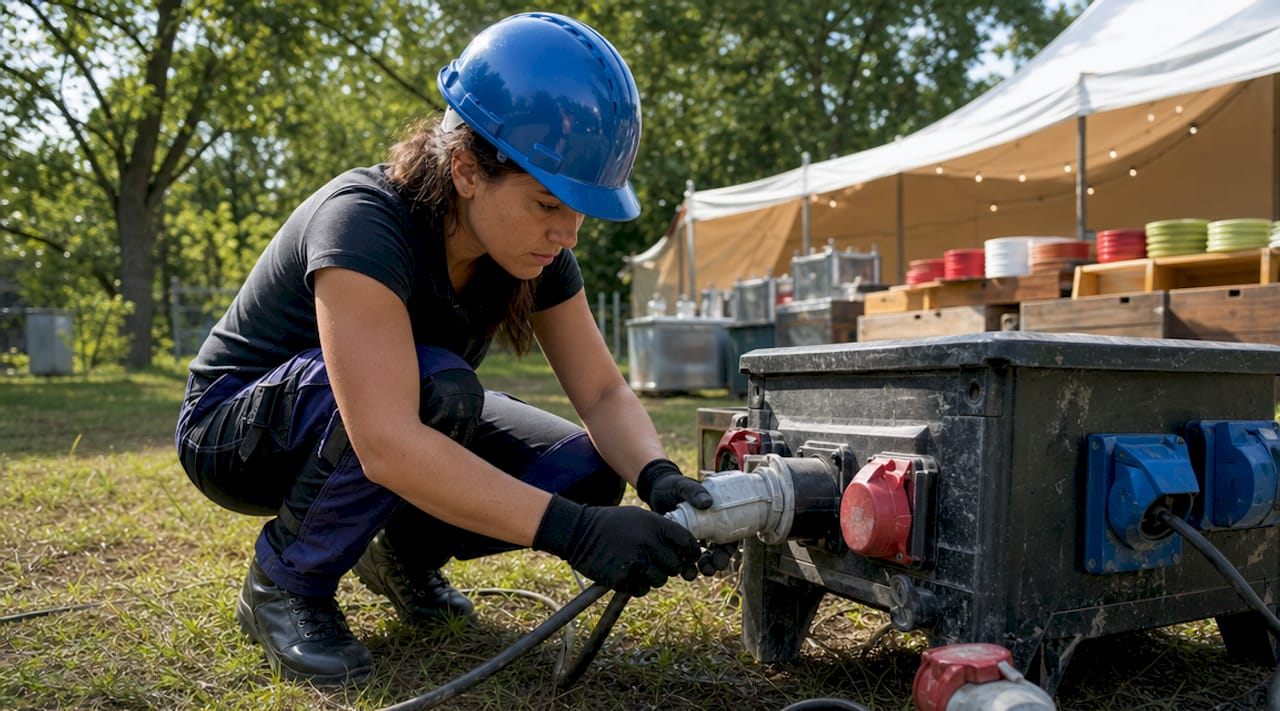
Water supply covers three distinct needs: food preparation, equipment cleaning, and dedicated handwashing. These cannot share a single source. Dedicated sanitation facilities, including separate sinks for food prep and equipment washing, are required onsite. Portable water tanks and gray water collection systems handle venues with no plumbing access.
Waste management planning happens before the first truck arrives. Grease traps, food waste bins, and wastewater disposal points must be positioned away from cooking and service areas to meet health code requirements.
Pro Tip: Book a site walkthrough with your equipment supplier at least three weeks out. Ground conditions, overhead clearance, and access road width directly affect which equipment can be delivered and how it is positioned.
Cooking for outdoor events requires equipment that performs reliably without a fixed kitchen structure. The choice between a mobile kitchen unit and a modular station setup determines throughput, flexibility, and cost.
| Equipment type | Best use case | Key limitation |
|---|---|---|
| Mobile kitchen trailer | Large events, 300+ guests | Requires vehicle access and level ground |
| Modular tent stations | Flexible layouts, multi-cuisine menus | Longer setup time, more staff needed |
| Portable gas grills | Buffet and live-fire stations | Limited to grilling; no enclosed cooking |
| Commercial hot boxes | Holding pre-cooked food at temperature | Not a cooking unit; holding only |
| Portable refrigeration units | Cold storage onsite | Requires power; monitor temperature continuously |
High-volume outdoor cooking uses throughput systems with oversized grills and fryers to prevent service bottlenecks. A documented example: 500 portions per hour served from a 6x3m tent using a 30kW grill and four 30kW fryers. That output requires precise station layout and pre-assigned staff roles, not just powerful equipment.
Menu design and equipment selection are directly linked. A plated dinner service with sauces and proteins requires ovens, induction burners, and holding units. A festival buffet with grilled items needs high-BTU gas grills and fryers with rapid recovery times. Choosing equipment before finalizing the menu is a common planning error that creates bottlenecks during service.
Mobile kitchen deployment involves positioning, utility hookup, systems testing, a safety walkthrough, and a decommissioning process completed within 24 to 72 hours. Professional operators follow a commissioning checklist before any food is prepared. Skipping the systems test is the single most common cause of equipment failure during service.
Pro Tip: Match your grill size to your peak demand window, not your total guest count. A 500-person event with a 90-minute service window needs far more throughput capacity than the same count spread over four hours.
Food safety in outdoor catering depends on cumulative temperature management across every stage from kitchen to plate, not just the cooking step itself. HACCP plans for outdoor events cover transport, setup, service, and teardown as a continuous chain.
The two critical temperature thresholds are non-negotiable: hot food must stay at or above 135°F, and cold food must stay at or below 41°F. The temperature danger zone between those two points is where bacterial growth accelerates. Food must survive temperature control including up to a 90-minute gap between kitchen and plate at outdoor events. Wind, direct sun, and ambient heat all work against holding temperatures.
The four-hour rule governs discard decisions. Food that has spent a cumulative four hours in the danger zone must be discarded, regardless of how it looks or smells. Monitoring every 30 minutes during service is the standard protocol to catch temperature drift before the limit is reached.
Here is the standard outdoor catering food safety monitoring sequence:
Outdoor environments introduce hazards that indoor kitchens do not face. Insects, airborne debris, and direct sunlight require covered food stations and lids on all holding containers. Staff hygiene practices, including handwashing frequency and separation of raw and cooked food, must be enforced more strictly outdoors because cross-contamination risks increase without fixed sinks and surfaces.
Outdoor cooking failures typically stem from temperature drift during transport and holding, not from initial cooking errors. A perfectly grilled protein held in an unchecked hot box for two hours can become a food safety violation before it reaches a single plate.
Selecting a menu that holds well outdoors is itself a food safety decision. Dishes with cream-based sauces, raw garnishes, or complex cold components are harder to maintain safely than grilled proteins, roasted vegetables, and dry-heat preparations.
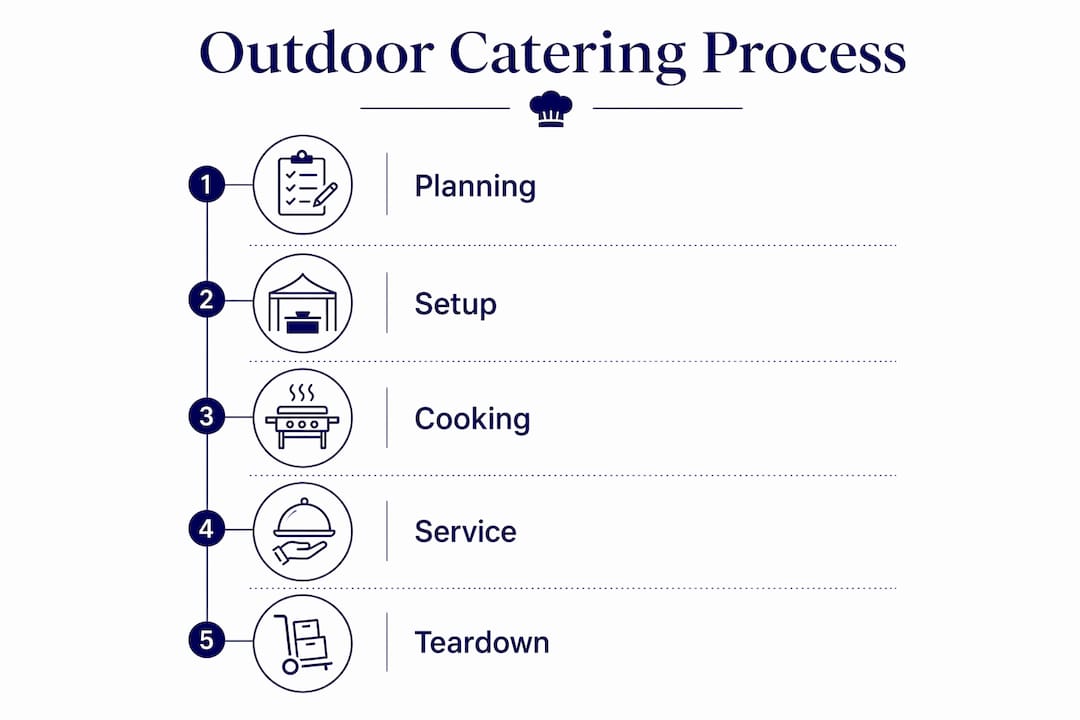
The outdoor catering process runs in four distinct phases: pre-event planning, onsite setup, active service, and teardown. Each phase has defined tasks and handoff points.
Pre-event planning starts with a site analysis conducted with the event planner. Caterers assess terrain, access, power availability, and guest count to determine equipment requirements and staffing levels. Pre-planning includes terrain, access, and backup rain plans developed well in advance. Menu finalization happens at this stage, with choices made to complement the equipment and holding conditions available at the specific venue.
Onsite setup covers equipment delivery, positioning, and utility connections. Staff assignments are confirmed before cooking begins. Each station, whether a grill station, carving station, or cold buffet line, has a designated lead responsible for temperature logs and restocking.
Common outdoor catering station types include:
| Service format | Typical guest range | Key equipment needed |
|---|---|---|
| Buffet | 50 to 500+ | Hot boxes, chafing dishes, portable refrigeration |
| Plated dinner | 50 to 300 | Ovens, induction burners, holding units, transport racks |
| Food truck | 100 to 1,000 | Self-contained mobile kitchen |
| Action station | 20 to 150 per station | Portable grill or induction, prep table |
Active service requires continuous monitoring. Temperature logs, restocking schedules, and waste removal run simultaneously. Staff rotate through stations on defined intervals to prevent fatigue-related errors.
Teardown follows a decommissioning checklist: disconnect utilities, clean all surfaces, collect waste, and restore the site to its original condition. Professional operators complete this within 24 to 72 hours of service end.
Outdoor catering cooking works by building a complete temporary kitchen onsite, managing food safety through continuous temperature monitoring, and coordinating equipment, staff, and logistics as a single integrated system.
| Point | Details |
|---|---|
| Infrastructure comes first | Power, water, and waste systems must be planned before any equipment is selected or ordered. |
| Equipment matches the menu | Choosing grills, ovens, or fryers before finalizing the menu creates throughput bottlenecks during service. |
| Temperature monitoring is continuous | Check hot and cold holding units every 30 minutes; discard food that exceeds four cumulative hours in the danger zone. |
| Site analysis drives all decisions | Terrain, access routes, and weather contingencies determine setup time, costs, and equipment options. |
| Teardown is part of the operation | Decommissioning steps, including utility disconnection and site restoration, require the same planning as setup. |
Most articles on outdoor catering treat the tent as a backdrop. After working with catering operations across dozens of outdoor events, the clearest lesson is this: the tent, the layout, and the cooking stations are the kitchen. They are not decoration around the kitchen.
The biggest operational failures I have seen come from teams that replicated their indoor workflow outdoors without adjusting for the constraints. They brought the same menu, the same station layout, and the same staffing model. Then wind knocked over a prep table, a generator tripped a breaker, and the hot-holding unit drifted to 120°F before anyone checked it.
Early infrastructure planning is not a logistics detail. It is the difference between a functional kitchen and a field with expensive equipment in it. The caterers who get this right spend more time on the site survey than on the menu tasting. They know the ground conditions, the power draw of every piece of equipment, and the weather forecast for the week before the event.
Temperature monitoring also deserves more attention than it typically gets. Most operators check temperatures at setup and again at service start. The 30-minute monitoring interval during service is where the real risk sits. A hot box that reads 138°F at noon can drift to 128°F by 1:30 PM without anyone noticing. That drift is the food safety problem, not the cooking.
If you are planning an outdoor event and evaluating caterers, ask them specifically how they handle temperature monitoring during service and what their corrective action protocol is. The answer tells you more about their professionalism than any menu tasting will.
— John
Outdoor catering demands equipment built to perform without a fixed kitchen structure behind it. Culinaryprofis stocks commercial-grade grills, portable refrigeration units, gas burner ranges, and food prep tools suited for high-volume outdoor service.
The Dukers commercial gas burner range is a direct fit for outdoor cooking stations that need reliable, high-BTU output without a fixed gas line. For onsite ingredient prep, the Pro-Cut KSDS-12 deli slicer handles volume slicing at the event site. Browse the full range of professional catering equipment at Culinaryprofis to find gear rated for the demands of outdoor service. Free shipping and expert support are available on all orders.
Outdoor catering is the delivery of food service at an outdoor venue using a temporary kitchen built onsite. It requires portable cooking equipment, mobile refrigeration, and infrastructure for power, water, and waste management.
Hot food must stay at or above 135°F throughout service. Cold food must stay at or below 41°F. Food that spends a cumulative four hours between those two temperatures must be discarded.
HACCP protocols require temperature checks every 30 minutes during active service. This frequency allows caterers to catch temperature drift and take corrective action before the four-hour danger zone limit is reached.
Common station types include live-fire grill stations, buffet hot lines with chafing dishes, cold display stations, food truck units, and action or carving stations. Each requires specific equipment and dedicated staff.
Site surveys and infrastructure planning should begin at least two to three weeks before the event. Access constraints, power requirements, and weather contingency plans all require lead time to execute correctly.