

Call us NOW


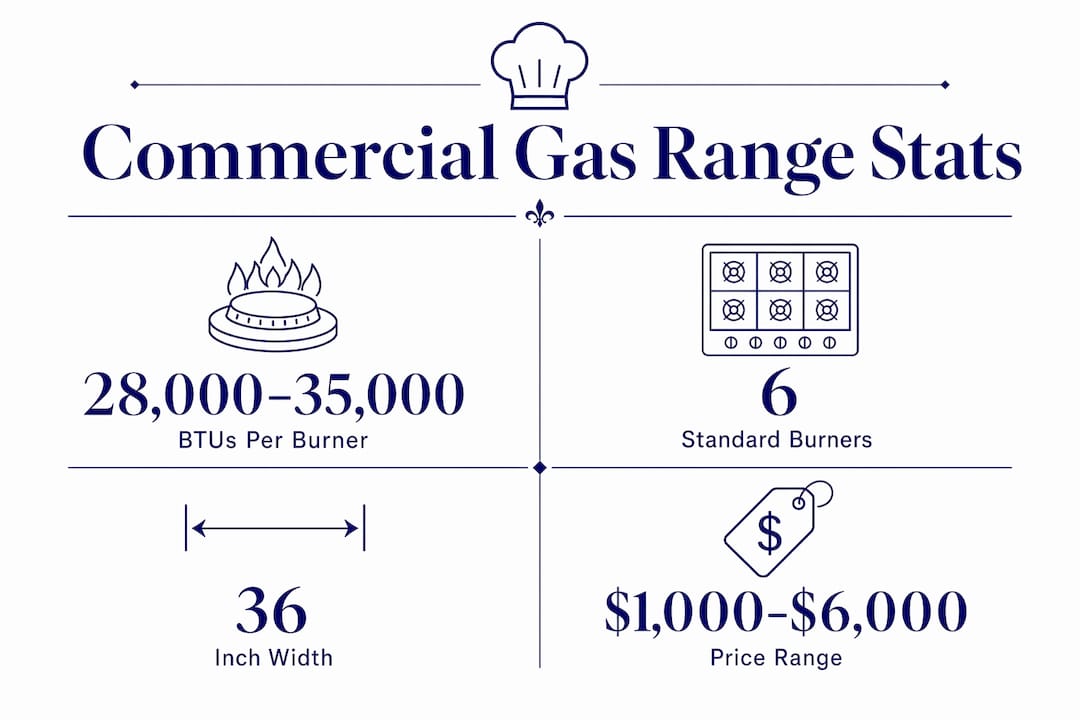
A commercial gas range is defined as a heavy-duty cooking appliance engineered for professional kitchens, delivering burner outputs of 28,000 to 35,000 BTUs per burner and total gas demands up to 180,000 BTUs. Brands like Vulcan and Garland build these units to NSF and CSA certification standards, making them compliant for health and fire inspections in commercial settings. The standard configuration is a 36-inch, 6-burner unit, though sizes range from 24 inches to 72 inches depending on kitchen volume. Unlike residential ranges, which typically cap out at 15,000 BTUs per burner, commercial units are built for continuous high-heat service, all-day use, and field-level repairability. This guide covers every specification, comparison, and selection factor you need to make the right call.
The industry standard for a commercial gas range is a 36-inch, 6-burner unit priced between $1,000 and $6,000 depending on build quality and brand. That price spread reflects real differences in materials, burner construction, and long-term durability. Knowing what separates a $1,500 unit from a $5,000 unit is the first step in making a sound purchase.
Each burner on a commercial range typically produces between 28,000 and 35,000 BTUs. The two primary burner types are open burners and sealed burners. Open burners expose the flame directly beneath the cookware, allowing maximum heat transfer and easier cleaning of the grate area. Sealed burners enclose the flame under a flat surface, making spill cleanup simpler but reducing peak heat output slightly. For wok cooking, searing, and high-volume sauté work, open burners are the professional standard.
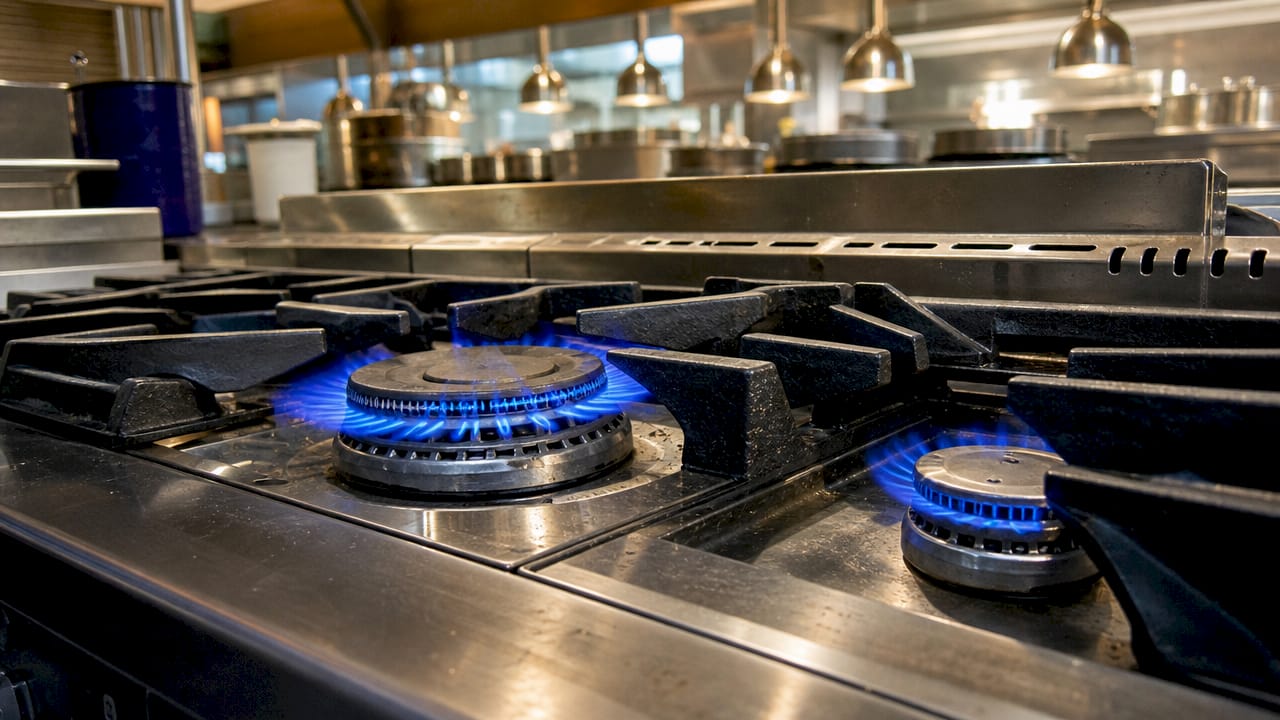
Some units include a dedicated simmer burner, which produces a smaller, steady flame for delicate tasks like reducing sauces or holding stocks. Proper pan selection and flame control on simmer burners are critical. Using an oversized pan on a low-output burner creates uneven heat distribution and increases the risk of scorching.
NSF and CSA certification are non-negotiable for any range used in a licensed commercial kitchen. Health inspectors and fire marshals require these marks as proof that the unit meets sanitation and safety standards. Skipping certification to save money on purchase price is a liability that can result in failed inspections or voided insurance. For more on why these standards matter in practice, the Culinaryprofis resource on sanitation standards is worth reading before you buy.
Commercial ranges use heavy-gauge stainless steel bodies, cast-iron grates, and all-metal knobs. These materials withstand the thermal cycling, grease exposure, and physical impact of a working kitchen. Cheaper units substitute plastic components in control panels and lighter-gauge steel in the body. Those substitutions reduce upfront cost but increase failure rates within the first three years of service.
Pro Tip: Check whether replacement burner heads, igniters, and grates are available directly from the manufacturer. Field-repairable components are the single biggest factor in long-term operating cost.
Gas remains the preferred choice in professional kitchens for its repairability and high-heat performance, even as induction technology gains traction in ventilation-constrained environments. The comparison below covers the three main categories culinary professionals evaluate.
| Feature | Commercial gas | Residential gas | Induction |
|---|---|---|---|
| BTU output per burner | 28,000–35,000 | 10,000–15,000 | Equivalent to ~15,000 BTU |
| Burner responsiveness | Instant, visual | Instant, visual | Instant, no visual flame |
| Wok and high-heat cooking | Excellent | Limited | Poor (flat contact required) |
| Ventilation requirement | High (Type I hood) | Moderate | Low |
| Repairability | Field-serviceable | Moderate | Requires specialist |
| Energy efficiency | Moderate | Moderate | High |
The responsiveness advantage of gas is most visible in high-heat applications. Wok cooking, for example, requires a flame that wraps around the curved base of the pan. Induction requires flat-bottomed ferromagnetic cookware and cannot replicate that heat geometry. For kitchens running heavy sauté and stir-fry programs, gas is the only practical option.
Induction does win on energy efficiency and ventilation costs. A kitchen that cannot install a Type I exhaust hood, or one operating under strict energy regulations, may find induction more practical for certain stations. The decision is not gas versus induction as a whole. It is gas for high-heat stations and induction where ventilation or energy constraints apply. The Culinaryprofis article on induction vs. gas breaks down that tradeoff in detail.
Pro Tip: If your kitchen runs both gas and induction, position the gas range on the hot line for sauté and sear stations, and use induction for sauce reduction and holding. This splits the ventilation load and reduces hood operating costs.
Range sizing must align with workflow and output demand, not just available floor space. A range that is too small for your service volume becomes the bottleneck that slows every ticket. A range that is too large wastes gas and occupies space that could serve another function.
The relationship between covers and burner count is well established in commercial kitchen planning:
These thresholds assume a full-service menu. A high-volume pasta concept with limited proteins may run 100 covers on 6 burners. A steakhouse with heavy sear demand may need 10 burners for 60 covers. Menu type drives burner demand as much as raw cover count.
Commercial gas ranges require at least 7 inches water column of natural gas pressure to operate correctly. Insufficient supply pressure produces a weak, yellow-tipped flame, incomplete combustion, and underperformance across every burner. Before purchasing a range, have a licensed technician verify your gas line capacity and pressure. Adding burners to an existing line without checking supply capacity is one of the most common and costly installation mistakes.
| Kitchen size | Recommended range width | Burner count | Typical BTU demand |
|---|---|---|---|
| Small (under 50 covers) | 24–30 inch | 4 burners | ~120,000 BTU |
| Mid-volume (50–100 covers) | 36 inch | 6 burners | ~180,000 BTU |
| High-volume (100+ covers) | 60–72 inch | 10–12 burners | ~360,000 BTU |
Pro Tip: Size for your projected volume at 18 months, not your current volume. Replacing a range after 18 months because you outgrew it costs more than buying one size up at the start.
Operators choose commercial gas ranges for maintenance ease and burner responsiveness, but those advantages only hold if the unit is operated and maintained correctly. Poor habits accelerate wear and reduce output quality.
Key operational practices that protect performance:
The most common mistake professional cooks make is running every burner at maximum output regardless of the task. High-volume kitchens burn through igniters and burner heads faster when operators treat every station as a sear station. Matching output to task extends component life and reduces service calls. For more on pairing appliances to volume demands, the Culinaryprofis guide on high-volume cooking appliances covers this in practical detail.
Pro Tip: Schedule a full burner inspection every 90 days. Check igniters, air shutters, and grate condition. Catching a worn igniter before it fails costs $20. Replacing it during a Friday dinner service costs far more.
A commercial gas range delivers professional-grade performance only when selected, installed, and maintained to match the specific volume and workflow of your kitchen.
| Point | Details |
|---|---|
| BTU output defines capability | Burners rated 28,000–35,000 BTUs each; total demand can reach 180,000 BTUs on a 6-burner unit. |
| Certification is mandatory | NSF and CSA marks are required for commercial kitchen compliance and insurance validity. |
| Size to service volume | Match burner count to cover volume: 4 burners under 50 covers, 6 for mid-volume, 10–12 for 100+ covers per hour. |
| Gas pressure must be verified | Minimum 7 inches water column required; low pressure causes poor combustion and underperformance. |
| Higher upfront cost saves money | A $5,200 unit can save approximately $6,250 in service costs over 10 years versus a cheaper alternative. |
I have worked with commercial gas ranges across a wide range of kitchen types, from 30-seat neighborhood restaurants to high-volume hotel operations. The pattern I see repeated most often is operators buying on price and paying for it in service costs within two years. A $5,200 unit can save roughly $6,250 in service costs over 10 years compared to a $3,500 model. That math is not abstract. It shows up in technician invoices, lost service hours, and the cost of running a kitchen short one burner during peak service.
The other mistake I see is treating range selection as a space problem rather than a workflow problem. Kitchens that size their range to the floor plan rather than the menu and cover count end up either overloading a small unit or running a large one at 40% capacity. Neither outcome is efficient. The range is the operational core of the hot line. Every other decision about staffing, ticket speed, and menu complexity flows from it.
My honest recommendation: buy the best-certified unit your budget allows, verify your gas supply before installation, and plan for the volume you expect to hit in 18 months. Gas technology has not changed dramatically in 20 years, and that is a feature, not a limitation. The repairability, the flame responsiveness, and the wok-cooking capability are exactly why professional kitchens still run on gas. Induction has its place, but it does not replace a properly specified commercial gas range on a high-heat line.
— John
Culinaryprofis stocks a full range of NSF and CSA-certified commercial cooking equipment for professional kitchens and serious home cooks. From 4-burner starter units to 12-burner high-volume configurations, the catalog covers every service level and kitchen size.

Every unit ships with expert support from staff who understand commercial kitchen specifications, gas pressure requirements, and compliance standards. Free shipping and a flexible return policy back every purchase. Whether you are outfitting a new restaurant line or upgrading a catering operation, Culinaryprofis has the equipment and the expertise to match the right range to your workflow. Browse the full catalog and call the team for specification advice before you order.
A commercial gas range is a professional-grade cooking appliance with burner outputs of 28,000 to 35,000 BTUs per burner, built to NSF and CSA standards for use in licensed commercial kitchens. It differs from residential ranges primarily in heat output, construction durability, and compliance certification.
Each burner on a commercial gas range typically delivers 28,000 to 35,000 BTUs, with a standard 6-burner unit demanding up to 180,000 BTUs total. Higher BTU output enables faster heat recovery and supports high-volume cooking tasks like searing and wok cooking.
Commercial gas ranges require a minimum of 7 inches water column of natural gas pressure to operate correctly. Insufficient pressure produces incomplete combustion, weak flames, and reduced cooking performance across all burners.
Match burner count to your service volume: 4 burners for under 50 covers, 6 burners for 50 to 100 covers, and 10 to 12 burners for operations exceeding 100 covers per hour. Menu type and workflow also influence the final configuration.
Gas outperforms induction for high-heat applications like wok cooking and searing, and offers easier field repairability. Induction is more energy-efficient and requires less ventilation, making it a practical choice for specific stations where ventilation or energy constraints apply.