
Catering Equipment Trailer: What It Is and How It Works

A catering equipment trailer is defined as a towable mobile kitchen unit designed for on-site food preparation and service at multiple locations. Unlike a food truck, which integrates the kitchen into a self-propelled vehicle, a catering trailer is pulled by a separate tow vehicle and offers significantly more workspace. These units range from compact 8-foot setups to large commercial rigs exceeding 24 feet. For event organizers and mobile food businesses, a catering equipment trailer delivers professional-grade cooking capacity without the cost of a permanent kitchen facility.
What features and equipment are typically found in a catering trailer?
A fully outfitted catering trailer functions as a complete commercial kitchen on wheels. The equipment inside mirrors what you would find in a fixed restaurant, scaled for mobility and compliance with health codes.
The core cooking appliances include commercial gas ranges, convection ovens, flat-top grills, and fryers. These units must meet NSF certification standards, which verify sanitation and material safety for food contact surfaces. Food preparation tools such as work tables, cutting boards, food processors, and thermometers are standard across most trailer builds. Equipment selection depends directly on menu complexity and production volume.
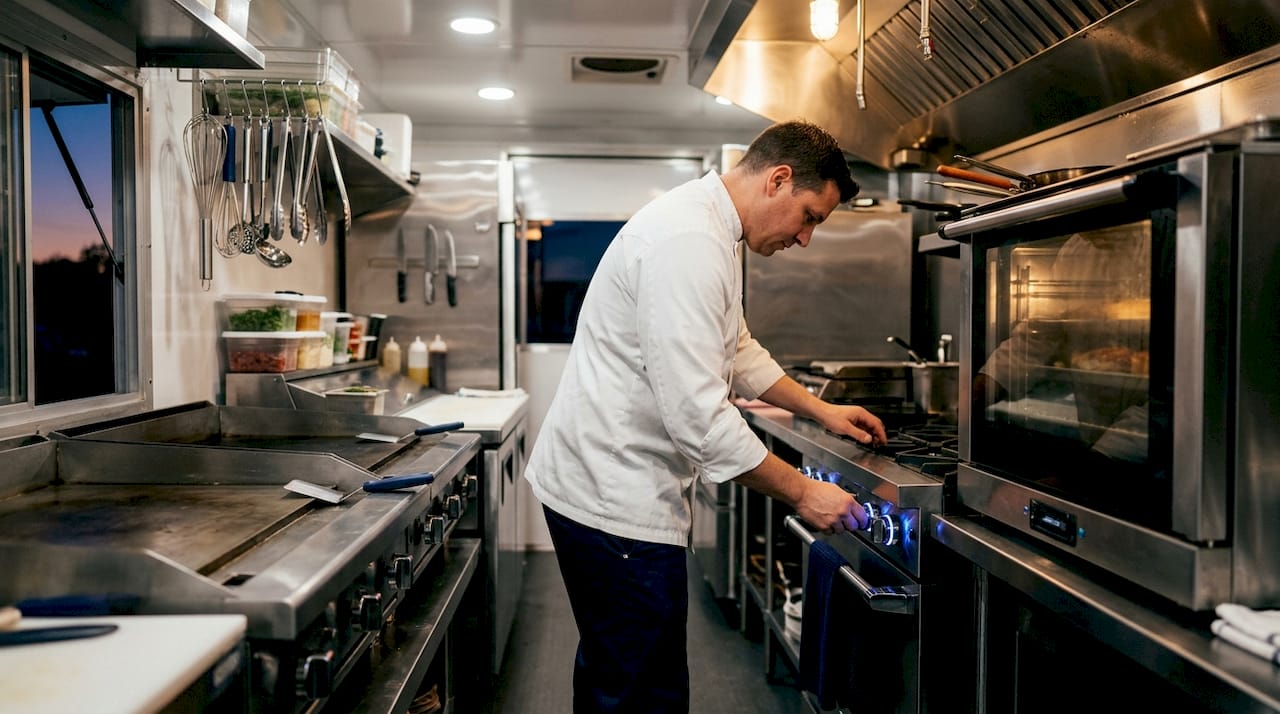
Refrigeration is non-negotiable. Most trailers include reach-in refrigerators, under-counter coolers, and sometimes chest freezers for multi-day events. Potable water tanks and three-compartment sinks handle food safety and sanitation requirements set by local health departments.
Ventilation is where many first-time buyers underestimate costs. Mobile kitchen trailers require Type I exhaust hoods with UL 710 certification and UL 300 fire suppression systems. These are not optional upgrades. They are mandatory for health department approval and fire safety compliance. Propane storage with emergency shutoffs is also standard on gas-powered units.
Electrical systems power lighting, refrigeration, and smaller appliances. Many trailers run on generator power or shore power connections, depending on the event setup. Ergonomic workspace design, non-slip flooring, and full HVAC systems improve staff efficiency during long service periods.
Pro Tip: Before purchasing any trailer, request a full equipment manifest from the seller. Cross-reference every appliance against current NSF and UL certification requirements for your state.
How do catering trailer sizes and layouts impact capacity and usability?
Trailer size is the single biggest factor in determining how many meals you can produce per service. Larger trailers accommodate more staff, more equipment, and more complex menus.
Mobile kitchen trailers range from 32 to 53 feet for high-volume commercial operations, while smaller concession-style trailers start around 8 feet. Food trucks, by comparison, average 10–26 feet and typically offer under 100 square feet of kitchen space. That constraint creates cramped conditions that limit both menu variety and staff comfort during extended events.
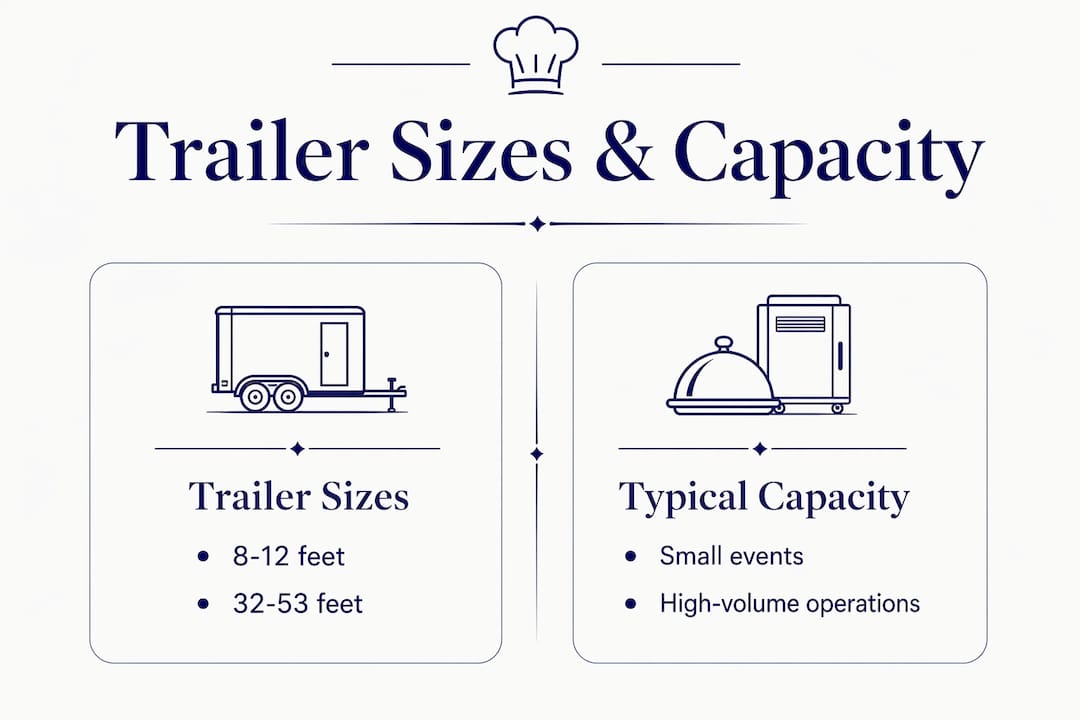
The table below shows how size correlates with capacity and typical use cases.
| Trailer Size | Kitchen Space | Typical Capacity | Best Use Case |
|---|---|---|---|
| 8–12 feet | Under 80 sq ft | 1–2 staff, simple menu | Farmers markets, small pop-ups |
| 14–20 feet | 80–150 sq ft | 2–4 staff, moderate menu | Corporate events, private parties |
| 22–30 feet | 150–250 sq ft | 4–6 staff, full menu | Festivals, weddings, large catering |
| 32–53 feet | 250+ sq ft | 6+ staff, complex production | High-volume events, disaster relief |
Layout configuration matters as much as raw square footage. A galley layout places equipment along both walls with a central aisle, maximizing workflow for two or three cooks. An L-shaped layout works well for trailers with a dedicated prep zone and a separate cooking line. For high-volume cooking operations, a parallel layout with pass-through windows on one side speeds up service dramatically.
Buyers often focus on length and overlook width. A trailer wider than 8.5 feet requires oversize load permits, which adds recurring transportation costs. Plan your layout around your menu first, then select the minimum size that supports it comfortably.
What permits and regulatory requirements apply to catering trailers in 2026?
Permitting for a mobile kitchen is more complex than most new operators expect. The process involves multiple agencies and can take weeks to complete.
The standard permit process covers four main areas:
- Health department permit. Your local health department inspects the trailer for NSF-certified equipment, proper refrigeration, potable water supply, and wastewater disposal. This is the most critical approval. Without it, you cannot legally operate.
- Fire safety certification. Fire marshals verify that your exhaust hood meets UL 710 standards and that your suppression system carries UL 300 certification. Propane systems require separate inspection in most jurisdictions.
- Vehicle registration and transportation permits. The trailer itself must be registered as a vehicle. Trailers wider than 8.5 feet require oversize load permits costing roughly $75 per trip. This cost adds up quickly for operators who move frequently.
- Food Protection Manager certification. Most states require at least one certified food protection manager on staff. Certification costs range from $80 to $180 and must be renewed periodically.
The full permitting timeline runs 2–8 weeks depending on your municipality. Costs range from $100 to over $1,000 before you factor in equipment certifications. Permit fees vary significantly by state and city, so consulting your local health department early saves time and money.
Commissary agreements are a requirement most new operators miss entirely. A commissary is a licensed commercial kitchen where you perform food prep, clean equipment, and dispose of wastewater. Most health jurisdictions require a signed commissary agreement before they issue your mobile food permit. Failing to secure one is the leading reason mobile food entrepreneurs fail the permitting process.
Pro Tip: Contact your county health department before you buy a trailer. Ask for their mobile food unit checklist. Building your trailer to match that checklist from the start eliminates costly retrofits later.
What are the benefits and practical applications of using a catering trailer?
Catering trailers solve a specific problem: how to deliver restaurant-quality food at locations that have no permanent kitchen. The benefits are concrete and measurable.
- More workspace than a food truck. A food truck’s kitchen typically offers under 100 square feet. A catering trailer doubles or triples that space, allowing full HVAC, ergonomic layouts, and room for multiple cooks working simultaneously.
- Lower purchase cost than a food truck. Food trucks cost between $85,000 and $145,000. Trailers of equivalent capacity cost $45,000 to $70,000. That price difference funds a significant amount of equipment upgrades or operating capital.
- Versatility across event types. A single trailer can serve a private wedding on saturday, a corporate lunch on wednesday, and a music festival the following weekend. The trailer moves to the event rather than requiring the event to come to a fixed location.
- Food safety at scale. Commercial refrigeration, NSF-certified surfaces, and proper ventilation maintain food safety standards even during multi-day events. This protects both guests and your operating license.
- Faster setup than a temporary kitchen tent. A well-organized trailer arrives pre-equipped. Setup involves leveling, connecting utilities, and opening for service. A temporary tent kitchen requires building the workspace from scratch each time.
For large-scale events, catering vehicle storage and organization directly affect how fast your team can work. Trailers designed with dedicated storage zones for each equipment category reduce prep time and minimize errors during service.
The rental market reflects this demand. Mobile kitchen trailer rentals run roughly $5,000 to $15,000 per month, which makes ownership the better financial choice for operators who use a trailer more than a few times per year.
What should buyers consider when selecting used catering trailers?
Used trailers offer real savings, but they carry hidden risks that a new buyer can easily miss. A thorough inspection before purchase protects your investment.
- Structural condition. Check the chassis, frame welds, axles, and wheel bearings. Rust on structural components is a disqualifier. Surface rust on non-structural panels is manageable.
- Equipment functionality. Test every appliance under load. A range that ignites in a cold showroom may fail under sustained service conditions. Verify that refrigeration units hold temperature consistently.
- Regulatory compliance. Used trailers may carry outdated equipment that no longer meets current health or fire codes. Replacing a non-compliant exhaust hood or suppression system can cost thousands of dollars.
- Permit transferability. Some permits attach to the trailer’s vehicle identification number. Others attach to the operator. Confirm which permits transfer with the sale and which you must reapply for.
- Hidden modification costs. A trailer sized or configured for a previous owner’s menu may require significant modifications to fit yours. Budget for electrical upgrades, plumbing changes, or equipment swaps before finalizing any purchase.
Pro Tip: Hire a licensed commercial kitchen equipment technician to inspect any used trailer before you sign a purchase agreement. A $200 inspection can prevent a $10,000 mistake.
Sourcing used trailers through foodservice equipment dealers rather than general classified listings gives you better documentation history and some degree of seller accountability. Review the portable catering equipment guide from Culinaryprofis to benchmark equipment quality before you evaluate any used unit.
Key Takeaways
A catering equipment trailer is the most cost-effective way to deliver commercial-grade food service at scale, provided buyers plan for permitting, layout, and equipment compliance before purchase.
| Point | Details |
|---|---|
| Definition and purpose | A catering trailer is a towable mobile kitchen built for professional on-site food production. |
| Size determines capacity | Trailers range from 8 to 53 feet; larger units support more staff and complex menus. |
| Permitting takes time | The approval process runs 2–8 weeks and requires health, fire, and transportation permits. |
| Cost advantage over food trucks | Trailers cost $45,000–$70,000 versus $85,000–$145,000 for food trucks of similar capacity. |
| Used trailer risks | Always inspect structure, equipment compliance, and permit transferability before buying used. |
What I’ve learned from watching operators get catering trailers wrong
Most operators who struggle with catering trailers make the same mistake: they buy the trailer first and figure out the permits later. That sequence costs time, money, and sometimes the entire investment.
The regulatory side of mobile kitchens is genuinely underestimated. Fire suppression certification, commissary agreements, and oversize load permits are not bureaucratic formalities. They are operational requirements that determine whether you can legally serve food at all. I have seen operators park a brand-new trailer for three months while waiting for health department approval because they built it to the wrong specifications.
The second mistake is buying on size alone. A 30-foot trailer sounds impressive, but if your menu only requires two burners and a prep table, you are paying to haul and heat empty space. Match the trailer to the menu, not to an idea of what looks professional.
The operators who get the most out of catering trailers treat them like fixed kitchens from day one. They invest in quality commercial appliances, organize storage for efficiency, and train staff on the specific workflow of that trailer’s layout. That discipline is what separates a profitable mobile catering business from one that constantly fights its own equipment.
— John
Culinaryprofis equipment for your catering trailer setup
Culinaryprofis carries commercial-grade food prep equipment built for the production demands of catering trailers and mobile kitchens.
For high-volume meat preparation, the Pro-Cut KMG-32 7.5 HP Meat Mixer Grinder handles large batch processing without slowing down your service line. Operators who need a reliable single-phase option can look at the Pro-Cut KG-32-MP commercial meat grinder, which delivers consistent output in tight trailer spaces. Culinaryprofis offers free shipping, a flexible return policy, and expert support to help you spec the right equipment for your trailer build. Call the team directly for guidance on matching equipment to your production volume and trailer layout.
FAQ
What is a catering equipment trailer?
A catering equipment trailer is a towable mobile kitchen unit equipped with commercial-grade appliances for on-site food preparation and service. It differs from a food truck in that it is pulled by a separate vehicle rather than being self-propelled.
How much does a catering trailer cost compared to a food truck?
Catering trailers of commercial capacity cost $45,000–$70,000, while food trucks of equivalent size cost $85,000–$145,000. Rental rates for mobile kitchen trailers run $5,000–$15,000 per month.
What permits do I need to operate a catering trailer?
You need a health department permit, fire safety certification, vehicle registration, and in most states a Food Protection Manager certificate. The full process takes 2–8 weeks and costs $100 to over $1,000 depending on your location.
Do I need a commissary agreement for a catering trailer?
Most health jurisdictions require a signed commissary agreement before issuing a mobile food permit. The commissary provides licensed space for food prep, equipment cleaning, and wastewater disposal.
What size catering trailer do I need for large events?
Trailers in the 22–30-foot range support 4–6 staff and a full menu, making them suitable for weddings and festivals. High-volume operations such as disaster relief or stadium catering typically use 32–53-foot units.