
What Is a Convection Oven? Home Cook's 2026 Guide

A convection oven is defined as an oven equipped with a built-in fan and exhaust system that actively circulates hot air around food during cooking. That constant airflow transfers heat to food far faster than the static heat in a conventional oven. Cooking times drop by 15%–25% compared to standard ovens, and browning becomes more even across every rack. For home cooks who bake bread, roast vegetables, or batch-bake cookies, understanding how this technology works is the difference between guessing and getting consistent results every time.
How does a convection oven work compared to a regular oven?
A conventional oven heats food through radiant heat from fixed elements at the top and bottom of the cavity. Air inside stays mostly still, which creates hot spots near the elements and cooler zones in the center. Food cooks unevenly unless you rotate pans halfway through.
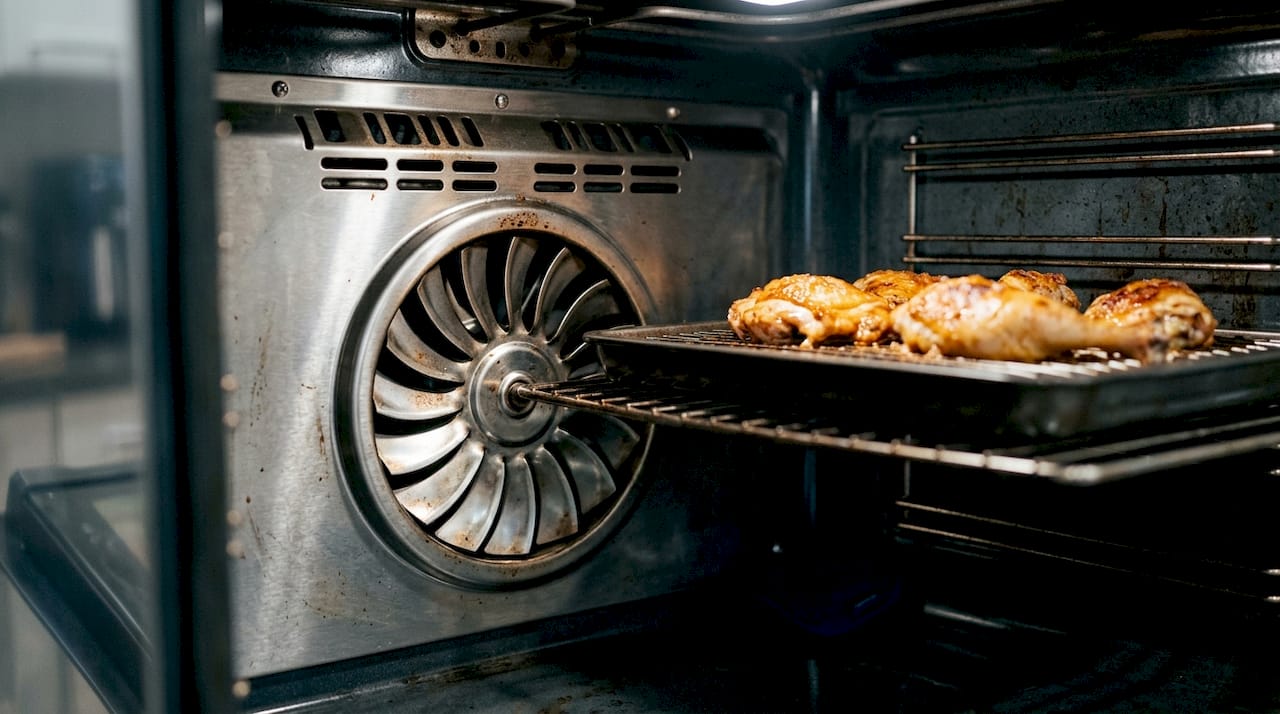
A convection oven adds a fan and an exhaust vent to that same basic setup. The fan pulls air across the heating element and pushes it around the food continuously. That motion strips away the cool air layer that naturally forms around food surfaces, which is why heat transfers faster in a convection environment than in still air.
Fan-assisted vs. true convection
Not all convection ovens work the same way. A fan-assisted oven simply adds a fan to an existing heating setup. A true convection oven, also called European convection, adds a third heating element wrapped directly around the fan. That element heats the air before it circulates, producing temperature uniformity of ±3°C compared to ±10°C in fan-assisted models. That tighter control matters most for bread baking and pastry work, where a 10-degree swing can change the final texture.
Convection modes: bake vs. roast
Many full-size convection ovens offer two distinct modes. Convection Bake uses the bottom element and the fan together, directing steady heat upward for baking. Convection Roast activates both top and bottom elements alongside the fan, creating the aggressive surface heat needed to crisp chicken skin or caramelize a pork shoulder. Choosing the wrong mode produces the wrong result, so matching the mode to the dish matters.
Pro Tip: If your oven manual lists both Convection Bake and Convection Roast, use Bake for cookies and bread, and Roast for whole birds and thick cuts of meat.
What are the benefits of using a convection oven in home cooking?
Convection ovens deliver four concrete advantages that directly affect the quality of your food.
- Faster cooking. Cooking times drop by 15%–25% versus a conventional oven at the same temperature. That time savings adds up significantly during holiday baking or multi-course dinners.
- Even browning. The fan eliminates hot spots by keeping air in constant motion, so cookies on the top rack brown at the same rate as those on the bottom rack.
- Multi-rack efficiency. Batch baking becomes practical. You can fill three racks with sheet pans and expect consistent results across all of them, which is not possible in a conventional oven without constant rotation.
- Better roasting results. Circulating air pulls moisture away from food surfaces faster, producing crispier skin on poultry and better caramelization on roasted vegetables.
The consistency benefit is the one most home cooks underestimate. Eliminating hot spots means you stop compensating for your oven’s quirks and start trusting your recipes. That shift alone improves results across every dish you make.
Which dishes and recipes work best in a convection oven?
Convection cooking excels with specific food categories and struggles with others. Knowing which is which saves you from ruined soufflés and dry cakes.
Best recipes for convection oven cooking:
- Roasted meats and poultry. The circulating air crisps skin and seals in juices faster than radiant heat alone. A whole chicken that takes 90 minutes conventionally may finish in 70 minutes with better color.
- Roasted vegetables. High airflow caramelizes cut surfaces without steaming the interior. Brussels sprouts, potatoes, and root vegetables all benefit.
- Batch-baked cookies. Even heat across multiple racks means you can bake two or three trays at once without rotating.
- Pizza and artisan bread. The dry, moving air creates a crispier crust. For pizza specifically, professional bakers debate static versus convection heat for crust texture, and convection generally wins for home ovens where maximum temperature is limited.
- Pies and tarts. Bottom crusts set faster and stay crisp because the fan drives heat downward through the pan.
Recipes to approach with caution:
Convection is not ideal for soufflés, custards, delicate sponge cakes, or any preparation where surface drying causes structural problems. The moving air can form a crust on a soufflé before the interior sets, causing collapse. Cheesecakes crack when surface moisture evaporates too fast. For these dishes, switch to conventional bake mode or cover the pan loosely with foil.
Pro Tip: When baking an artisan loaf, start with convection for the first 15 minutes to set the crust, then switch to conventional mode to finish the interior without over-drying the crumb.
How to adjust cooking times and temperatures for a convection oven
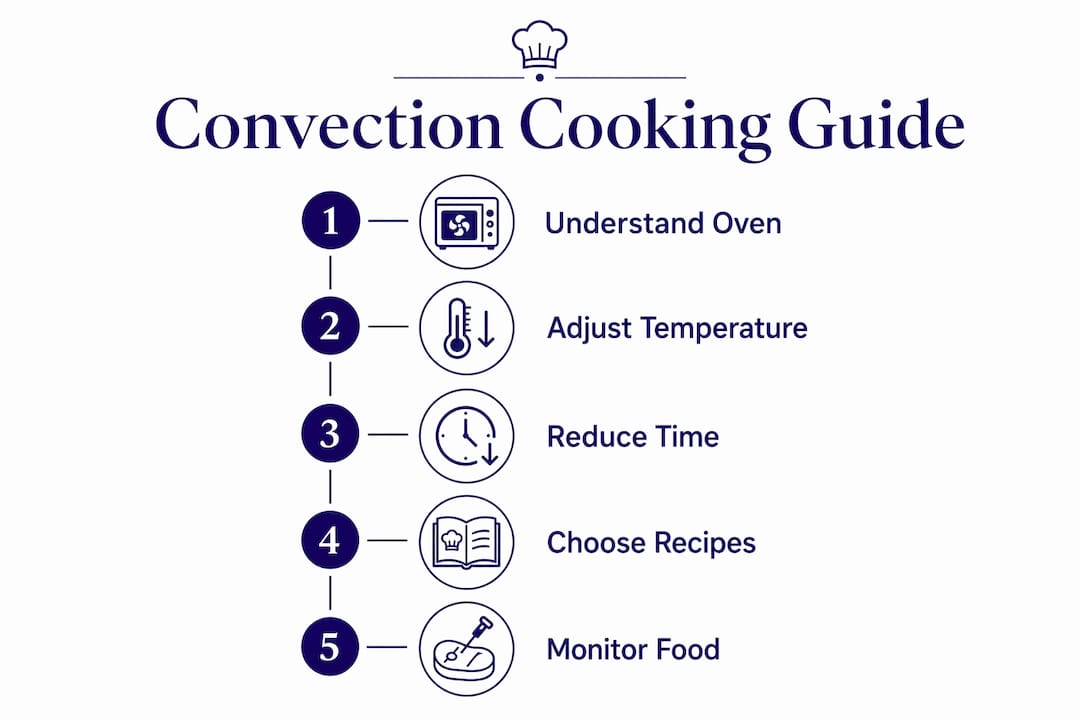
Recipe adjustment is the most practical skill for convection cooking. The standard rule is simple: reduce the oven temperature by 25°F or reduce cooking time by about 25%, and start checking for doneness earlier than the recipe suggests.
The table below shows how common adjustments translate in practice.
| Conventional setting | Convection temperature | Convection time adjustment | Start checking at |
|---|---|---|---|
| 350°F / 60 min | 325°F | Reduce by ~15 min | 40 min |
| 375°F / 45 min | 350°F | Reduce by ~10 min | 30 min |
| 400°F / 30 min | 375°F | Reduce by ~7 min | 20 min |
| 425°F / 20 min | 400°F | Reduce by ~5 min | 13 min |
Key airflow rules to follow:
- Use low-sided or rimless sheet pans. High-sided pans block airflow and reduce the convection effect.
- Leave at least one inch of space between pans and oven walls on all sides.
- Avoid overloading the oven. Blocked air paths eliminate the benefits and can produce worse results than a conventional oven.
- For low-and-slow cooking under 130°F, turn convection off. The fan dries out food at low temperatures without adding meaningful speed.
Some smart ovens automatically adjust time and temperature when you select convection mode. Check your appliance manual before applying manual conversion rules, because automatic adjustments can conflict with manual ones and overcook your food.
What types of convection ovens exist and which features matter?
Home cooks encounter three main categories of convection ovens. Understanding the differences helps you choose the right appliance for your cooking style.
| Oven type | How it works | Best for |
|---|---|---|
| Fan-assisted convection | Fan added to standard radiant heat setup | General home baking, roasting |
| True convection | Third element around the fan heats circulating air | Bread, pastry, precision baking |
| Smart convection | Auto-adjusts time and temperature by mode | Cooks who want minimal manual conversion |
True convection ovens deliver 5%–10% higher energy efficiency and tighter temperature control than fan-assisted models. That efficiency matters if you bake frequently. The third heating element keeps the circulating air at a stable temperature rather than pulling cooler ambient air across the food.
For home cooks focused on artisan bread and sourdough, oven capacity and steam injection matter as much as convection type. A larger cavity allows bigger loaves and proper oven spring. Some precision cooking appliances now combine true convection with steam functions, giving home bakers the control previously available only in professional kitchens.
Controls also matter. A convection oven with clearly labeled Bake and Roast modes is more useful than one with a single generic convection setting. Knowing which convection mode to select is the difference between a properly browned roast and a dried-out one.
Key Takeaways
A convection oven’s built-in fan and exhaust system reduce cooking times by 15%–25%, eliminate hot spots, and produce more consistent browning than a conventional oven at the same temperature.
| Point | Details |
|---|---|
| Core definition | A convection oven uses a fan and exhaust system to circulate hot air for faster, more even cooking. |
| Temperature adjustment | Reduce recipe temperature by 25°F or cooking time by 25% when switching from conventional to convection. |
| True vs. fan-assisted | True convection adds a third heating element for ±3°C uniformity; fan-assisted models vary by ±10°C. |
| Best use cases | Roasting meats, batch baking cookies, pizza, and artisan bread benefit most from convection heat. |
| Airflow management | Avoid high-sided pans and overloading; blocked airflow eliminates convection benefits entirely. |
Why convection changed how I think about home baking
The first time I switched a cookie recipe from conventional to convection, I expected a minor improvement. What I got was a full tray of evenly browned cookies with no pale centers and no burnt edges. That result is not luck. It is physics working in your favor.
The mistake I see most often is treating convection as a “faster conventional oven.” It is not. The airflow changes the surface chemistry of your food. Moisture leaves the surface faster, which means browning starts sooner and crust formation happens at a lower internal temperature. That is why a convection-baked loaf has a crispier crust than the same dough baked conventionally at the same temperature.
My practical advice: start with recipes you already know well. Bake your standard chocolate chip cookies in convection mode at 25°F lower than usual. Compare the result side by side with your conventional batch. The difference will be obvious, and you will understand immediately why professional kitchens use convection as the default. From there, experiment with roasting and bread. The commercial oven types guide at Culinaryprofis is a useful reference when you are ready to understand how professional kitchens configure their convection setups.
One caution: do not abandon conventional mode entirely. Custards, cheesecakes, and soufflés need the gentler, static heat. Knowing when to switch modes is the real skill.
— John
Culinaryprofis has the equipment to match your baking ambitions
Serious home baking starts with the right tools. Culinaryprofis carries commercial-grade convection ovens and premium kitchen appliances built for cooks who want professional results at home.

The Culinaryprofis catalog includes stand mixers, baking accessories, and full-size convection ovens from trusted brands. Every product ships free, and the support team is available to help you match the right appliance to your cooking style. Whether you bake sourdough weekly or roast for a crowd, Culinaryprofis has the equipment to support it. Visit culinaryprofis.com to browse the full selection.
FAQ
What is a convection oven in simple terms?
A convection oven is an oven with a built-in fan that circulates hot air around food. That airflow cooks food faster and more evenly than a standard oven.
How much do I reduce cooking time in a convection oven?
Reduce cooking time by about 25% or lower the temperature by 25°F. Start checking for doneness earlier than the original recipe suggests.
Can I use a convection oven for baking bread?
Yes. Convection heat produces a crispier crust and more even oven spring, making it well suited for artisan bread and sourdough. Switch to conventional mode if you want a softer crust.
What foods should not go in a convection oven?
Soufflés, custards, cheesecakes, and delicate sponge cakes perform better in a conventional oven. The moving air dries surfaces too fast and can cause structural failures in moisture-sensitive preparations.
What is the difference between true convection and fan-assisted convection?
True convection adds a third heating element around the fan, delivering temperature uniformity of ±3°C. Fan-assisted convection uses a fan without that element and varies by ±10°C, which can affect consistency in precision baking.