
Catering Equipment Rental vs. Buying: The Operator's Guide

Catering equipment rental versus buying is defined by three variables: how often you use the gear, what it costs to own it fully, and how much capital you can afford to lock up. Rental converts a capital expense into a predictable operating cost, while buying builds long-term asset value for equipment you use daily. The catering equipment rental market is projected to reach nearly $450 million by 2035, with event applications generating 40% of all rental revenue. That growth signals a structural shift in how food service operators manage their equipment strategy.
Why catering equipment rental versus buying comes down to total cost
The purchase price of commercial kitchen equipment is only the starting point. Hidden ownership costs add 15–25% annually on top of the original investment. That means a $20,000 combi oven carries $3,000–$5,000 per year in maintenance, repairs, and storage before you count depreciation or financing charges.
Those costs compound quickly. A piece of equipment that sits idle between events still demands storage space, insurance coverage, and periodic servicing. Operators who buy specialized gear for occasional use often find the total cost of ownership exceeds what rental fees would have been over the same period.
Buying catering gear also ties up capital that could fund marketing, staffing, or menu development. Rental strategies free that capital by shifting equipment costs to a line item you control month by month. For growing operations, that flexibility matters more than asset ownership.
The core question is not which option is cheaper on paper. The question is which option costs less when you account for every dollar the equipment demands over its useful life.
What are the total costs of buying catering equipment?
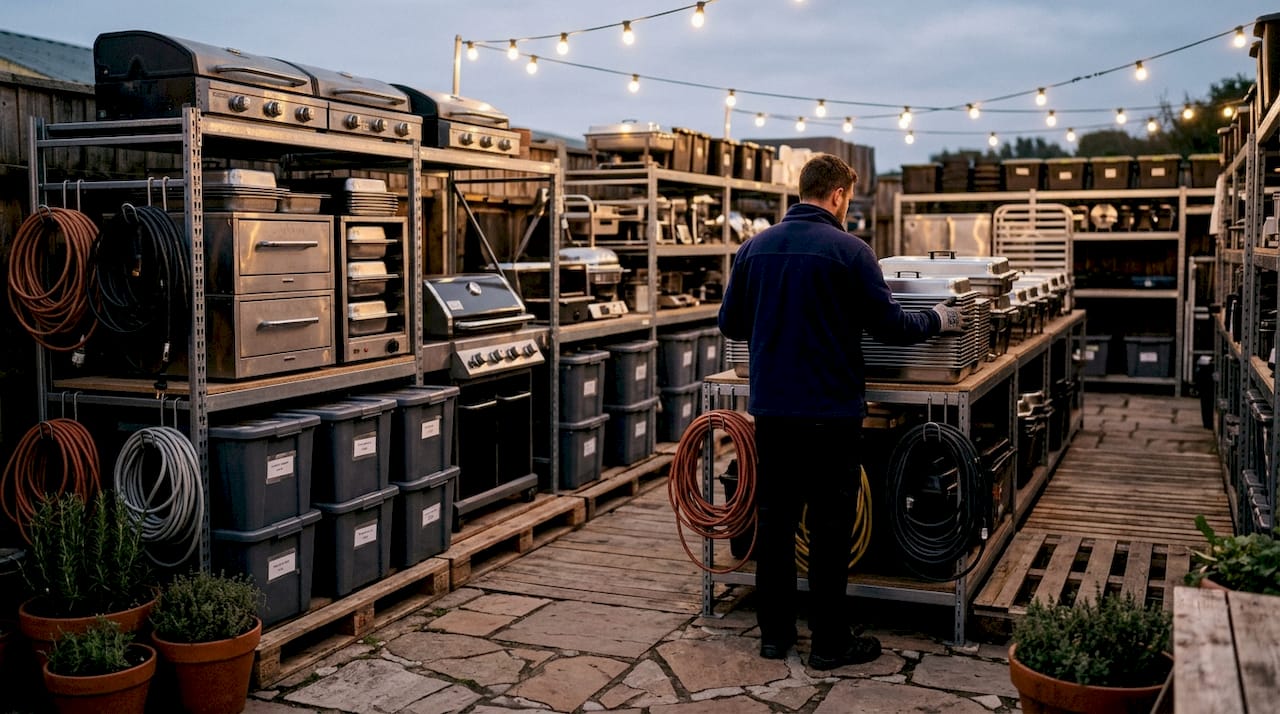
Ownership costs fall into four categories that most operators underestimate at the point of purchase.
- Maintenance and repairs. Commercial equipment requires scheduled servicing. Annual maintenance costs run 15–25% of the purchase price. A $15,000 blast chiller can cost $2,250–$3,750 per year just to keep operational.
- Storage. Specialized gear like large chafing rigs, mobile hot-holding units, or event-scale beverage dispensers needs dedicated space. Equipment costing more than $200 per month to store typically makes renting the better financial choice.
- Depreciation. Commercial kitchen equipment depreciates fast. A unit worth $10,000 today may carry a resale value of $3,000–$4,000 within five years.
- Opportunity cost. Capital tied up in owned equipment cannot fund other business priorities. This is the cost most operators never put on a spreadsheet, but it is real.
Pro Tip: Build a total cost of ownership spreadsheet before any purchase. Include purchase price, annual maintenance, storage, insurance, and estimated resale value. Compare that five-year total against cumulative rental fees for the same period.
Equipment prone to high hidden costs includes large-format cooking ranges, commercial refrigeration units, and event-scale food warming systems. These items demand regular calibration, refrigerant checks, and parts replacement that add up fast. Buying them only makes sense when daily or near-daily use justifies the investment.
How does renting catering equipment improve cash flow and flexibility?
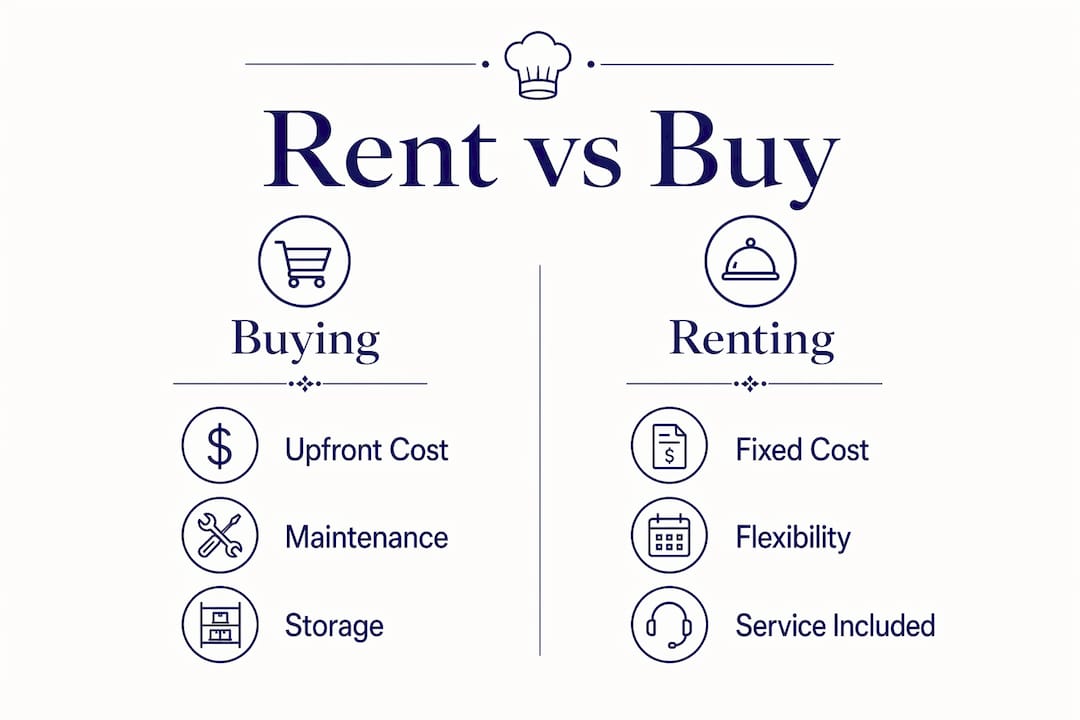
Rental converts a large capital outlay into a fixed monthly expense. That shift matters because it makes budgeting predictable and protects working capital during slow seasons.
All-inclusive rental agreements cover delivery, installation, maintenance, and emergency repairs in one monthly fee. There are no surprise invoices when a compressor fails at 10 PM before a Saturday event. The rental provider handles it. That operational simplicity is a concrete financial benefit, not just a convenience.
Rental also scales with demand. Seasonal caterers who do 80% of their business in short bursts can expand equipment capacity for peak periods without carrying that gear through nine months of low demand. Renting a second commercial range for the holiday season costs a fraction of buying one that sits idle in February.
The advantages of renting catering equipment for event-focused operators are especially clear. You can spec the exact equipment each event requires, return it when the event ends, and never pay for storage or maintenance between bookings. For operators who work across multiple venue types, that flexibility is a genuine competitive advantage.
Pro Tip: Always request all-inclusive contracts that specify emergency repair response times. A rental agreement that excludes after-hours repairs shifts risk back to you at the worst possible moment.
For a broader look at how leasing structures compare to outright rental, the equipment leasing guide at Culinaryprofis covers the financial mechanics in detail.
When should catering professionals rent vs. buy equipment?
The decision framework rests on three metrics: usage frequency, payback period, and storage cost.
The 30-use threshold
The 30-use rule is the most practical starting point. Equipment used more than 30 times per year typically justifies buying. Equipment used fewer than 15 times per year favors renting. The range between 15 and 30 uses requires a payback period calculation.
Payback period calculation
Payback period equals the purchase price divided by annual usage multiplied by the rental cost per use. If a commercial slicer costs $4,000 to buy and rents for $150 per use, and you use it 20 times per year, the payback period is 1.33 years. That math favors buying. If you use it 8 times per year, the payback period stretches to 3.3 years, and rental wins.
Decision criteria by equipment type
| Equipment category | Typical usage pattern | Recommended approach |
|---|---|---|
| Core cooking ranges and ovens | Daily use | Buy |
| Commercial refrigeration | Continuous operation | Buy |
| Large event chafing and warming rigs | Seasonal or event-specific | Rent |
| Specialty beverage dispensers | Occasional events | Rent |
| Mobile hot-holding units | Renovation or overflow | Rent |
| High-volume food processors | Frequent prep cycles | Buy |
Storage cost is the tiebreaker when usage frequency sits in the middle range. If storing a piece of equipment costs more than $200 per month, renting almost always wins on total cost, regardless of how often you use it.
For operators managing vehicle-based catering, equipment storage strategies directly affect whether owning or renting specialized gear makes financial sense.
Pro Tip: Review your equipment use logs quarterly. Usage patterns shift as your business grows. An item that justified renting at 10 events per year may cross the buy threshold at 25.
How do mobile kitchen rentals preserve revenue during shutdowns?
Kitchen renovations and equipment failures are the two scenarios where rental delivers its clearest financial return. Closing a kitchen for renovation without a replacement solution costs operators real money fast.
Operators using mobile kitchens during renovations preserve 95% of food service revenue. A full closure, by contrast, produces losses exceeding $75,000 per month for a mid-volume operation. That gap makes the rental cost trivial by comparison.
Mobile kitchen units deploy within 7–14 days and cost $4,000–$12,000 per month depending on configuration. A two-month renovation that would otherwise generate $150,000 in losses costs $8,000–$24,000 in rental fees instead. The math is straightforward.
The ROI formula for rental during shutdowns is: (Revenue Preserved + Costs Avoided minus Rental Investment) divided by Rental Investment. Operators who run this calculation consistently find returns of 200–400%. That range reflects why temporary rental has become a standard risk management tool in food service, not an emergency fallback.
Rental also supports seasonal capacity expansion without permanent infrastructure. A catering company that adds a second mobile kitchen for a summer festival season avoids buying equipment it will not need in october. The portable catering equipment guide at Culinaryprofis covers the specific unit types suited to temporary deployment.
For operators comparing rental against event-specific purchasing, the practical advantages of event equipment rental include consolidated logistics, single-vendor accountability, and predictable per-event costs. These factors reduce administrative load on operations teams during high-pressure event periods.
Key Takeaways
Renting catering equipment beats buying whenever usage is infrequent, storage costs are high, or capital preservation matters more than asset accumulation.
| Point | Details |
|---|---|
| Hidden ownership costs are real | Maintenance and repairs add 15–25% annually to the purchase price of commercial equipment. |
| The 30-use threshold guides the decision | Buy equipment used more than 30 times per year; rent what you use fewer than 15 times. |
| Storage cost is the tiebreaker | Equipment costing more than $200 per month to store almost always favors renting. |
| Mobile rentals protect revenue | Operators using rental kitchens during renovations preserve 95% of revenue versus $75,000+ monthly losses from closure. |
| All-inclusive contracts reduce risk | Rental agreements covering delivery, maintenance, and emergency repairs eliminate surprise costs. |
The real cost of owning equipment you don’t use every day
I’ve watched operators buy a $12,000 commercial spit roaster after one successful event, convinced they’d use it constantly. Two years later, it’s sitting in a storage unit costing $250 per month, and they’ve used it four times. That’s a $6,000 storage bill on top of the purchase price, plus two service calls. The math never worked.
The mistake isn’t buying equipment. The mistake is buying equipment before you have the usage data to justify it. I’d always recommend running any specialized item as a rental for at least one full season before committing to purchase. You learn exactly how often you need it, what configuration works best, and whether the vendor’s service network is reliable in your market.
Core equipment is different. Gas ranges, refrigeration, and prep tables that run every day should be owned. They’re the foundation of your operation, and rental fees for daily-use items accumulate fast. But specialty gear, event-scale items, and anything with a seasonal usage pattern belongs in the rental column until the numbers say otherwise.
The operators I’ve seen build the most durable catering businesses treat equipment decisions like capital allocation decisions. They ask what the money would do if it weren’t tied up in a piece of gear. That question changes the calculus on a lot of purchases.
— John
Culinaryprofis has the commercial equipment your operation needs
Catering professionals who have identified which equipment to buy rather than rent need a supplier that stocks commercial-grade gear built for daily production demands.
Culinaryprofis carries a full range of commercial kitchen equipment suited to catering operations of every scale. The Dukers commercial stock pot range delivers high-output gas burner performance for large-batch cooking. For meat processing, the Pro-Cut KG-32-MP meat grinder handles commercial volume with single-phase power. Browse the full commercial kitchen catalog at Culinaryprofis for cooking ranges, refrigeration, food prep machinery, and more. Free shipping and expert support are included on every order.
FAQ
What is the main advantage of renting catering equipment?
Rental converts capital expenditure into a predictable operating cost and typically includes maintenance, repairs, and delivery in one monthly fee. This protects working capital and eliminates surprise repair invoices.
How do I know when to buy instead of rent?
Equipment used more than 30 times per year generally justifies buying, while gear used fewer than 15 times per year favors renting. Use the payback period formula: purchase price divided by annual usage multiplied by rental cost per use.
What does mobile kitchen rental cost per month?
Mobile kitchen rentals typically cost $4,000–$12,000 per month depending on size and configuration, and can be deployed within 7–14 days to maintain operations during renovations or equipment failures.
Does renting catering equipment make sense for seasonal operators?
Seasonal caterers who generate most of their revenue in short bursts benefit directly from rental because it lets them scale equipment capacity for peak periods without carrying storage and ownership costs year-round.
What should an all-inclusive rental contract cover?
A strong rental agreement covers delivery, installation, scheduled maintenance, and emergency repairs in one fixed monthly fee. Contracts that exclude after-hours repairs shift operational risk back to the operator at the worst possible time.