
What Is a Turbo Oven? A Home Cook's Guide

A turbo oven is a convection oven equipped with a high-speed fan that circulates hot air rapidly around food, cooking it faster and more evenly than a standard oven. The industry term is “turbo convection oven,” and the “turbo” label signals a more powerful fan system than basic convection models. Turbo convection technology reduces cooking times by 20%–30% compared to traditional ovens. That speed advantage, combined with consistent heat distribution, makes turbo ovens a practical upgrade for home cooks who want better results with less waiting. Culinaryprofis covers the full picture below, from how the technology works to when you should and should not use it.
How does a turbo oven work to cook food faster?
A turbo convection oven uses a powerful fan, paired with a dedicated heating element, to push hot air at high velocity across every surface of your food. That constant air movement strips away the cool, moist boundary layer that forms around food in a still oven. Without that insulating layer, heat transfers directly and quickly into the food.
Standard convection ovens also use a fan, but turbo models go further. Turbo ovens include an additional dedicated heating element positioned directly behind the fan. That element heats the circulating air before it reaches the food, giving you more precise temperature control and faster heat delivery. European-style convection ovens use this same design, which is why you will sometimes see turbo convection called “true convection” or “European convection.”
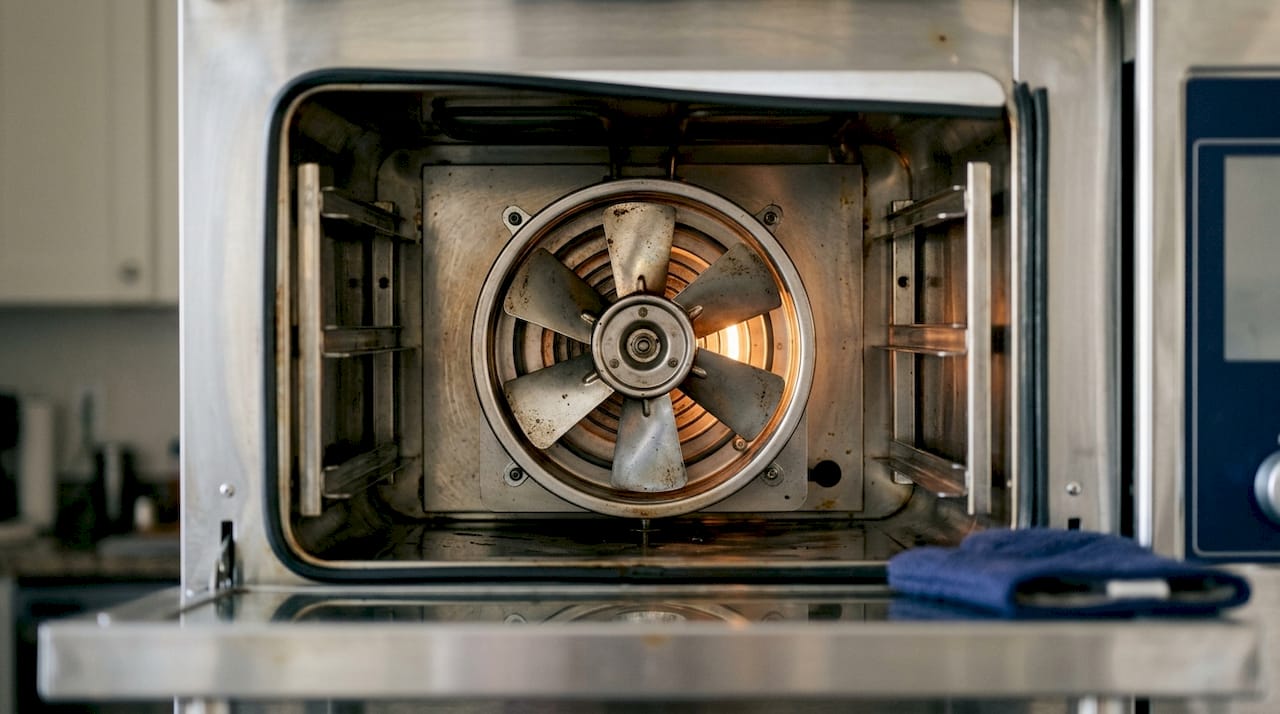
The practical result is significant. Roast chicken cooks 25% faster in a turbo oven, roughly 30 minutes versus 40 minutes in a conventional oven. That time saving adds up across a week of home cooking.
The higher air velocity also creates a drier environment inside the oven chamber. Dry heat promotes browning and crisping through the Maillard reaction, which is why turbo ovens produce roasted vegetables and chicken skin with noticeably better color and texture than still-heat cooking.
Pro Tip: When you first use a turbo oven, run it empty at 375°F for 15 minutes. This burns off any manufacturing residue and gives you a baseline sense of how quickly the oven reaches temperature.
What are the main benefits of using a turbo oven?
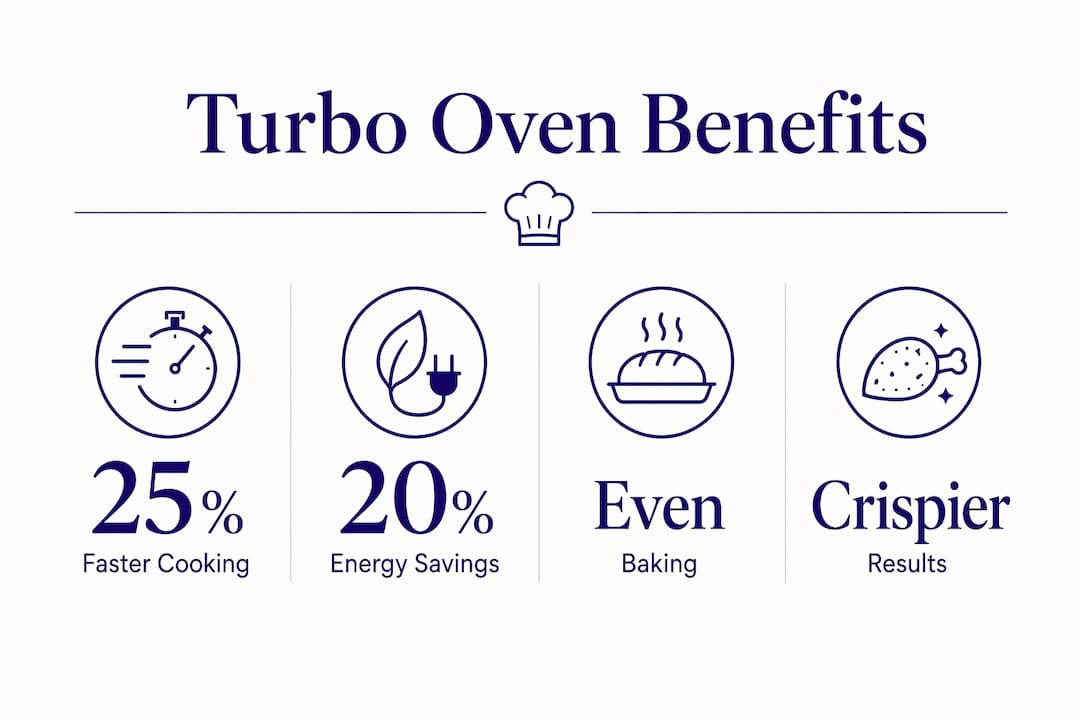
Turbo ovens deliver four concrete advantages for home cooks: speed, evenness, browning quality, and energy savings.
- Faster cooking times. Turbo convection reduces meal prep time by about 25% compared to traditional convection. For a weeknight dinner, that difference is real.
- Even heat distribution. Professional chefs note that turbo ovens eliminate hot and cold spots inside the oven chamber. Cookies bake uniformly across the entire tray, and casseroles cook through without scorched edges.
- Better browning and crisping. The drier, high-velocity air environment accelerates surface browning on roasts, pastries, and vegetables. You get results that look and taste like restaurant cooking.
- Energy efficiency. Turbo convection ovens consume approximately 20% less energy than standard ovens. Shorter cooking times mean the oven runs for less time, which directly cuts your electricity use.
- Versatility. A single turbo oven handles baking, roasting, toasting, dehydrating, and reheating. You do not need separate appliances for each task.
The energy savings point deserves emphasis. A 20% reduction in energy use is not a minor footnote. Over a year of regular cooking, it represents a measurable drop in your utility bill.
Chef Julia Torres points out that the turbo function’s main advantage is preventing uneven baking, which is especially critical for pastries and cookies where a single hot spot ruins an entire batch. That consistency is what separates turbo convection from basic oven technology.
Turbo oven vs conventional oven: what home cooks should know
Conventional ovens rely on radiant heat from elements at the top and bottom of the oven cavity. Air inside the oven is largely still, which creates temperature gradients. The area near the heating element runs hotter, and the center of the oven runs cooler. Food cooks unevenly as a result.
Turbo ovens solve that problem directly. The fan and dedicated heating element work together to maintain a consistent temperature throughout the entire cavity. The comparison below shows the key differences.
| Feature | Turbo convection oven | Conventional oven |
|---|---|---|
| Air circulation | High-velocity fan with dedicated element | Still air, radiant heat only |
| Cooking speed | 20%–30% faster | Baseline speed |
| Heat evenness | Uniform throughout cavity | Hot and cold spots common |
| Surface browning | Strong, consistent crisping | Slower, less even browning |
| Energy use | Approximately 20% less | Higher due to longer cook times |
| Best uses | Roasting, baking, crisping | Delicate batters, slow braises |
The table shows that turbo convection wins on most performance metrics. However, conventional mode still has a place. Delicate items like soufflés, custards, and light cake batters can be disrupted by strong air movement. For those recipes, still heat gives you more control.
Pro Tip: When converting a conventional recipe to turbo convection, lower the temperature by 25°F or reduce the cooking time by 20%–25%. Do not do both at once. Adjust one variable first, then fine-tune from there.
For a broader look at how different oven designs compare in professional and home kitchens, the commercial oven types guide at Culinaryprofis breaks down the full range of options.
Is a turbo oven the same as an air fryer?
No. Both appliances use forced hot air, but they are built for different jobs. Turbo ovens and air fryers differ in size, air velocity, and cooking purpose. Understanding that difference saves you from buying the wrong tool.
Here is how they compare in practice:
- Capacity. Turbo ovens have large cavities that fit whole chickens, sheet pans, and multiple racks. Air fryers use compact chambers designed for small portions.
- Air velocity. Air fryers push air at extreme speeds in a tight space, which creates intense surface crisping very quickly. Turbo ovens circulate air more broadly across a larger volume.
- Best uses for turbo ovens. Whole roasts, batch baking, reheating pizza, roasting vegetables for a family, and multi-rack baking all suit a turbo oven. The confit of lamb recipe at Res Fortes is a good example of a slow, even cook that benefits from turbo convection’s consistent heat.
- Best uses for air fryers. French fries, chicken wings, frozen snacks, and small portions of anything you want crispy fast. Air fryers excel at quick, high-heat crisping in small batches.
- Temperature range. Both appliances reach similar maximum temperatures, but air fryers heat up and cool down faster due to their smaller size.
Turbo ovens are better for whole proteins and batch cooking, while air fryers are the right choice for speed and crispness on small portions. If you cook for a family regularly, a turbo oven gives you more flexibility.
Practical tips for cooking with a turbo oven at home
Getting the best results from a turbo oven requires a few adjustments from standard cooking habits. Follow these steps to avoid common mistakes.
- Lower your temperature or reduce your time. The turbo function creates a drier environment that accelerates cooking. Drop the temperature by 25°F or cut the cooking time by 20%–25% when adapting any conventional recipe.
- Check food earlier than the recipe states. Turbo ovens cook faster than the recipe assumes. Start checking for doneness at the 75% mark of the stated cooking time.
- Use low-sided pans. High pan walls block airflow around food. Sheet pans and shallow roasting pans let hot air reach all surfaces.
- Avoid turbo mode for delicate batters. Light batters can ripple or crust prematurely due to strong air movement. Switch to conventional mode for soufflés, chiffon cakes, and delicate custards.
- Rotate food halfway through if needed. Most turbo ovens distribute heat evenly, but older models may have stronger airflow on one side. A quick rotation at the halfway point guarantees uniform results.
Pro Tip: For extra-crispy roasted vegetables, pat them completely dry before seasoning and place them in a single layer with space between pieces. The turbo fan needs airflow around each piece to crisp the surface properly.
For a deeper look at how rapid cooking technology applies across different oven formats, the rapid cook oven guide at Culinaryprofis covers the full spectrum.
Key Takeaways
A turbo convection oven cooks food 20%–30% faster than a conventional oven by combining a high-speed fan with a dedicated heating element to deliver consistent, even heat throughout the entire cavity.
| Point | Details |
|---|---|
| Core technology | A dedicated heating element behind the fan separates turbo convection from basic convection models. |
| Speed and efficiency | Turbo ovens reduce cooking times by 20%–30% and cut energy use by approximately 20%. |
| Even heat distribution | High-velocity air eliminates hot spots, producing uniform results across the entire oven rack. |
| Recipe adjustments | Lower temperature by 25°F or reduce cooking time by 20%–25% when converting conventional recipes. |
| Turbo vs air fryer | Turbo ovens suit whole roasts and batch cooking; air fryers are best for small, quick, crispy portions. |
Why I think most home cooks underestimate the turbo setting
Most ovens with a turbo or convection setting ship with it turned off by default. Home cooks use the oven for years without ever switching it on. That is a real missed opportunity.
The first time I used turbo convection on a sheet pan of root vegetables, the difference was immediate. The edges crisped in the time it normally takes the center to soften. No flipping, no checking every five minutes. The oven did the work.
Where I see cooks go wrong is applying turbo mode to everything without adjusting the recipe. A batch of muffins baked at the same temperature and time as the recipe states will come out over-browned on top and underdone in the center. The fix is simple: drop the temperature by 25°F and check five minutes early. Once you build that habit, turbo mode becomes your default setting for almost everything.
The one area where I stay cautious is delicate baked goods. Soufflés, angel food cake, and anything with a light, airy batter need still heat. The airflow flattens the rise before the structure sets. For everything else, roasts, vegetables, cookies, casseroles, the turbo setting delivers better results than conventional mode every time.
— John
Culinaryprofis: kitchen equipment and guidance for serious home cooks
Culinaryprofis stocks commercial-grade ovens, baking equipment, and kitchen appliances built for cooks who want professional results at home.

Whether you are selecting your first convection oven or upgrading to a full commercial unit, the Culinaryprofis team provides expert guidance on every category. The site covers high-volume cooking appliances for cooks who want to scale up, along with detailed buying guides across all major appliance categories. Free shipping, a flexible return policy, and direct expert support make Culinaryprofis a practical starting point for any kitchen upgrade. Visit culinaryprofis.com to browse the full catalog.
FAQ
What is a turbo oven in simple terms?
A turbo oven is a convection oven with a high-speed fan and a dedicated heating element that circulates hot air rapidly to cook food faster and more evenly than a standard oven.
How much faster does a turbo oven cook compared to a conventional oven?
Turbo convection reduces cooking times by 20%–30% compared to conventional ovens. Roast chicken, for example, cooks in about 30 minutes instead of 40 minutes.
Do I need to adjust recipes when using turbo convection?
Yes. Lower the oven temperature by 25°F or reduce the cooking time by 20%–25% to prevent overcooking. Check food earlier than the recipe states.
Can I use a turbo oven for baking bread and pastries?
Yes for most baked goods, but avoid turbo mode for delicate batters like soufflés or chiffon cakes. Strong airflow can cause light batters to crust prematurely before the structure sets.
Is a turbo oven worth it for a home kitchen?
Yes. The combination of faster cooking, even heat distribution, and approximately 20% lower energy use makes turbo convection a practical upgrade for any home cook who bakes or roasts regularly.