
What Is a Flat Top Griddle: Uses, Tips, and Buying Guide

A flat top griddle is a solid metal cooking surface, typically cast iron or steel, that delivers even, consistent heat across a broad contact area for diverse cooking methods. Unlike a traditional grill with open grates, a flat top griddle gives you full surface contact with your food. That design makes it the go-to tool for smash burgers, eggs, pancakes, and delicate fish that would fall through standard grill grates. The industry term for this appliance in professional kitchens is a “flat top” or “fry top,” and both terms describe the same solid-surface cooking platform. A flat top preheats in 5–15 minutes and holds temperature steadily across the entire cooking zone.
What is a flat top griddle and how does it work?
A flat top griddle works by transferring heat directly from a burner or heating element into a solid metal plate. That plate then radiates heat evenly upward into your food. Cast iron holds heat longer and recovers slowly after cold food hits the surface. Steel heats faster and responds more quickly to temperature adjustments. Both materials produce the Maillard reaction, the browning process that creates crust and flavor on proteins and vegetables.
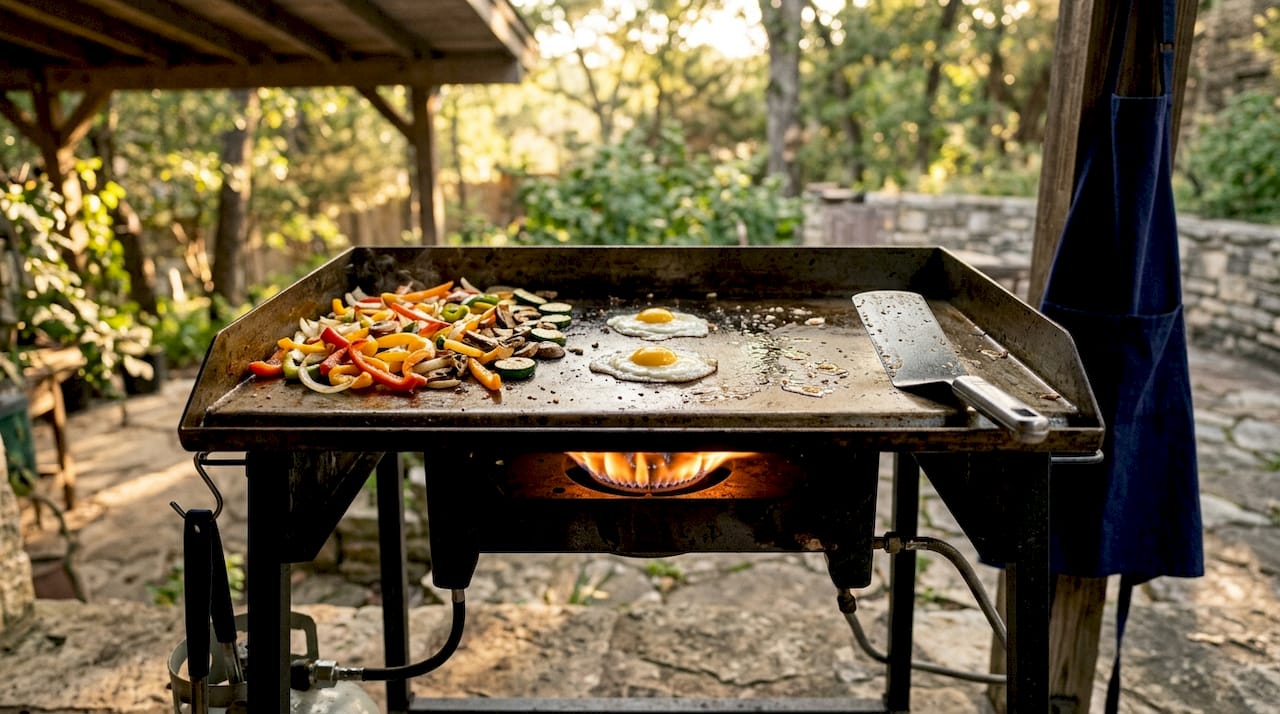
The cooking surface sits flush and level, with no gaps, ridges, or grates. Food stays in full contact with the hot metal the entire time it cooks. That contact is what produces the caramelized crust on a smash burger or the golden edge on a fried egg. Professional kitchens rely on this design for speed and consistency across high-volume service.
How does a flat top griddle differ from a traditional grill?
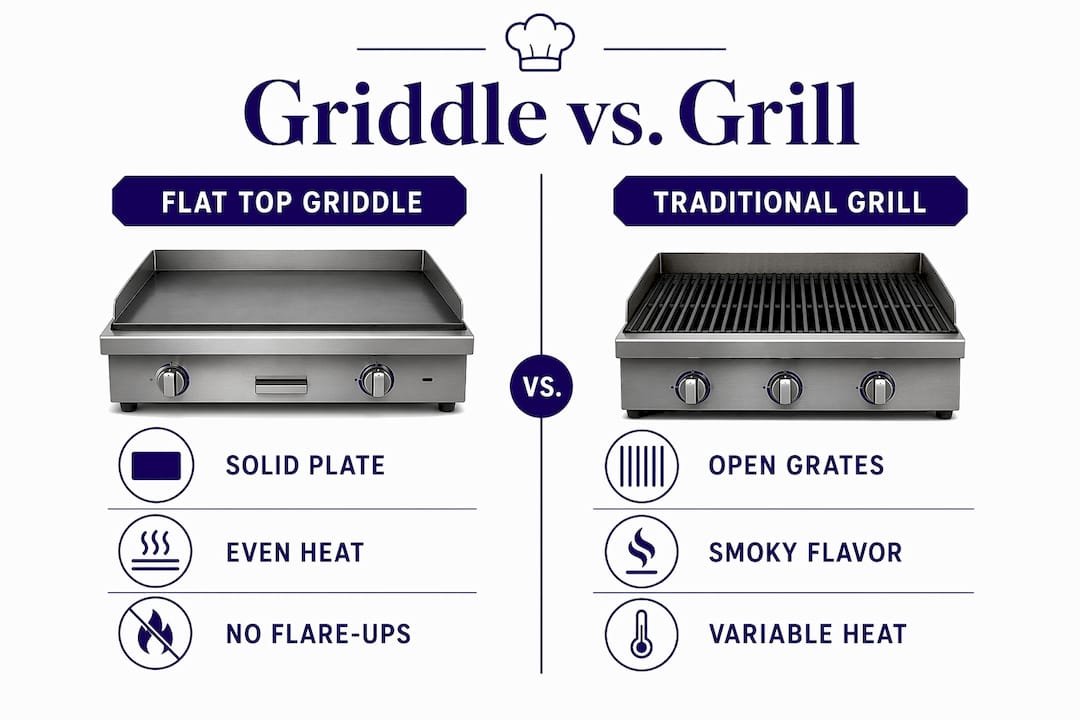
The core difference is surface design. A traditional grill uses open metal grates over a flame or heat source, while a flat top griddle uses a solid, uninterrupted metal plate. That single difference changes everything about how food cooks and tastes.
A grill produces smoky flavor through direct flame contact and fat dripping onto heat sources. A flat top produces caramelization and crust through sustained surface contact. Neither is better overall. They produce different results, and the right choice depends on what you are cooking.
Flat tops avoid flare-ups and cold spots that are common on grill grates. That means more consistent results across the entire cooking surface, especially for foods that need steady, even heat. Grills excel at bone-in chicken, thick steaks, and anything that benefits from smoke and char. Flat tops excel at anything delicate, small, or prone to falling apart.
| Feature | Flat top griddle | Traditional grill |
|---|---|---|
| Surface type | Solid metal plate | Open grates |
| Flavor profile | Caramelization and crust | Smoky and charred |
| Flare-up risk | None | Moderate to high |
| Best foods | Eggs, pancakes, smash burgers, fish | Steaks, ribs, chicken, corn |
| Heat control | Precise, zone-based | Variable, flame-dependent |
Pro Tip: If you want smoky flavor from a flat top, add wood chips to a foil pouch and place it near the burner. You get some smoke without losing the surface benefits.
What are the main uses and cooking techniques on a flat top griddle?
A flat top griddle handles more cooking methods simultaneously than almost any other single appliance. You can sear, fry, sauté, and steam on the same surface at the same time. That versatility comes from the ability to set independent temperature zones across the cooking surface.
The best foods for a flat top griddle include:
- Smash burgers: Press ground beef directly onto the hot surface for maximum crust contact.
- Eggs: Fried, scrambled, or over-easy all cook cleanly without sticking on a seasoned surface.
- Pancakes and French toast: Uniform heat prevents hot spots that burn edges before centers cook through.
- Vegetables: Zucchini, onions, peppers, and mushrooms caramelize quickly with full surface contact.
- Delicate fish: Foods that fall through grill grates cook perfectly on a solid surface without foil or baskets.
- Quesadillas and flatbreads: The solid surface toasts evenly without tearing.
Temperature zoning is the technique that separates good flat top cooks from great ones. Set one burner to high for searing proteins and an adjacent burner to medium for holding cooked food warm. You can run a full breakfast service, cooking bacon on high heat while keeping finished eggs warm on low, without moving anything off the griddle.
Pro Tip: Use an infrared thermometer to check actual surface temperature before cooking. The dial setting and the real surface temperature often differ by 25–50°F, especially on propane models.
For outdoor cooking, griddles suited for campfire meals follow the same zoning principles and work well for mixed meals where timing is critical.
What should you know about flat top griddle maintenance and cleaning?
Proper maintenance is the single biggest factor in how long a flat top griddle lasts and how well it performs. A neglected surface builds up carbon, loses its seasoning, and starts sticking. A well-maintained surface cooks better every year.
Follow this routine after every cook:
- Scrape while warm. Use a metal bench scraper to push food debris toward the grease trap immediately after cooking. The surface should still be warm but not dangerously hot.
- Add water and steam. Pour a small amount of water onto the warm surface and scrub with a grill brick or pad. The steam loosens residue without harsh chemicals.
- Wipe dry. Use a clean cloth or paper towels to remove all moisture. Water left on steel causes rust.
- Apply a thin oil coat. Rub a light layer of high-smoke-point oil (flaxseed, canola, or avocado) across the entire surface. This re-seasons the metal and protects it until the next use.
Daily maintenance takes about 10 minutes and prevents the carbon buildup that requires a full deep clean. Deep cleaning requires letting the surface cool for 30–45 minutes before applying degreaser. Rushing that process damages the seasoning and can warp the metal.
Never apply ice or cold water to a hot flat top. Thermal shock causes irreversible warping or cracking in the metal plate. Always let the surface cool gradually or clean while warm, not hot.
Professional kitchens have moved away from pumice-based griddle bricks toward systems like 3M Scotch-Brite Quick Clean, which reduce cleaning time by 30% and lower the risk of surface scratching. Home cooks benefit from the same approach.
What should you consider when buying the best flat top griddle?
The right flat top griddle depends on cooking volume, available fuel, and how much surface area you actually need. Buying too small means crowding food and losing heat. Buying too large means wasting fuel and storage space.
| Consideration | Entry-level home models | Mid-range home models | Professional models |
|---|---|---|---|
| Surface size | 17–22 inches | 28–36 inches | 36–60 inches |
| Fuel type | Propane or electric | Propane or natural gas | Natural gas or electric |
| Price range | Under $200 | Around $399 | $800 and up |
| Best for | Apartment patios, small households | Family cooking, outdoor kitchens | Restaurants, catering, high volume |
| Temperature zones | 1 zone | 2 zones | 2–4 zones |
A 28-inch home model around $399 gives most home cooks enough surface area to cook a full meal simultaneously. That size fits a standard patio and handles everything from a weekend breakfast to a backyard cookout.
Electric models offer the most precise temperature control and work indoors without ventilation concerns. Propane models heat faster and work anywhere with a tank. Natural gas models suit permanent outdoor kitchen installations where a gas line is already present.
For serious home cooks or foodservice operators, commercial-grade flat tops offer heavier steel plates, more burner zones, and longer service life than consumer models. The upfront cost is higher, but the performance gap is significant for high-volume use.
The Le Griddle lineup, available at Culinaryprofis, covers both ends of the spectrum. The Le Griddle 16-inch Wee Electric Griddle suits compact kitchens and single-person households. The Le Griddle 30-inch Ranch Hand Built-In Electric Griddle fits built-in outdoor kitchen setups and handles full family meals with room to spare.
Key Takeaways
A flat top griddle is the most versatile solid-surface cooking appliance available, excelling at caramelization, temperature zoning, and cooking delicate foods that grills cannot handle.
| Point | Details |
|---|---|
| Surface design | A solid metal plate delivers even heat and full food contact, unlike open grill grates. |
| Best food applications | Eggs, smash burgers, pancakes, and delicate fish all cook better on a flat top than a grill. |
| Temperature zoning | Independent heat zones let you sear and hold food simultaneously on one surface. |
| Daily maintenance | A 10-minute post-cook routine prevents carbon buildup and protects the seasoned surface. |
| Buying decision | Match surface size and fuel type to your cooking volume; a 28-inch propane model suits most home cooks. |
Why most cooks misunderstand what a flat top actually does
The most common mistake I see is cooks buying a flat top expecting it to replace their grill. It does not. A flat top and a grill are different tools that produce different results. A grill infuses smoke and char. A flat top builds crust and caramelization. Both are worth owning, but they are not interchangeable.
What surprises most people is how much the temperature zoning changes the way you cook. Once you start running a hot zone and a warm zone at the same time, you stop rushing. You cook proteins on high, slide them to low to rest, and use the freed-up hot zone for vegetables. The whole meal comes together at once, without the juggling act that comes with a single-zone cooktop.
Maintenance is where most home cooks fall short. Skipping the post-cook oil coat even twice in a row starts degrading the seasoning. A degraded surface sticks, and a sticky surface gets scrubbed harder, which removes more seasoning. The 10-minute routine after every cook is not optional if you want the surface to perform well long-term.
The flat top also excels at high-volume cooking scenarios that would overwhelm a standard stovetop. Cooking breakfast for eight people at once is genuinely easy on a 28-inch surface. On a 12-inch skillet, it is a 45-minute ordeal.
— John
Quality flat top griddles at Culinaryprofis
Culinaryprofis carries a curated selection of professional-grade flat top griddles for both home cooks and foodservice operators.

The catalog includes electric and gas models across multiple surface sizes, from compact countertop units to full built-in outdoor kitchen griddles. Every product meets commercial durability standards, with heavy-gauge steel plates and precise burner controls. Culinaryprofis offers free shipping, a flexible return policy, and direct expert support for product selection. Browse the full griddle lineup at culinaryprofis.com to find the right surface size, fuel type, and price point for your kitchen setup.
FAQ
What is a flat top griddle used for?
A flat top griddle cooks eggs, pancakes, smash burgers, vegetables, fish, and flatbreads on a solid metal surface. Its even heat and full food contact make it ideal for foods that need caramelization or would fall through grill grates.
What is the difference between a flat top grill and a griddle?
The terms are used interchangeably in most consumer contexts. Both refer to a solid, flat metal cooking surface. “Flat top grill” typically describes outdoor propane or gas models, while “griddle” often refers to countertop or stovetop versions.
How do you season a flat top griddle?
Apply a thin layer of high-smoke-point oil across the entire surface and heat it until the oil smokes and bonds to the metal. Repeat this process 3–5 times on a new griddle to build a durable non-stick layer.
How long does a flat top griddle take to preheat?
A flat top griddle preheats in 5–15 minutes depending on the size of the surface and the fuel type. Electric models tend to heat more evenly; propane models heat faster but may show slight variation across zones.
Can you use a flat top griddle indoors?
Electric flat top griddles work indoors with standard ventilation. Gas and propane models produce combustion byproducts and require outdoor use or commercial-grade ventilation systems rated for open-flame cooking appliances.